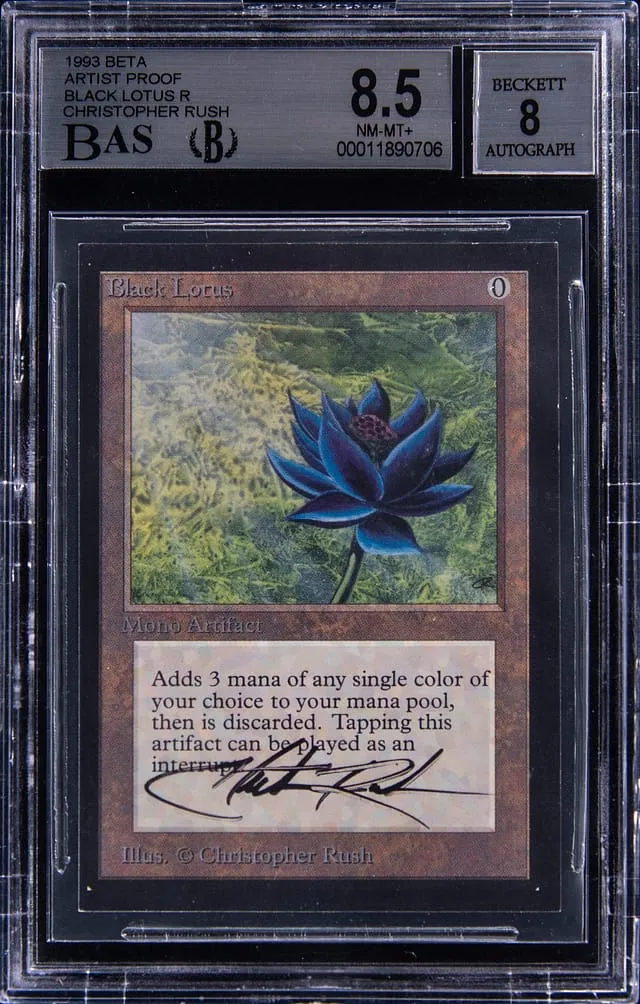
1993 Beta Artist Proof Black Lotus Sale at Goldin
Goldin sold a BGS 8.5 1993 Beta Artist Proof Black Lotus, signed by Christopher Rush, for $111,837. See the market context and collector significance.
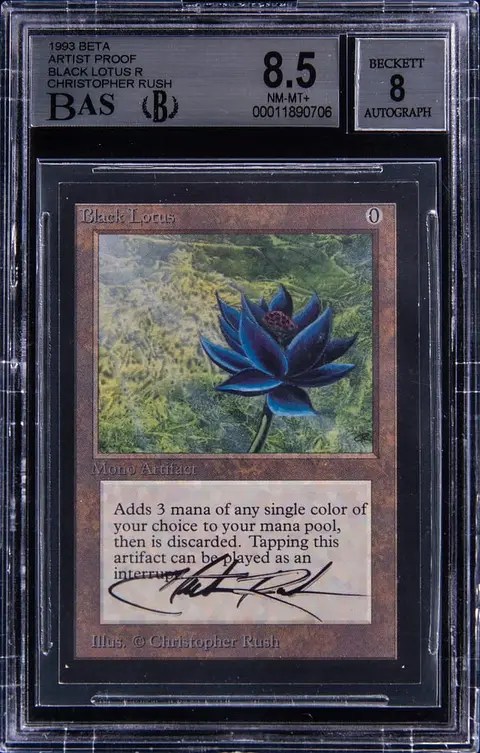
Sold Card
1993 Magic The Gathering Beta Artist Proof Black Lotus, Signed By Christopher Rush - BGS NM-MT+ 8.5 - Pop 2
Sale Price
Platform
Goldin1993 Magic: The Gathering Beta Artist Proof Black Lotus cards sit at the intersection of game history and high‑end art collecting, and this latest result underlines just how carefully the market tracks true rarity.
On May 18, 2026, Goldin sold a 1993 Magic: The Gathering Beta Artist Proof Black Lotus, signed by original illustrator Christopher Rush and graded BGS NM‑MT+ 8.5, for $111,837. For a niche subset of an already iconic card, that is a noteworthy data point.
The card at a glance
- Card: Black Lotus
- Game: Magic: The Gathering
- Year / Set: 1993 Beta, Artist Proof edition
- Variant: Artist Proof (non‑tournament, white‑backed test/artist copy)
- Autograph: Signed by Christopher Rush (on‑card signature)
- Grader: Beckett Grading Services (BGS)
- Grade: 8.5 NM‑MT+
- Population: Pop 2 in this configuration (per BGS: two copies at 8.5, with none or very few higher in the same combo)
- Auction house: Goldin
- Sale date (UTC): May 18, 2026
- Sale price: $111,837
This is not a regular Beta Black Lotus pulled from a booster pack. Artist proofs are a special production made for the illustrator. They typically have a blank or white back, were never meant for tournament play, and were produced in very low numbers compared with the normal run.
Why Beta Black Lotus artist proofs matter
Among Magic: The Gathering collectors, Black Lotus is the hobby’s equivalent of a vintage key rookie card:
- It is part of the original “Power Nine” – a group of nine cards that defined early Magic gameplay.
- The Beta printing (1993) follows the ultra‑scarce Alpha but is still early, limited, and heavily played in the 1990s.
- Artist Proof copies sit on top of that scarcity. They were given directly to Christopher Rush and are closer to art collectibles than to game pieces.
For many collectors, an Artist Proof signed by Rush connects three pillars:
- Early Magic history – a 1993 Beta printing of the most famous card in the game.
- Original artwork – a direct link to Christopher Rush, whose Black Lotus illustration is foundational to the game’s visual identity.
- Documented condition – third‑party grading from BGS, with a defined population and subgrades.
The result is a card that lives in the overlap of TCG, original art, and memorabilia collecting.
Grading, population, and why BGS 8.5 matters
Beckett’s 8.5 NM‑MT+ grade is often a sweet spot for high‑end, early‑era Magic: many cards from 1993 suffer from edge wear, centering issues, and handling. An 8.5 in a sensitive card like an Artist Proof Black Lotus suggests:
- Above‑average corners and edges relative to the age.
- Eye appeal that collectors will generally accept at the elite level.
- A price point below the very best surviving copies, but still clearly in the premium bracket.
The noted pop 2 (population of two) means that, in BGS’s census, there are only two copies in this exact grade with the same configuration. Population, or “pop report,” is the grading company’s count of how many identical cards exist at each grade level. While there may be other artist proofs graded differently—or ungraded copies in private collections—the documented supply in slabs is thin.
In cardboard markets, that kind of known scarcity often drives competitive bidding when more than one serious buyer is ready.
Market context and recent sales
When looking at a sale like this, collectors typically compare it to comps, short for comparable sales: prior auction or marketplace outcomes for the same or very similar cards.
For Black Lotus in general, the last few years have seen:
- High‑grade Alpha and Beta pack‑pulled Lotuses pushing into six‑figure territory in top condition.
- Signed and graded Christopher Rush cards commanding clear premiums over unsigned copies.
- Artist Proof pieces, especially for Black Lotus, selling for strong but sometimes uneven numbers due to their rarity and very thin transaction history.
Exact public comps for a 1993 Beta Artist Proof Black Lotus, BGS 8.5, signed by Rush, are limited. Instead, the market tends to triangulate this kind of card against:
- Alpha/Beta pack‑issued Black Lotus sales in similar or higher grades.
- Other Rush‑signed Lotus artist proofs, often in different grading holders or raw (ungraded).
- Original art and high‑end MTG ephemera linked to Rush and the early Wizards of the Coast era.
Within that context, a $111,837 result at Goldin fits firmly in the high‑end segment but does not appear out of line with how the market has treated top‑tier Lotus items in recent years. For this specific configuration—Beta Artist Proof, signed, BGS 8.5—the sale helps define the current range rather than break an obvious, well‑documented record.
How this sale fits the broader Magic market
Magic: The Gathering has matured into a multi‑decade collectible ecosystem:
- Vintage / early era (1993–1999): Cards from Alpha, Beta, and Unlimited—especially the Power Nine—are viewed similarly to vintage sports cards. Lower print runs and heavy play in the 1990s mean fewer high‑grade survivors.
- Graded population growth: Over time, more copies are submitted to PSA, BGS, and CGC, which clarifies supply and can stabilize price tiers.
- Original artist focus: As the community has aged, there’s been more emphasis on the creators behind the cards—illustrators, designers, and early Wizards staff.
Christopher Rush’s passing in 2016 further concentrated attention on items that directly bear his name or signature. Signed Artist Proofs feel especially finite: he could only sign and personalize so many, and the underlying supply of proofs was small from the start.
This Goldin result fits several trends collectors have been tracking:
- Premium for provenance: Items that connect clearly to original creators (artist proofs, signed pieces, sketches) are increasingly treated like art collectibles rather than just game pieces.
- Separation of tiers within Black Lotus: Not all Lotuses are equal; factors such as set (Alpha vs Beta vs Unlimited), printing quirks, grading, and signature/proof status create distinct lanes and pricing bands.
- Steady demand for blue‑chip Magic assets: While modern chase cards and sealed product can be volatile, marquee early‑era pieces like Lotus, Moxen, and key dual lands tend to anchor the high‑end TCG market.
What this means for collectors and small sellers
For collectors looking at this sale, a few practical takeaways:
- Thin data: expect variability. Highly specific items—like a signed Beta Artist Proof Lotus in BGS 8.5—trade infrequently. Each auction can set or reset expectations because there aren’t dozens of recent comps.
- Condition and configuration matter. A raw (ungraded) artist proof, a different grade, or a non‑Rush signature can sit in a very different price range, even if the card looks similar at a glance.
- Provenance is part of the value. Documentation about when, where, and how the card was signed—or how long it stayed in a particular collection—can influence outcomes in tight bidding.
For small sellers, this sale is not a blueprint for ordinary Magic cards, but it does highlight some principles:
- Early, high‑impact MTG cards in clean condition are often worth professional grading, especially if signed by key artists.
- Unique or low‑population items may perform best at established auction houses like Goldin, which can assemble the right bidder pool.
- When you examine your own holdings, look beyond set and card name: artist proofs, early promos, and signed pieces can sit in their own category.
Final thoughts
The May 18, 2026 Goldin sale of a 1993 Magic: The Gathering Beta Artist Proof Black Lotus, signed by Christopher Rush and graded BGS 8.5 for $111,837, reinforces how the market treats this card as more than just a powerful game piece. It is an artifact of early Magic, a signed work of fantasy art, and a scarce graded collectible with a documented population.
For those tracking the high‑end TCG space, this result provides a new reference point for Rush‑signed Lotus artist proofs and adds another chapter to the ongoing story of the game’s most famous card.
As always, these outcomes are snapshots in time, not predictions. But for collectors who value history, art, and scarcity, this particular Black Lotus checks every box—and the market response at Goldin reflects that alignment on May 18, 2026.