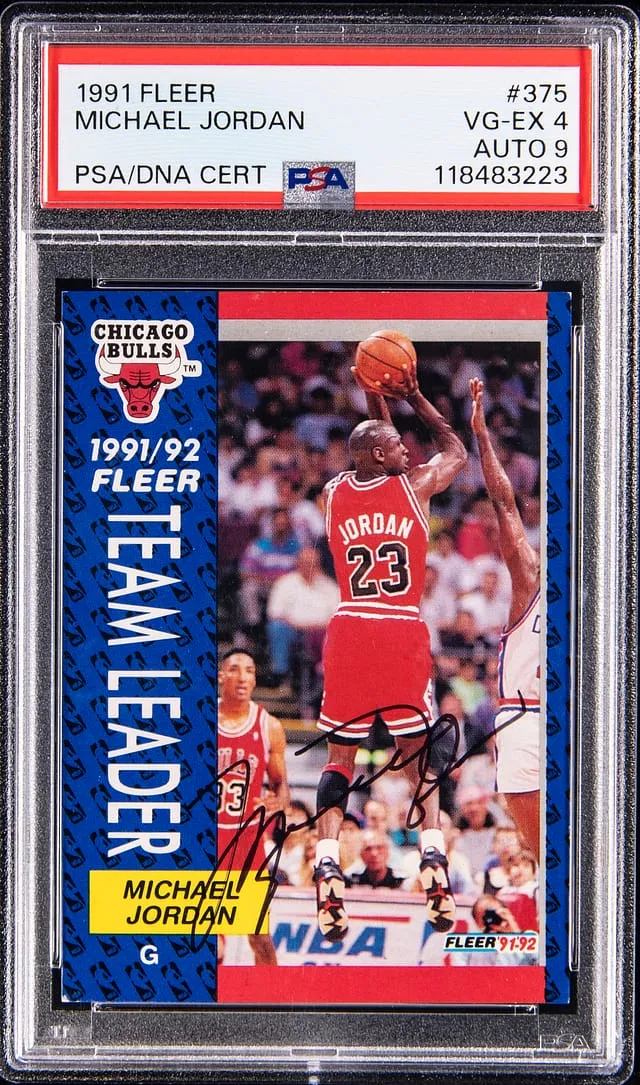
1991-92 Fleer Jordan Auto PSA 4 / DNA 9 Sells for $15K
Breakdown of Goldin’s $15,067 sale of a 1991-92 Fleer #375 Michael Jordan signed card, graded PSA 4 with a PSA/DNA MINT 9 autograph.
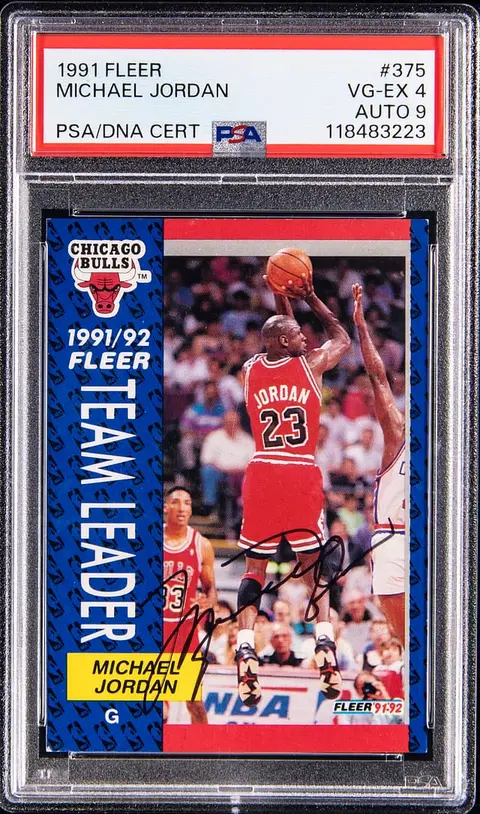
Sold Card
1991-92 Fleer #375 Michael Jordan Signed Card - PSA VG-EX 4, PSA/DNA MINT 9 - Pop 1
Sale Price
Platform
Goldin1991-92 Fleer #375 Michael Jordan Signed Card Sells for $15,067 at Goldin
When most collectors think of Michael Jordan, they jump straight to 1980s Fleer and Upper Deck. But a recent sale at Goldin on 2026-05-10 shows that early-90s signed Jordan cards, especially with strong third‑party authentication, are quietly building their own lane.
In this post, we’ll walk through what sold, why it matters, and how this result fits into the broader Jordan autograph market.
The card that sold: key details
- Player: Michael Jordan
- Team: Chicago Bulls
- Year / Set: 1991-92 Fleer Basketball
- Card number: #375
- Type: Base card with an aftermarket, on‑card autograph (not a pack‑issued auto)
- Grading: PSA VG-EX 4 (card condition)
- Autograph grade: PSA/DNA MINT 9 (signature grade)
- Population: Pop 1 at this exact card + auto grade combo, according to the sale listing
- Sale venue: Goldin
- Sale date: 2026-05-10
- Realized price: $15,067 (hammer + buyer’s premium)
This is a 1991-92 Fleer base Michael Jordan that was later signed by Jordan and then authenticated and graded by PSA/DNA. PSA assigned separate grades: one for the card itself (VG-EX 4, which is a mid‑grade) and one for the autograph (MINT 9, which is a high grade and a strong selling point).
The listing notes this specific configuration as a population 1 (“pop 1”), meaning PSA’s population report shows only one example with this exact combination of grades. Population reports track how many copies of a card have been graded at each grade level.
Why collectors care about 1991-92 Fleer Jordan
The 1991-92 season marks the early part of the Bulls’ first three‑peat. By then, Jordan was already a global superstar, and the hobby was fully in what’s now called the “junk wax” era—a time when card companies printed very large quantities of product.
A few reasons this card still carries weight, even though it’s from a widely produced set:
Era and imagery
1991-92 Fleer captures peak, fully established championship Jordan. Many collectors who grew up in the early ‘90s remember ripping this set, so it has strong nostalgia value.Autographed overlay on a mass‑produced card
While the base card itself is common, a clean, authenticated Jordan signature on top of that card is not. Jordan’s autograph is in demand across jerseys, basketballs, photos, and cards. A PSA/DNA MINT 9 grade signals a bold, well‑preserved signature with strong eye appeal.Certified by PSA/DNA
PSA/DNA is one of the hobby’s most trusted third‑party authenticators. For high‑end Jordan items, many buyers strongly prefer PSA/DNA or Upper Deck Authenticated (UDA) documentation.Cross‑collectibility
This type of piece appeals both to basketball card collectors and to general Jordan memorabilia collectors who like signed items tied to a specific season.
It’s not a rookie, not a short print, and not a pack‑pulled auto. Its appeal comes from the combination of: iconic player, early‑90s nostalgia, and a high‑grade signature on a licensed, pack-released card.
Understanding the grades: PSA 4 card, PSA/DNA 9 auto
It helps to separate the card grade from the autograph grade:
PSA VG-EX 4 (Very Good–Excellent)
On a 1–10 scale, 4 is a mid‑grade. Expect noticeable edge/corner wear, light creases, or surface issues. For a mass‑produced 1991-92 Fleer base, this is not a premium card grade.PSA/DNA MINT 9 (autograph)
This is where the value really lives. A MINT 9 auto usually means:- Strong, clear ink
- Good placement on the card
- No major streaking, bubbling, or smudging
For signed cards—especially in the junk wax era—many collectors care more about how the autograph presents than whether the base card is a 4, 6, or 8. A weak card with a stellar signature can still be very desirable.
Market context: how does $15,067 fit in?
Because this is a pop 1 at this exact configuration, we don’t have a deep history of identical comps ("comps" are comparable recent sales that help gauge current market levels). Instead, we look at closely related data points:
- Other 1991-92 Fleer Jordan signed cards in PSA/DNA holders
- Similar early-1990s Jordan base cards with PSA/DNA graded autos
- The broader market for Jordan on-card autos on non-rookie base cards
Across recent auction and major marketplace activity, patterns for similar items generally look like this:
Unsigned 1991-92 Fleer Jordan #375 PSA 9–10
These are widely available and, as an unsigned base card, trade for a small fraction of this sale price. The unsigned base isn’t the driver here.Jordan signed base and insert cards from the early ‘90s
When authenticated by PSA/DNA, early-90s signed Jordans often cluster in the low to mid five-figure range if the signature grade is strong and the presentation is clean. Key factors include:- On-card vs sticker (these aftermarket pieces are on-card by definition)
- Signature placement and contrast
- Whether the card image is visually appealing or iconic
Higher-end Jordan autograph cards
Pack-issued autograph cards from later premium sets (for example, limited Upper Deck or Exquisite autos) can reach well beyond this price range, particularly when low‑serial numbered or tied to patches. That helps frame this Fleer auto as a mid‑tier but notable Jordan autograph piece: meaningful, but not at the very top of the Jordan auto hierarchy.
Within that landscape, $15,067 for a PSA 4 / PSA/DNA 9 1991-92 Fleer Jordan:
- Sits toward the upper middle of what collectors often pay for non-rookie, non-limited Jordan autos on mass‑produced base cards, especially when the signature grade is strong.
- Reflects a premium attached to the PSA/DNA 9 auto and the pop 1 status for this exact configuration, rather than the base card’s grade.
Because population and demand for specific card + auto grade combinations can be thin, realized prices can move noticeably from one sale to the next, even when the items are similar.
Population report and scarcity in a junk wax context
On the surface, calling any 1991-92 Fleer card “scarce” feels off; the set was printed in very large numbers. But a few important distinctions matter:
- Raw, unsigned base: abundant.
- Properly authenticated, on-card Jordan autograph on this specific card: much less common.
- PSA‑slabbed, with a MINT 9 auto and documented as pop 1 in this exact grade combo: truly uncommon.
Population reports tell you how many copies have been submitted and graded, not how many exist overall. Many Jordan autos on base cards may still sit in private collections without PSA/DNA holders. That said, when collectors see “pop 1,” it usually signals that they won’t be able to comparison-shop many identical copies at any given time.
Why someone would target this card
A collector may have pursued this card at Goldin on 2026-05-10 for several reasons:
Signature-first collecting
Some Jordan collectors prioritize auto quality over everything else. A bold MINT 9 signature on a recognizable early-90s Fleer image checks that box.Nostalgia plus ink
For collectors who opened 1991-92 Fleer packs as kids, owning the same card now signed by Jordan is a strong emotional link to that era.Budget compared to elite Jordan autos
This piece costs much less than many of the top-tier Jordan autograph cards from ultra-premium sets, while still delivering an authenticated high-grade signature.Portfolio depth within a Jordan focus
Advanced Jordan collectors often build across eras and formats: rookies, inserts, memorabilia, and signed base cards. A unique graded configuration like this can fill a specific niche in that kind of focused collection.
None of these factors guarantee future prices; they simply describe why this kind of card has a steady audience.
How this sale fits into today’s Jordan market
The broader Jordan market in recent years has shown:
- Stabilization after a speculative spike: Many Jordan cards saw sharp price run-ups during 2020–2021 and then cooled.
- Resilience of true collector pieces: Items with real collector demand—on-card autos, key inserts, high-grade iconic rookies—have generally held better than commodity base.
Within that environment, a $15,067 sale for a mid‑grade card with a high‑grade autograph fits the pattern of:
- Collectors willing to pay for authenticated quality signatures, even when the base card grade is modest.
- Ongoing demand for early-90s Jordan content tied directly to his championship window.
Because the card and auto grade combo is unique in the PSA population, we should treat this result as one data point, not a definitive benchmark for every signed 1991-92 Fleer Jordan.
Takeaways for collectors and small sellers
If you collect Jordan or are thinking about selling a similar piece, here are a few practical points:
Autograph quality matters a lot
For signed cards from mass-produced sets, the autograph grade (and eye appeal) often has more influence on the final price than the underlying card grade.Third‑party authentication is key
PSA/DNA, Beckett Authentication Services (BAS), and Upper Deck Authenticated (for items they issued) are widely recognized. For high‑value Jordan items, buyers strongly prefer this kind of documentation.Look at the right comps
When evaluating a signed base card:- Match the card (year, set, number).
- Match the authentication and auto grade as closely as possible.
- Consider auction house, timing, and the overall market tone.
Expect variance
Thin populations and unique combinations of card and signature grades mean realized prices can swing. One strong or weak result doesn’t automatically reset the entire market for similar items.
Final thoughts
The 1991-92 Fleer #375 Michael Jordan signed card that sold for $15,067 at Goldin on 2026-05-10 is a useful snapshot of how today’s hobby values:
- Authentic, high-quality Jordan signatures
- Nostalgic early-90s imagery
- Trusted third‑party grading and authentication
It’s not a rookie and not a low‑serial premium insert, but it delivers what many Jordan collectors still chase: a bold, graded autograph on a card tied directly to his championship era.
For collectors building a Jordan-focused collection—or for sellers holding similar signed base cards—this sale is a helpful reference point in understanding where the middle tier of the Jordan autograph market currently sits.