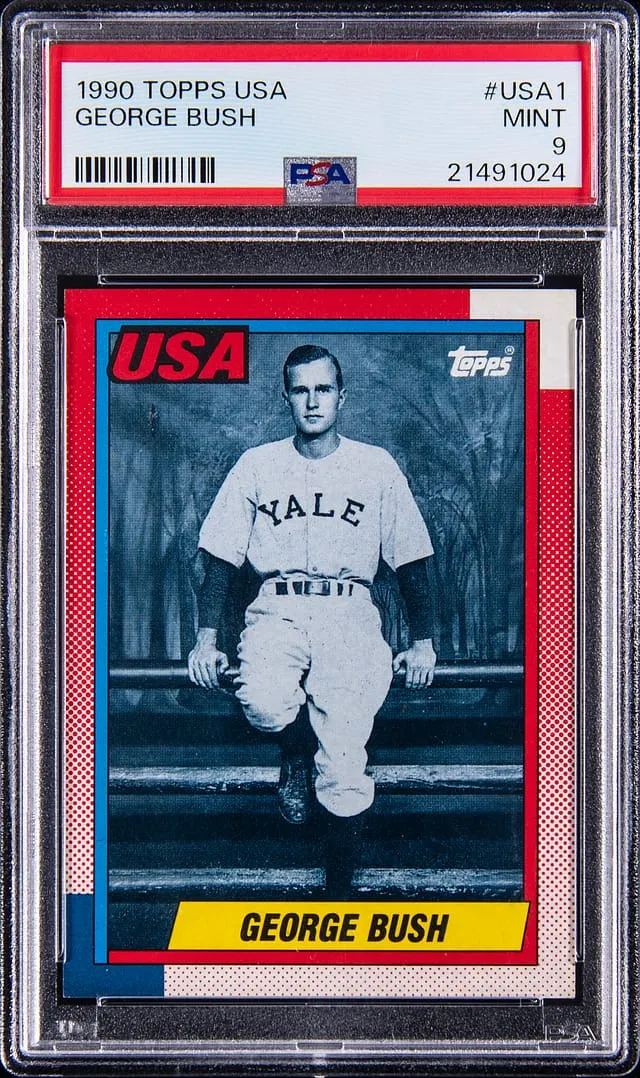
1990 Topps George Bush PSA 9 Sells for $43,920
Goldin sold a 1990 Topps USA #USA1 George Bush PSA 9 (Pop 2) for $43,920. See why this rare junk‑wax oddball matters to collectors.
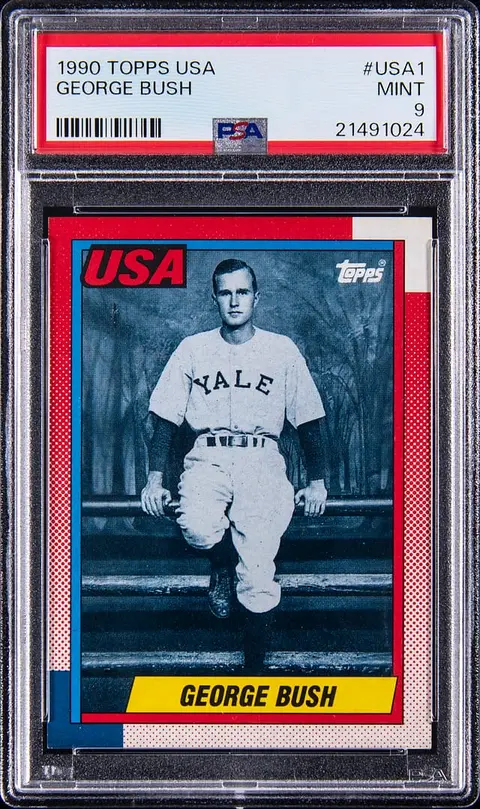
Sold Card
1990 Topps USA #USA1 George Bush - PSA MINT 9 - Pop 2
Sale Price
Platform
Goldin1990 Topps USA #USA1 George Bush - PSA MINT 9 - Pop 2: What This $43,920 Sale Tells Us
On March 8, 2026, Goldin closed a notable sale for a politically and hobby-significant card: a 1990 Topps USA #USA1 George Bush graded PSA MINT 9, with a population ("pop") of just 2 in that grade. The card realized $43,920.
For a piece that comes from the so‑called “junk wax era,” this kind of result always raises an important question for collectors: what exactly is driving the market for this card, and how does this sale fit into the broader price picture?
In this breakdown, we’ll walk through what the card is, why it matters, and how this $43,920 result compares to recent sales.
Card overview: what exactly sold?
• Year & set: 1990 Topps USA • Card: #USA1 George Bush • Subject: George H. W. Bush, 41st President of the United States • Variant: The card design mimics the 1990 Topps baseball flagship look but features Bush in his Yale baseball uniform with a USA banner • Key issue status: Considered a key non‑sport / political issue and a well‑known oddball from the junk wax era • Grade: PSA MINT 9 • Population: Pop 2 in PSA 9 according to the description • Grading notes: No auto, no relic/patch, no serial numbering – the value is driven by the story, scarcity of true originals, and high‑grade condition
This card is part of a niche but established lane in the hobby: presidential and political cards produced in a baseball card format. It’s one of the more recognizable George H. W. Bush collectibles, especially for collectors who bridge sports and historical/political items.
Background: the 1990 Topps George Bush card
The 1990 Topps George Bush card occupies an unusual place in hobby history. While 1990 Topps baseball is widely associated with mass production and low individual card values, the Bush card is not just another pack-pulled common.
Topps produced a special George Bush card in the 1990 design, showing him in his Yale baseball days. Historically, hobby research and auction house descriptions have noted that:
• The card was not distributed like a normal base card from wax packs. • Copies were produced for and associated with the White House and Bush administration circles. • For years, the hobby has differentiated between “original” versions tied to that early production and later, more plentiful reprints or commemorative issues.
Because of this history, serious collectors tend to focus on:
- Verifying that a card is an original 1990 Topps production rather than a later reprint.
- Condition, since handling, storage, and printing quality from that era make high‑grade examples relatively tough.
That context is important: even though the broader 1990 Topps set is common, the Bush card in verified original form is not treated like standard junk wax.
Where this card sits in the market (recent sales context)
When we talk about “comps” (short for comparables), we mean recent confirmed sales of the same card or very similar versions. They give a rough idea of current demand, but they’re not guarantees of future prices.
For the 1990 Topps USA #USA1 George Bush, the highest‑end examples historically have been:
• PSA 10s (if and when they appear) • Verified original cards with strong provenance in any high grade
Over the past few years, auction houses like Goldin and others have occasionally handled Bush cards that:
• Command a significant premium when clearly identified as original early‑issue examples. • Show a sharp drop‑off in price as you move from top grades (PSA 9 and 10) down to mid‑grades and ungraded copies.
Within that context, a PSA MINT 9 pop‑2 example selling for $43,920 at Goldin in March 2026 places this card near the premium end of the range for high‑grade Bush cards, especially considering:
• Population: With only 2 PSA 9s noted, the supply of top‑end graded copies is extremely thin. Even a few motivated bidders can move prices. • Grade gap: Assuming PSA 10s either do not exist or are even scarcer, PSA 9 effectively becomes a top‑tier chase grade. • Auction house: Goldin tends to attract serious high‑end buyers, which can bring stronger realized prices for rare or niche but desirable items.
Compared with lower‑grade sales and ungraded examples seen across major marketplaces, the $43,920 result is clearly a premium outcome. It reflects both grade scarcity and the card’s status as a recognized oddball key from a heavily collected era.
Because this card trades infrequently in PSA 9, each sale can reset expectations. Rather than a smooth price curve, the market often looks more like a series of individual data points—a handful of auctions over multiple years.
Why collectors care about this card
Even in a hobby dominated by star players and rookie cards, the George Bush 1990 Topps card maintains a steady presence for several reasons.
- Cross‑collecting appeal
• Political and presidential collectors: For people who focus on U.S. presidents, this is one of the more visually recognizable Bush items in an accessible format. • Baseball and oddball collectors: It blends presidential history with a classic baseball card design, tapping into the long history of U.S. presidents and baseball.
- Junk wax contrast
The late 1980s and early 1990s are often labeled the “junk wax era” because sets were printed in huge quantities. Most base cards from 1990 Topps are extremely common and low‑value.
The Bush card stands out as an exception:
• It was not pack‑distributed in the same way as the regular set. • Genuine early copies are relatively scarce. • High‑grade, well‑authenticated examples have a much tighter supply than the rest of the checklist.
For collectors who enjoy finding pockets of scarcity and history in a mass‑produced era, this card is a natural target.
- Historical resonance
The image of Bush in his Yale baseball uniform connects a U.S. president back to the sport’s collegiate and post‑war history. The card also reflects a period when manufacturers were experimenting more overtly with celebrity and political crossovers.
That mix of hobby history, presidential history, and nostalgia keeps interest relatively stable even when broader market conditions change.
Grading, population, and condition sensitivity
When we talk about a “pop report” (population report), we’re referring to a grading company’s public count of how many copies of a given card they’ve graded at each grade level (e.g., how many PSA 8, PSA 9, PSA 10, etc.).
For the 1990 Topps USA #USA1 George Bush:
• PSA MINT 9 population is listed as 2 in the sale description. • That means only two examples have earned a 9 from PSA. • If there are no PSA 10s—or only a very small number—the PSA 9 effectively functions as a top‑tier grade for this card.
Condition matters because:
• 1990 Topps printing quality is not always perfect (centering, edges, and print defects can be issues). • Cards that were not stored as collectibles from day one often show wear, handling marks, or surface issues.
So while raw (ungraded) or lower‑grade Bush cards are more obtainable, the leap to a high‑end PSA 9 is significant, and the price gap reflects that.
How this $43,920 sale fits into the broader hobby
A result like this highlights a few ongoing themes in the trading card market:
- Story and provenance still matter
Even in an era of serial‑numbered parallels and autographed patches, collectors remain willing to pay up for non‑sport and historical cards with a clear story and place in hobby lore. The Bush card checks those boxes.
- Scarcity within a common era can be powerful
The junk wax era is not uniformly overprinted in terms of every card and every variant. When you isolate a card that was produced differently, distributed narrowly, or condition‑sensitive, you can see pockets of genuine scarcity—especially in top grades.
- High‑grade pop counts can drive bidding
With only two PSA 9 copies noted, any auction that brings both of them to market—or offers a fresh example—can spark competitive bidding. The Bush card sale at Goldin illustrates how closely high‑end buyers watch population data.
What collectors and small sellers can take away
If you’re a collector or small seller looking at this result, here are a few practical, non‑speculative takeaways:
• Understand the variant: Not all George Bush 1990‑style cards are equal. Knowing how to distinguish original production from later reprints or tributes is critical. • Verify with grading and authentication: For cards like this, a trusted grading company’s label and population data can materially affect value. • Expect volatility at the top: With pop‑2 levels in a flagship grade like PSA 9, each auction is a small sample size. Prices can swing based on who shows up to bid. • Look for story‑driven pieces: Even if you never handle a PSA 9 Bush, this sale is a reminder that cards with strong stories—historical, cultural, or hobby‑specific—often draw sustained interest.
Final thoughts
The March 8, 2026 Goldin sale of the 1990 Topps USA #USA1 George Bush in PSA MINT 9 for $43,920 underscores how selective scarcity and historical relevance can stand out even in an era famous for overproduction.
For collectors, it’s another data point in the evolving market for presidential and political cards, as well as a case study in how a single key issue can emerge from a massive, otherwise common set.
As more population data comes into focus and additional high‑grade examples surface—or don’t—sales like this one will continue to shape how the hobby values this unique crossover between baseball design and presidential history.