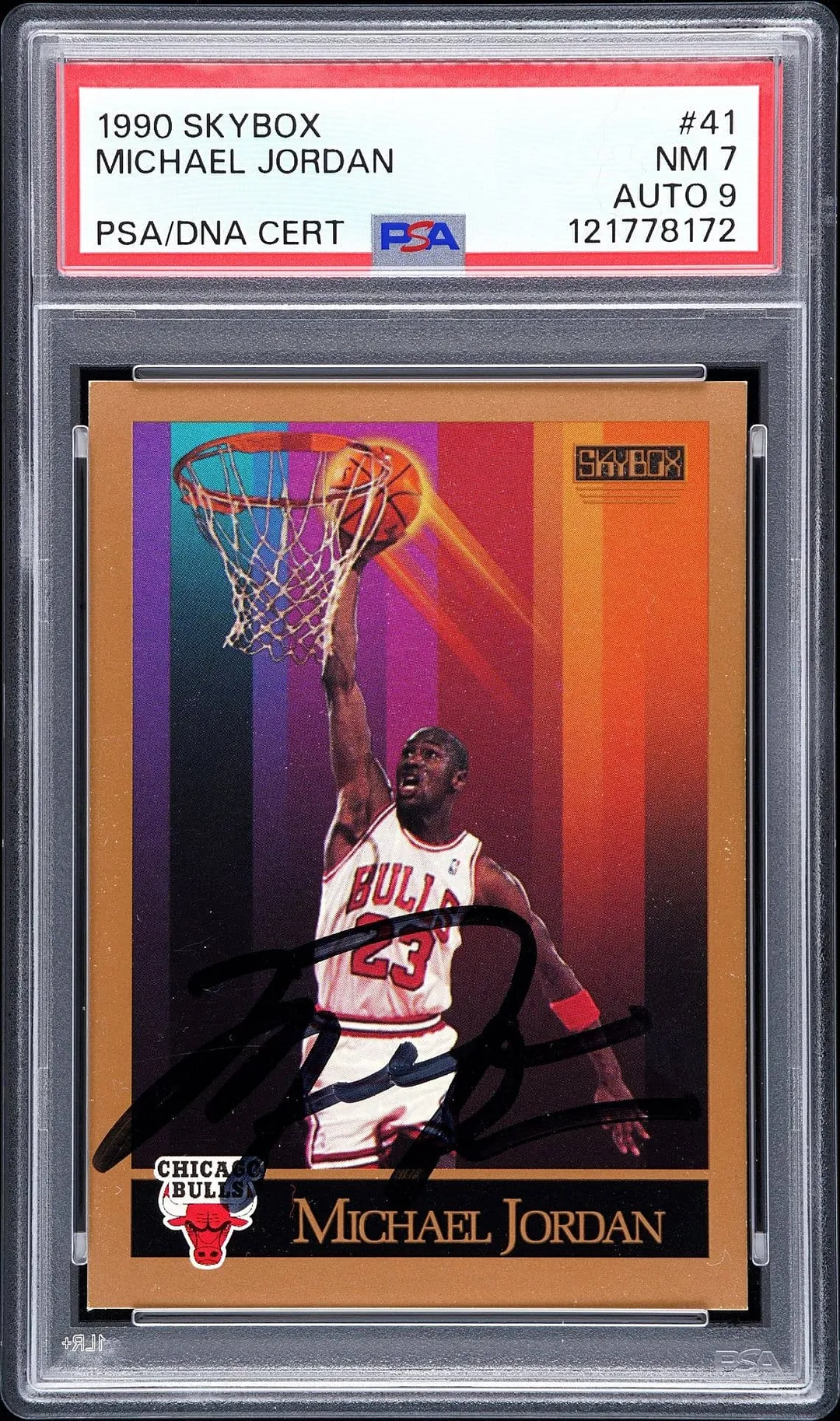
1990-91 SkyBox Jordan Auto PSA 7/9 Sells for $18K
Goldin sold a 1990-91 SkyBox #41 Michael Jordan auto, PSA 7 with PSA/DNA 9 autograph, for $18,056. Here’s what the sale means for collectors.
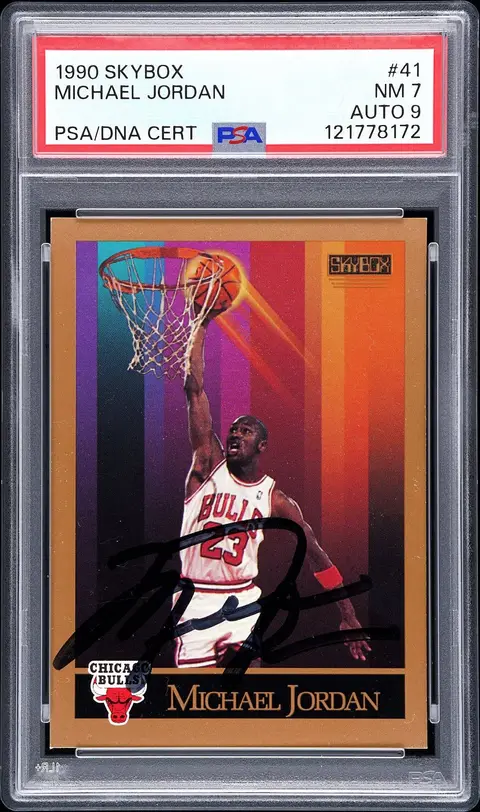
Sold Card
1990-91 Skybox #41 Michael Jordan Signed Card - PSA NM 7, PSA/DNA MINT 9
Sale Price
Platform
Goldin1990-91 SkyBox is one of those sets almost every basketball collector has handled at some point. It’s bright, it’s loud, and it’s pure early-90s NBA. Within that run, Michael Jordan’s base card is everywhere in raw form—but signed and graded examples tell a very different story.
Goldin recently closed a sale for a 1990-91 SkyBox #41 Michael Jordan Signed Card, graded PSA NM 7 for the card with a PSA/DNA MINT 9 autograph, at a final price of $18,056 on December 27, 2025. For a mass-produced “junk wax era” issue, that’s a meaningful number and a good chance to pause and look at how collectors value early-90s Jordan autos.
The card: 1990-91 SkyBox #41 Michael Jordan, PSA NM 7, PSA/DNA MINT 9
Key details:
- Player: Michael Jordan (Chicago Bulls)
- Year / Set: 1990-91 SkyBox Basketball
- Card number: #41
- Type: Standard base card (not a rookie, not a serial-numbered parallel)
- Era: Early 1990s “junk wax” era (high production volume)
- Attributes: On-card autograph authenticated and graded by PSA/DNA
- Grades:
- Card: PSA NM 7 (Near Mint)
- Autograph: PSA/DNA MINT 9 (high-grade, clean signature)
This is not a rookie card—Jordan’s true rookies are from 1984-85 Star and 1986-87 Fleer—but it is a recognizable, widely collected early-90s MJ. Most copies exist as unsigned, raw cards. The value in this particular example is driven primarily by the authenticated on-card autograph and its MINT 9 grade, more than by the technical card grade itself.
Why collectors care about 1990-91 SkyBox Jordan
1990-91 SkyBox is often described as the start of a new visual era in basketball cards. The abstract, space-themed backgrounds, bright colors, and bold design separated it from the more traditional look of late-80s issues.
For Jordan specifically, this card has a few things going for it:
- Era-defining design: Many collectors who grew up in the 1990s remember SkyBox vividly. The Jordan from this set is one of the poster cards for that nostalgic wave.
- Accessible base, scarce in high-end auto form: The unsigned base is common. What’s scarce is a clean, authenticated Jordan autograph with a high auto grade on this specific issue.
- On-card signature: The autograph is directly on the card, not a sticker. For many Jordan collectors, on-card autos, even on non-premium issues, are more desirable.
Because the underlying card is from a high-print-run era, the card grade (PSA 7) is less of a driver than it would be for a vintage or low-serial modern card. The focus here is the combination of a popular early-90s image with a strong Jordan signature graded PSA/DNA 9.
Market context and recent sales
When collectors talk about “comps,” they mean recent comparable sales of the same or very similar card. For a signed, graded 1990-91 SkyBox Jordan, truly apples-to-apples comps require matching several variables:
- The same card (1990-91 SkyBox #41)
- On-card autograph
- PSA or equivalent grading
- Card grade plus separate autograph grade
Within that narrow lane, the data set is much smaller than for unsigned base copies. Recent hobby patterns around similar cards show a few clear trends:
- Unsigned PSA 9–10 base cards from this set generally sell for modest amounts, reflecting the heavy print run.
- Jordan on-card autos from the 1990s—especially on base or insert cards rather than pack-issued autograph sets—tend to command a premium due to limited signed supply from that era.
- Auto grade matters: A PSA/DNA MINT 9 or GEM MINT 10 autograph routinely sells stronger than the same card with an ungraded or lower-grade signature, because buyers see clear, bold ink as a long-term desirability factor.
The $18,056 realized at Goldin on December 27, 2025, places this copy squarely in the tier of nostalgia-driven, autograph-focused Jordan pieces that sit below his iconic rookie and premium 1990s inserts, but above most unsigned base material.
Without overreaching, this price looks consistent with how the market has been treating similar Jordan on-card autos on recognizable 90s issues: the autograph quality and the nostalgia factor can outweigh the modest card grade.
How this sale fits into the broader Jordan market
Michael Jordan’s card market is deep and layered. A simple way to think about it:
- Top tier: True rookies (Star and 1986 Fleer), high-end 1990s inserts (Precious Metal Gems, Jambalaya, etc.), and premium pack-issued autos. These tend to set record prices.
- Middle tier: Recognizable 80s–90s base and inserts with on-card autographs, especially with high autograph grades and strong provenance.
- Broad base: Raw and graded base cards from the junk wax era, which are widely available and more price-sensitive.
This 1990-91 SkyBox #41 signed and graded card lives in that middle tier:
- The card itself is not rare.
- The combination of a licensed Jordan auto, PSA encapsulation, and a MINT 9 autograph grade creates relative scarcity.
- SkyBox’s distinct design ties the card to a very specific hobby memory, which supports collector interest even without serial numbering.
The result at Goldin doesn’t signal a new all-time high for Jordan autos, but it does reinforce a clear pattern: clean, authenticated Jordan signatures on nostalgic 90s cards continue to find solid demand.
Condition breakdown: PSA 7 card, PSA/DNA 9 auto
For newer collectors, it’s important to separate card grade from autograph grade:
- Card grade (PSA 7 – Near Mint): Indicates minor corner or edge wear, slight surface issues, or centering that keeps it out of the NM-MT 8 and above range. For a mass-produced 1990 card, this is acceptable but not premium.
- Autograph grade (PSA/DNA 9 – Mint): Focuses on the signature itself: strength of ink, completeness, and absence of smearing or major fading.
In this sale, the autograph grade is the value driver. Many collectors of signed 80s and 90s cards prioritize a bold, high-grade signature over a perfectly centered, gem-mint base card.
What this means for collectors and small sellers
For collectors and smaller sellers, this Goldin sale on December 27, 2025, offers a few practical takeaways:
Autographed 90s base can be a real lane. Even when the underlying card is from a high-print era, a strong authenticated signature from an all-time great can create meaningful value.
Third-party authentication is key. A raw signed Jordan SkyBox card, even if genuine, will usually trail a PSA/DNA-certified example. The PSA slab and separate auto grade help buyers feel more confident.
Condition priorities shift with autos. On on-card autographs, many buyers happily accept a PSA 6–7 card grade if the autograph itself is sharp and graded highly. That can be a different mindset than purely chasing gem-mint base cards.
Nostalgia still matters. Sets like 1990-91 SkyBox hit a sweet spot with collectors who grew up in the 90s. When that nostalgia overlaps with a clean Jordan auto, the result often shows up in auction prices.
Final thoughts
The $18,056 sale of the 1990-91 SkyBox #41 Michael Jordan Signed Card (PSA NM 7, PSA/DNA MINT 9) at Goldin on December 27, 2025, is a clear example of how the market continues to separate common base from authenticated, high-quality autograph pieces within the same era.
For anyone tracking Jordan’s market, it’s another data point showing steady demand for on-card autographs on recognizable 90s designs. For collectors building a PC (personal collection), it underlines that you don’t need a rookie or a serial-numbered insert for a card to feel important—sometimes, a bold signature on a card you remember from childhood is more than enough.
As always, prices move over time, and no single auction defines a card’s value. But this Goldin result adds useful context: early-90s Jordan autos, especially with strong autograph grades, continue to hold the interest of serious collectors and focused 90s basketball enthusiasts alike.