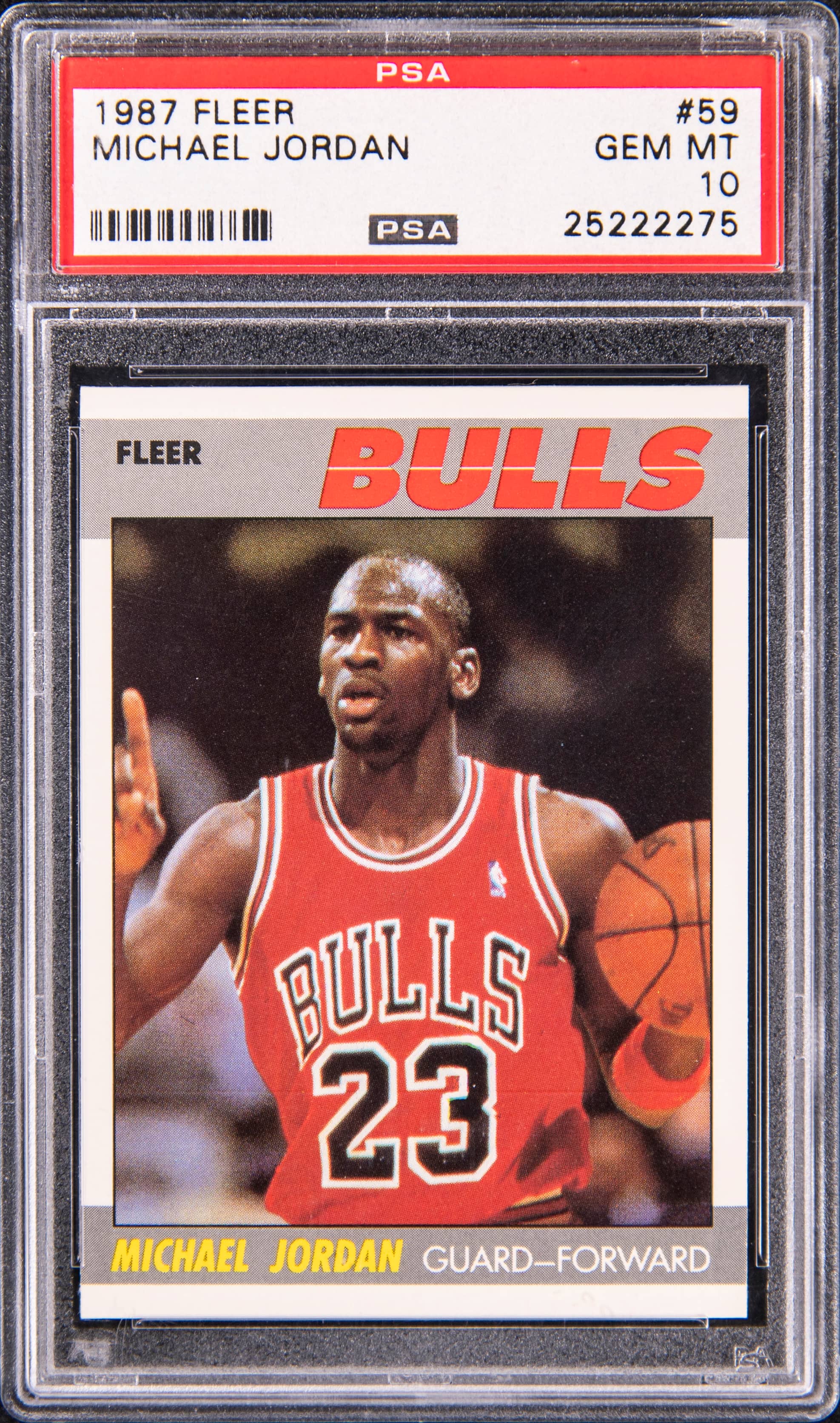
1987-88 Fleer Michael Jordan PSA 10 sells for $29K
Goldin’s Feb 8, 2026 sale of a 1987-88 Fleer #59 Michael Jordan PSA 10 at $29,280 shows steady demand for early Jordan in gem-mint condition.
Sold Card
1987-88 Fleer #59 Michael Jordan - PSA GEM MT 10
Sale Price
Platform
Goldin1987-88 Fleer #59 Michael Jordan PSA 10 Sells for $29,280 at Goldin
Michael Jordan’s second-year Fleer cards continue to be a quiet bellwether for the vintage–to–junk-wax crossover era. On February 8, 2026 (UTC), Goldin closed a copy of the 1987-88 Fleer #59 Michael Jordan graded PSA GEM MT 10 at $29,280.
Below, we break down what this card is, how this sale fits into recent market data, and why collectors still care so much about this particular Jordan.
The card at a glance
- Player: Michael Jordan
- Team: Chicago Bulls
- Year: 1987-88
- Set: Fleer Basketball
- Card number: #59
- Parallel / variant: Base issue (no parallel)
- Rookie?: No – this is Jordan’s second-year Fleer; his iconic Fleer rookie is 1986-87 Fleer #57
- Era: Late 1980s “junk wax” era, but with far fewer surviving gem-mint copies than modern ultra-printed sets
- Grading company: PSA (Professional Sports Authenticator)
- Grade: GEM MT 10 (PSA’s highest standard grade for condition)
- Attributes: Standard base card, no autograph, no patch, no serial numbering
The 1987-88 Fleer set is Jordan’s first non-rookie mainstream card from a major U.S. manufacturer. For collectors who focus on early Jordan cardboard, the ladder usually looks like this: 1984-85 Star issues, 1986-87 Fleer rookie (#57), then the 1987-88 Fleer #59 and #59 sticker as early flagship follow-ups.
Market context for this sale
- Sale price: $29,280
- Auction house: Goldin
- Sale date: February 8, 2026 (UTC)
To understand how meaningful that number is, it helps to look at comps—short for “comparables,” recent sales of the same card or very similar versions.
Recent PSA 10 sales and trends
Public auction results over the last few years show the 1987-88 Fleer #59 PSA 10 moving through a fairly clear cycle:
- Early hobby boom (around 2020–early 2021): Some PSA 10 copies pushed well above the $40,000 mark at peak.
- Post-boom normalization (2022–2024): Realized prices generally slid into the mid-to-high teens and then into the low-to-mid 20s, with condition appeal and centering driving premiums within that band.
- Recent auction ranges: More recent public comps from major auction houses and marketplaces typically fall in a rough band around the low-$20,000s to low-$30,000s, depending on eye appeal and timing.
Against that backdrop, a $29,280 result in early 2026 sits toward the upper end of that post-boom range but is still comfortably within what recent comps support for a strong-looking PSA 10. It doesn’t read as a new record, but it does affirm steady demand at the top of the condition spectrum.
How lower grades compare
To put the PSA 10 premium in context:
- PSA 9 (Mint): Recent PSA 9 copies commonly sell in the low-to-mid four figures. The gap between PSA 9 and PSA 10 on this card is wide, reflecting how tough a true gem is from this era.
- PSA 8 and below: These grades are much more accessible and have behaved more like a traditional “junk wax era” card, with prices that softened significantly after the 2020–21 spike but still maintain a solid collector base.
This kind of multi-tier structure—where PSA 10 sits in its own pricing universe—has become typical for key Jordan issues from the 1980s.
Population and scarcity in PSA 10
The pop report (short for population report) is a count published by grading companies showing how many copies of a given card they’ve graded at each grade level.
For the 1987-88 Fleer #59 Michael Jordan:
- The card itself is not truly rare in raw (ungraded) form. Packs were printed heavily, as was typical for the era.
- However, true gem-mint copies are meaningfully scarce. Off-centering, print dots, and edge and corner wear are common, and many cards were handled in binders and shoeboxes for years before grading took off.
While exact PSA 10 population counts can shift as more cards are submitted and re-submitted, the key takeaway is that the PSA 10 population is small relative to both total production and to grades like PSA 8 and PSA 9. That condition scarcity is what underpins the five-figure pricing.
Why collectors care about this card
Several factors keep the 1987-88 Fleer #59 Jordan in steady demand:
1. Early flagship Jordan issue
Although it’s not a rookie, many collectors treat the 1987-88 Fleer set as Jordan’s first “established superstar” card. By this time, he had already captured scoring titles and had become the defining player of his generation.
The card’s earliest years overlapped with some of Jordan’s foundational seasons—before the championships, but with the full scoring explosion already underway.
2. Part of a historically important set
1986-87 and 1987-88 Fleer are back-to-back foundational sets for 1980s basketball:
- 1986-87 Fleer delivered the iconic Jordan rookie and a deep roster of important rookie cards.
- 1987-88 Fleer followed as the hobby’s main NBA flagship set at a time when basketball cards were still far from the print and parallel complexity we see now.
Collecting both years in high grade has become a common goal for Jordan and 1980s basketball specialists.
3. Era appeal: late vintage / junk wax bridge
This card sits in a unique place between vintage (older, low-print, pre-1980s issues) and the junk wax era (high-print late 1980s and early 1990s). That gives it some interesting characteristics:
- Plenty of raw copies exist, and mid-grade slabs are common.
- The PSA 10, however, behaves more like a semi-scarce condition rarity, not an ultra-common mass card.
For collectors who appreciate 1980s aesthetics and the transition from early Jordan to the championship 1990s, this card has strong nostalgia value in addition to its market profile.
Recent hobby environment for Jordan cards
Jordan’s status in the hobby is about as stable as it gets:
- He’s retired and firmly cemented as one of the greatest players of all time.
- His playing-day cards are finite; there is no new rookie-year product, and no new in-uniform cards from his active years.
- Interest in 1980s and 1990s basketball has remained resilient even as the broader market has cooled from pandemic highs.
In that environment, key early Jordan cards—especially in PSA 10—often serve as reference points when collectors think about long-term demand and how the hobby values established legends versus rising modern stars.
What this $29,280 sale tells us
The Goldin sale on February 8, 2026 reinforces a few themes:
- PSA 10 still commands a significant premium. The gap between gem-mint and everything else remains large, reflecting how demanding collectors are when it comes to early Jordan condition.
- Pricing is elevated but not at 2021 extremes. At $29,280, this sale reflects mature, post-boom pricing rather than speculative peak levels.
- Steady demand for early Jordan. The result lines up with other recent high-grade comps, suggesting consistent interest rather than a one-off spike.
For collectors, this is less about a new record and more about confirmation: early Jordan in top grade continues to trade within a defined, data-backed range.
Takeaways for collectors and small sellers
If you’re a collector or small seller considering this card or nearby options:
- Set your expectations by grade. A PSA 10 is a different market than PSA 8 or PSA 9; comps should always be grade-specific.
- Study the pop report. Understanding how many PSA 10s exist, and how that compares to total graded copies, helps explain why the premium is so pronounced.
- Look at eye appeal within the same grade. Centering and print quality matter even at PSA 10. Strong visual copies can outpace weaker-looking ones at auction.
- Use multiple recent comps. Instead of fixating on a single high or low sale, look at several recent results across auction houses and fixed-price marketplaces to understand the current range.
As always, purchases and sales in the hobby carry risk, and prices can move for many reasons. But as of this Goldin auction on February 8, 2026, the 1987-88 Fleer #59 Michael Jordan in PSA GEM MT 10 shows that top-grade early Jordan remains a cornerstone segment of the basketball card market.