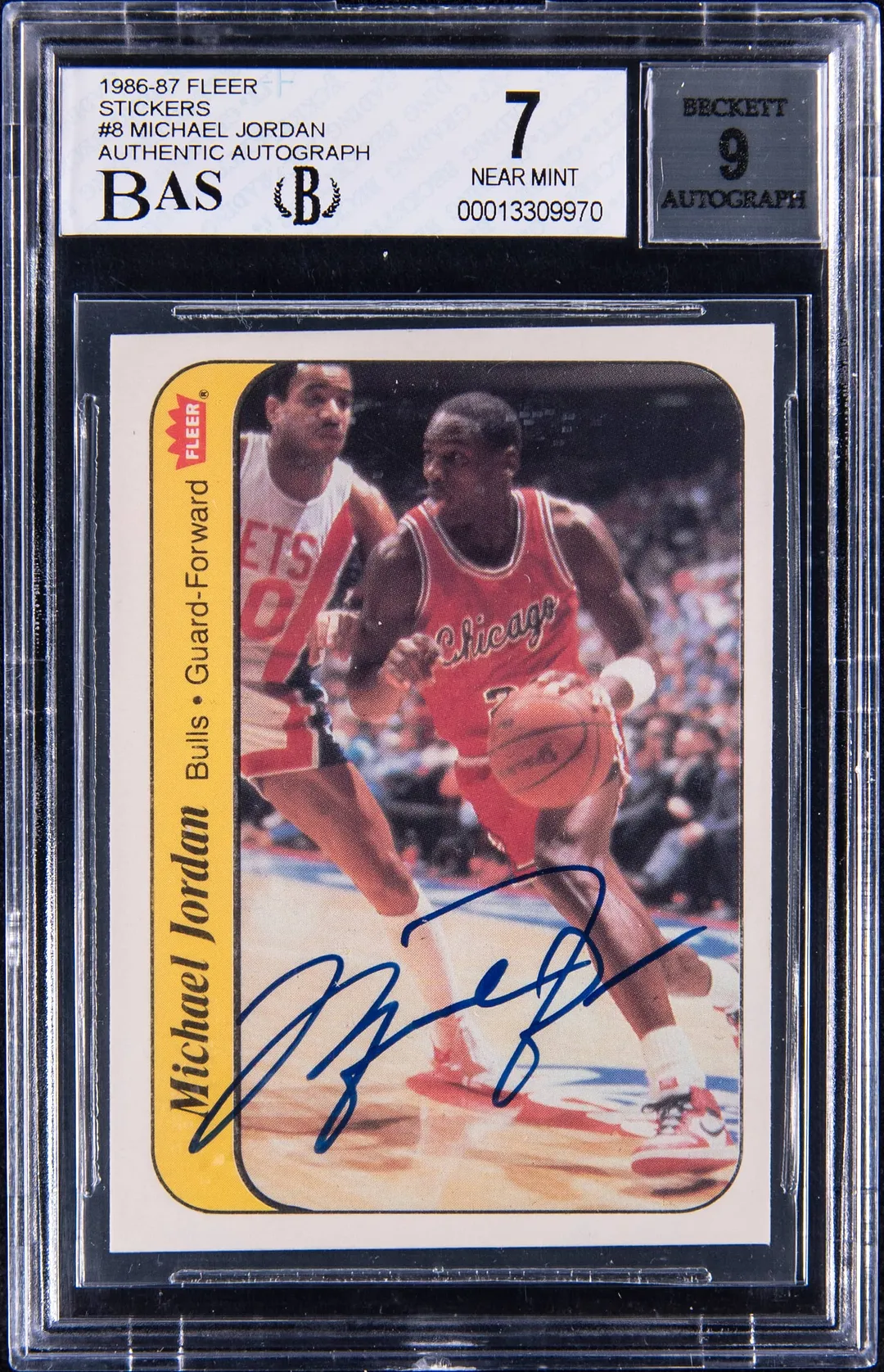
1986 Fleer Sticker Jordan Rookie Auto Sells for $34K
Figoca looks at Goldin’s $34,160 sale of a 1986-87 Fleer Sticker #8 Michael Jordan signed rookie card (BGS 7, Beckett 9 auto, UDA).
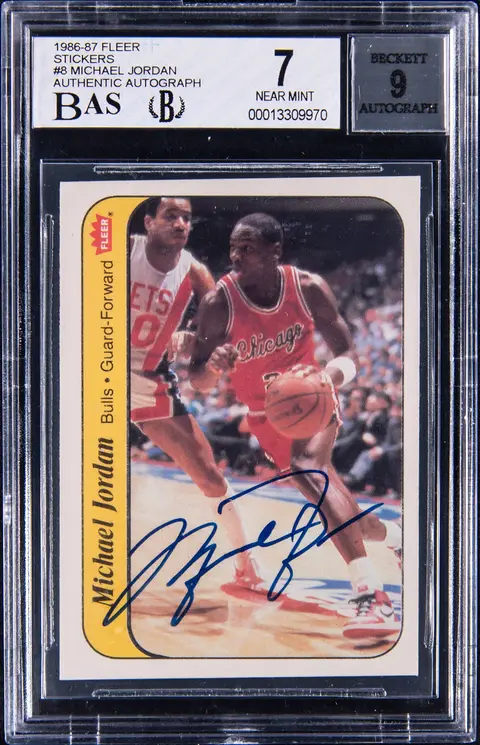
Sold Card
1986-87 Fleer Sticker #8 Michael Jordan Signed Rookie Card - BGS NM 7, Beckett 9, UDA
Sale Price
Platform
Goldin1986-87 Fleer Sticker #8 Michael Jordan Signed Rookie Card – BGS NM 7, Beckett 9, UDA
On February 8, 2026, Goldin sold a 1986-87 Fleer Sticker #8 Michael Jordan signed rookie card for $34,160. For collectors who follow Jordan’s early issues, this result sits at the intersection of three major drivers of value: the 1986-87 Fleer release, the sticker subset, and authenticated Jordan autographs.
In this breakdown, we’ll unpack what this card is, why it matters, and how this sale fits into the broader market for Jordan rookies and signed copies.
What exactly sold?
Card: 1986-87 Fleer Sticker #8 Michael Jordan
Team: Chicago Bulls
Year / Set: 1986-87 Fleer Basketball, Sticker subset
Card type: Rookie-year sticker, widely treated as a companion rookie to the base Jordan #57
Attributes: On-card autograph, Upper Deck Authenticated (UDA)
Grading:
- Card grade: BGS NM 7 (Near Mint) from Beckett Grading Services
- Autograph grade: Beckett 9
This is not the standard base 1986-87 Fleer #57 that many people think of first when they hear “Jordan rookie,” but its sticker counterpart: card #8 from the 11-card sticker insert set. These stickers were inserted one per pack alongside the base cards and are known for centering issues, surface wear, and edge/chipping problems, which makes high-grade examples meaningfully tougher.
Layered onto that is an on-card autograph from Michael Jordan, verified by Upper Deck Authenticated (UDA). UDA has been Jordan’s long-time primary autograph partner, so their holo and COA are particularly important to collectors who want assurance that a Jordan signature is genuine.
The sale price was $34,160 at Goldin on February 8, 2026 (UTC).
Why the 1986-87 Fleer Jordan stickers matter
For people newer to the hobby, the 1986-87 Fleer release is often described as Jordan’s flagship rookie set. While there are earlier regional and oddball issues, the 1986-87 Fleer base card and sticker are his most widely recognized pack-issued NBA rookies.
The sticker subset, including Jordan #8, has a few key points that appeal to collectors:
- Rookie-year issue: Released in the same product as the iconic #57 base rookie, so it’s typically viewed as part of his core rookie portfolio.
- Condition sensitivity: The sticker stock, glossy surface, and placement on the outside of stacks or near wax/pack sealing often led to edge wear, print defects, and centering problems. This has kept top grades relatively scarce.
- Set importance: The 1986-87 Fleer run marked basketball’s return to mainstream, pack-issued cards after a gap in major releases. As a result, the set functions as a cornerstone for modern basketball collecting.
When collectors talk about Jordan’s rookie cards, they often focus on the base #57, but the sticker #8 has steadily carved out its own lane. In some collections, a Jordan rookie “run” feels incomplete without both the base and the sticker.
Grading, autograph, and UDA: what they signal
This specific copy carries a BGS 7 card grade and a Beckett 9 autograph grade. For context:
- BGS 7 (Near Mint): Indicates visible but not severe flaws—often centering, edges, or light surface issues on a vintage/early modern card like this. For 1986-87 Fleer stickers, a 7 is a solid mid-grade.
- Beckett 9 auto: Suggests a clean, bold signature with only minor issues (such as slight streaking or pressure variation). For Jordan, whose autograph quality can vary across eras and signing sessions, a 9 is typically considered strong.
- UDA authentication: UDA’s involvement is a major plus for many Jordan collectors. UDA has maintained stricter control over Jordan’s signing events, and their COA/hologram gives extra confidence in authenticity beyond grading-company verification.
Combining card grade, auto grade, and UDA often places a piece like this into a premium tier versus a raw or uncertified signature on the same card.
Market context: how does $34,160 fit in?
Because signed 1986-87 Fleer Jordan stickers come in many configurations (different graders, card grades, auto grades, and authentication paths), it’s helpful to think in ranges rather than precise fixed values. Recent “comps”—short for comparable sales—show that:
- Unsigned, graded stickers: High-grade unsigned Jordan stickers (for example, PSA 9 or BGS 9) can reach significantly strong prices, with PSA 10s and BGS 9.5s in a much higher tier than mid-grades. Lower to mid-grade copies (6–8) trade at more accessible levels but still command a premium due to the set’s importance and condition difficulty.
- Signed, non-graded or lower-credentialed autos: Raw or minimally authenticated signed stickers usually sell at a discount to fully graded + UDA pieces, reflecting the higher perceived risk around the autograph.
- Signed, graded, UDA-backed examples: These tend to sit near the top of the spectrum for a given card grade. Strong auto grades (9 or 10) and clear UDA documentation can lift a card above similar-graded non-UDA versions.
Within that landscape, a BGS 7 / Beckett 9 / UDA combination reaching $34,160 aligns with what you’d expect for a mid-grade, UDA-certified Jordan rookie-era signed piece at a major auction house. It does not appear to be an outlier record for Jordan’s key rookies overall, but it is a meaningful price level that underscores ongoing demand for authenticated Jordan signatures on his earliest mainstream cards.
Comparing to broader Jordan rookie and auto markets
To better place this sale in context, it helps to zoom out to the broader Jordan market:
- Jordan’s base 1986-87 Fleer #57 rookies: Top-graded PSA 10s and BGS 9.5s have historically pushed into six-figure territory at market peaks. Mid-grades and lower grades can still command substantial prices, but are more common.
- Jordan autos across eras: Modern on-card autos with patches or limited serial numbering (for example, high-end 2000s or 2010s releases) can reach very high levels, especially from premium brands. However, many collectors specifically seek rookie-year cards with later autos because they combine the historic image with the personal touch of a signature.
- Rookie-year signed pieces: Signed copies of Jordan’s 1986-87 Fleer base and sticker rookies are a smaller subset compared with unsigned examples, especially when you factor in full grading and UDA authentication. That relative scarcity helps support strong prices over time.
This $34,160 result reflects a market that continues to differentiate between:
- Plain graded rookies
- Signed, authenticated, but ungraded copies
- Fully graded card + graded auto + UDA examples like this one
Why collectors care about this specific combo
Three factors tend to attract hobby attention to this kind of card:
Rookie-year platform
The 1986-87 Fleer release serves as the starting point for many modern NBA collections. Even collectors who don’t chase modern parallels or ultra-rare inserts often recognize this set as a foundational piece of hobby history.On-card Jordan autograph
An on-card signature means Jordan signed directly on the card surface, as opposed to a sticker auto applied later. Many collectors view on-card autos as more desirable and more personal than sticker autographs.Reputational layers: BGS + Beckett auto + UDA
Having both a major grading company and Upper Deck Authenticated attached can simplify decision-making for buyers who want to reduce authentication risk. For sellers, that same combination can widen the pool of confident bidders.
What this sale suggests for the market
A single auction never defines a full market, but this Goldin sale offers a few takeaways:
- Jordan demand remains broad-based. Even outside of PSA 10 base rookies or ultra-rare inserts, there is sustained interest in mid-grade, highly authenticated pieces.
- Autograph quality and authentication matter. The combination of a Beckett 9 auto grade and UDA authentication clearly factored into placing this card at a premium tier for a BGS 7.
- Set history still carries weight. Regardless of short-term market fluctuations, the 1986-87 Fleer brand and its Jordan cards continue to be reference points for both new and veteran collectors.
For collectors, buyers, and small sellers
If you’re a collector or small seller using figoca to track sales and understand the market, here are a few practical angles to consider when you see a result like this:
- Look at card grade and auto grade separately. A BGS 7 card with a Beckett 9 autograph can behave differently in the market than a BGS 7 with an ungraded or lower-grade auto.
- Note authentication sources. UDA on a Jordan auto is a meaningful attribute. When you’re comparing comps, distinguish between UDA-backed signatures and those authenticated only by a grader or a different third party.
- Use comps as ranges, not precise targets. Prices can vary by auction house, timing, card eye appeal, and who is bidding. Think in terms of typical ranges rather than treating any single result as a guaranteed benchmark.
- Factor in set and era. The 1986-87 Fleer set bridges “vintage” and “modern” for basketball. Its historical position often supports long-term collector interest even as short-term prices move around.
Summary
The 1986-87 Fleer Sticker #8 Michael Jordan signed rookie card (BGS NM 7, Beckett 9 auto, UDA) that sold at Goldin on February 8, 2026 for $34,160 highlights how collector demand continues to cluster around:
- Jordan’s rookie-year 1986-87 Fleer cards
- Verified on-card autographs
- Strong third-party grading and authentication
For Jordan collectors, it stands as a notable mid-grade, high-confidence example that connects the hobby’s most famous basketball rookie set with one of the most sought-after signatures in the game.