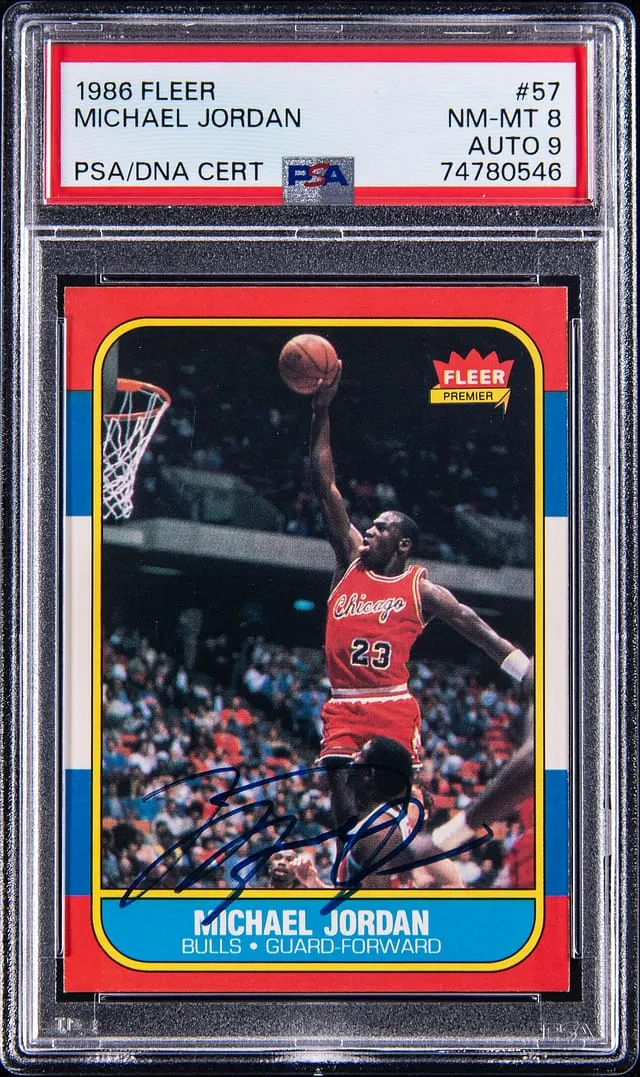
1986 Fleer Michael Jordan Signed Rookie PSA 8 Sells
Goldin sold a 1986-87 Fleer #57 Michael Jordan signed rookie, PSA 8 with PSA/DNA 9 auto and UDA/JSA, for $323,300 on March 15, 2026.
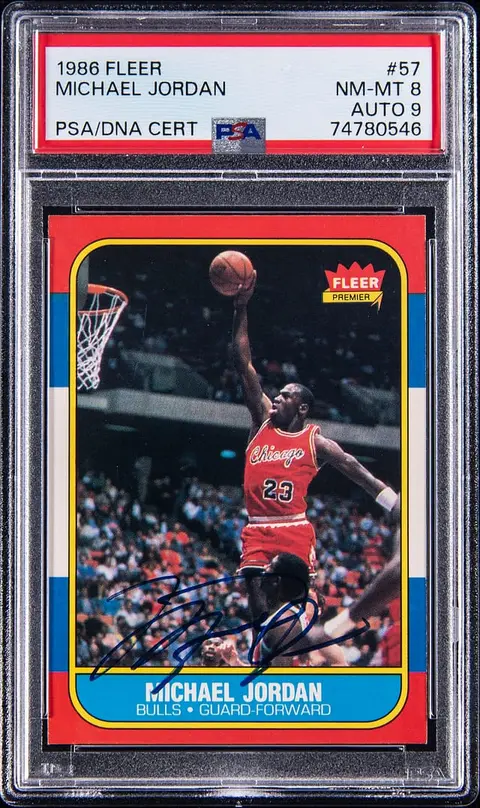
Sold Card
1986-87 Fleer #57 Michael Jordan Signed Rookie Card - PSA NM-MT 8, PSA/DNA MINT 9, UDA, JSA LOA
Sale Price
Platform
Goldin1986-87 Fleer #57 Michael Jordan Signed Rookie Card Sells for $323,300
On March 15, 2026, Goldin sold a 1986-87 Fleer #57 Michael Jordan signed rookie card for $323,300. For many collectors, this is the defining basketball card of the modern hobby, and this particular copy checks almost every premium box: strong card grade, high-grade autograph, and multiple layers of authentication.
In this breakdown, we’ll look at what exactly sold, how it fits into recent market data, and why signed Jordan rookies occupy such an important place in the hobby.
What exactly was sold?
Card ID
- Player: Michael Jordan
- Team: Chicago Bulls
- Year: 1986-87
- Set: Fleer Basketball
- Card number: #57
- Type: Flagship rookie card (MJ’s most recognized pack-issued rookie)
- Era: 1980s "vintage-to-early-modern" transition
Grading and authentication
- Card grade: PSA NM-MT 8 (Near Mint-Mint 8)
- Autograph grade: PSA/DNA MINT 9
- Autograph type: On-card, signed directly on the original Fleer rookie
- Additional authentication:
- Upper Deck Authenticated (UDA)
- JSA Letter of Authenticity (LOA)
In hobby terms, this is an on-card autograph: Jordan signed directly on the original 1986-87 Fleer card, not on a sticker or a reprint. The combination of PSA card grade, PSA/DNA autograph grade, UDA provenance, and a JSA LOA makes it a heavily documented piece.
Why the 1986-87 Fleer Jordan matters
For collectors at almost every experience level, 1986-87 Fleer is one of the cornerstone basketball sets.
Key set and key card
- Flagship rookie: While Michael Jordan has earlier Star Company cards, the 1986-87 Fleer #57 is widely treated as his mainstream, pack-issued rookie.
- Iconic design: The red, white, and blue border, the in-game dunk photo, and the simple layout make it instantly recognizable.
- Era-defining release: After several years with limited NBA card production, the 1986-87 Fleer release helped restart mainstream basketball card collecting.
Because of that, the Jordan #57 sits in the same conversational tier as the most important modern sports cards. It bridges the gap between true vintage (like 1950s–70s) and the later “junk wax” overproduction era.
Signed vs. unsigned copies
The original 1986-87 Fleer product did not include pack-issued autographs. Every signed Jordan rookie is a post-issue autograph: Jordan signed existing cards later, often through UDA or private/public signings.
That means:
- Unsigned PSA-graded cards are the baseline for most price conversations.
- Signed, multi-authenticated copies like this one combine both the card and autograph markets, which can push them into a different pricing tier than unsigned PSA 8s.
Price and market context
- Realized price: $323,300
- Auction house: Goldin
- Sale date (UTC): March 15, 2026
Recent market context (directional)
Exact, up-to-the-minute sales data can move quickly, but looking at the broader trend over the last few years gives context:
- Unsigned PSA 8s: In the recent market, PSA 8 copies of the 1986 Fleer Jordan have often traded in the mid five- to low six-figure range, depending on centering, eye appeal, and timing of the sale.
- Signed PSA-graded copies:
- On-card, PSA 8 with high-grade autos (PSA/DNA 9 or 10) frequently command a meaningful premium over unsigned equivalents.
- Multi-authenticated examples (PSA/DNA + UDA, often with an additional LOA) tend to be treated as "safer" or more complete packages by many buyers, which can further separate them from raw or singly-authenticated signed copies.
Against that backdrop, $323,300 for a PSA 8 card grade with a PSA/DNA 9 autograph, plus UDA and JSA documentation, sits toward the upper end of what many collectors would expect for a signed, non-10 card grade Jordan rookie. The layers of authentication and presentation help explain why it lands in that tier.
Because signed MJ rookies vary a lot by inscription, pen placement, eye appeal, and certification, comparing exact “like-for-like” comps (short for "comparables," meaning similar recent sales) is not always straightforward. Still, this result aligns with the idea that clean, well-documented signed rookies occupy a premium band above unsigned 8s, and often approach or exceed prices of higher-grade unsigned examples when the autograph and provenance stand out.
Why collectors chase this specific configuration
Several factors combine to make this particular example appealing:
1. Strong balance of card and autograph grades
- PSA 8 card grade indicates a clean copy with only moderate flaws—often centering or minor edge/corner issues. While not gem mint, it is above the large pool of lower-grade examples.
- PSA/DNA 9 autograph reflects a bold, clean signature with only very minor imperfections. For many collectors, a 9 auto is essentially “investment-grade” without paying the full premium of a 10.
The pairing of an 8 card and 9 auto is a sweet spot for a lot of hobbyists: premium feel, but somewhat more accessible than a true 9/10 or 10/10 combination.
2. Multi-layer authentication: PSA, UDA, JSA
- PSA/PSA-DNA: Industry-standard grading and autograph authentication; slabbed and labeled.
- Upper Deck Authenticated (UDA): Jordan’s long-standing official memorabilia partner; UDA provenance is often considered a strong assurance that the autograph came through a controlled signing.
- JSA LOA: A separate Letter of Authenticity from another major third-party authenticator.
For a card at this value level, redundancy is often seen as a plus. It doesn’t guarantee future prices, but it does give many collectors extra comfort about authenticity and documentation.
3. Long-term cultural significance
Regardless of short-term price swings, the 1986 Fleer Jordan remains central to basketball card history:
- Jordan’s ongoing global popularity and cultural influence keep demand wide and deep.
- The card is instantly recognizable even to casual fans.
- It is often a "goal card" for collectors returning to the hobby, especially those who watched Jordan play in the 1980s and 1990s.
Signed examples add an additional dimension: they function both as a key rookie card and as an autograph piece, which can appeal to collectors who cross over between cards and memorabilia.
How this sale fits into the broader MJ rookie market
Population and scarcity dynamics
The 1986 Fleer Jordan is not rare in the strict sense—PSA alone has graded tens of thousands of copies across all grades. Scarcity emerges at the higher end:
- High-grade unsigned cards (PSA 9 and 10) have limited populations relative to overall demand.
- High-grade signed copies with multi-agency authentication are a much smaller subset. Not every high-grade card was signed, and not every signed card holds up well enough for a PSA 8 grade and PSA/DNA 9 auto.
So, even though the base card itself is relatively common, a PSA 8 + PSA/DNA 9 auto + UDA + JSA configuration represents a more constrained slice of the population.
Recent hobby environment
Michael Jordan’s on-court legacy is fixed, but the hobby environment changes:
- The market for key 1980s and 1990s cards has gone through notable cycles, including a run-up, correction, and continued sorting by quality and eye appeal.
- Within that, top-tier, culturally important cards like the Fleer Jordan rookie have tended to behave differently from more speculative modern issues. They still fluctuate, but they remain major reference points for price conversations.
This $323,300 result fits a pattern where the hobby continues to differentiate:
- Average copies in weaker grades track broader market swings more directly.
- Premium, well-documented examples like this one continue to find deep-pocketed collectors when offered through major auction houses.
Takeaways for different types of collectors
For new or returning collectors:
- The 1986-87 Fleer Jordan is a useful reference point for understanding how the hobby values iconic players and flagship rookies.
- Signed versions introduce extra variables: autograph quality, placement, and authentication matter as much as the card grade.
For active hobbyists and small sellers:
- When you review comps, narrow your comparisons as much as possible: card grade, autograph grade, authentication mix, and visual appeal can significantly change the price.
- Multi-authenticated examples, especially those tied to UDA, may justify premiums over similar-grade but less-documented copies.
For long-term Jordan collectors:
- This Goldin sale underscores that the combination of a strong card, strong auto, and strong provenance remains highly competitive in auction settings.
- It also highlights how signed Jordan rookies now occupy their own lane, adjacent to but distinct from unsigned PSA 9s and 10s.
Final thoughts
The March 15, 2026 Goldin sale of a 1986-87 Fleer #57 Michael Jordan signed rookie card, PSA NM-MT 8 with a PSA/DNA MINT 9 autograph and UDA/JSA authentication, for $323,300 reinforces a few key themes in the modern basketball card market:
- The Fleer Jordan rookie remains one of the core reference points for serious collectors.
- Signed, high-grade, well-documented versions are increasingly viewed as their own category, not just an add-on to unsigned comps.
- Strong provenance and presentation matter just as much as the numeric grades when prices reach this level.
For anyone tracking the evolution of Jordan’s rookie market, this sale is a clear data point: the hobby continues to pay up for quality, clarity, and cultural significance, especially when all three appear in a single card.