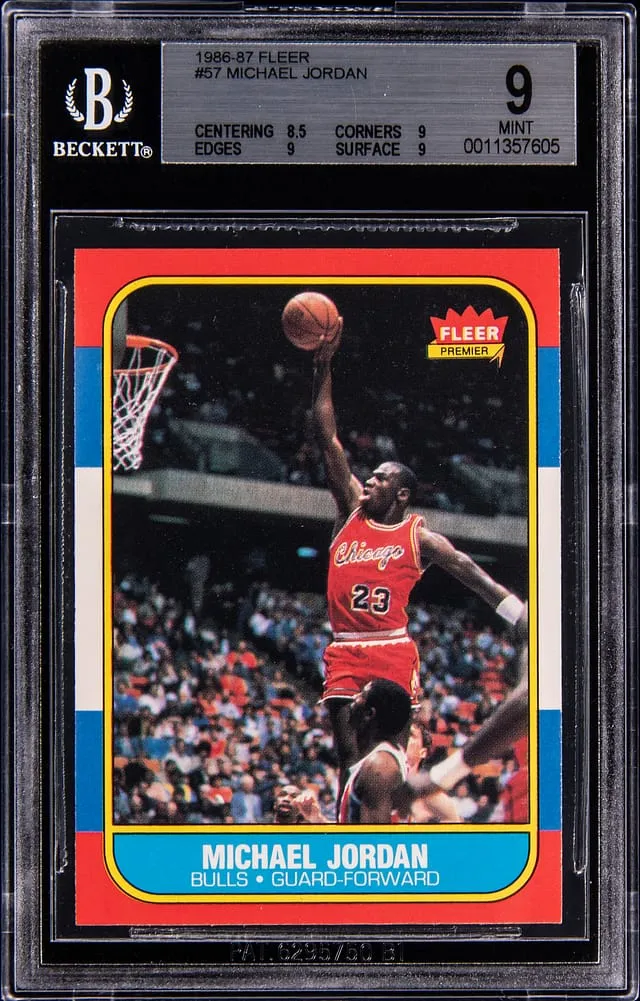
1986 Fleer Michael Jordan Rookie BGS 9 sells for $17K
Goldin sold a 1986-87 Fleer #57 Michael Jordan rookie card, BGS MINT 9, for $17,298 on March 15, 2026. See what this result means for collectors.
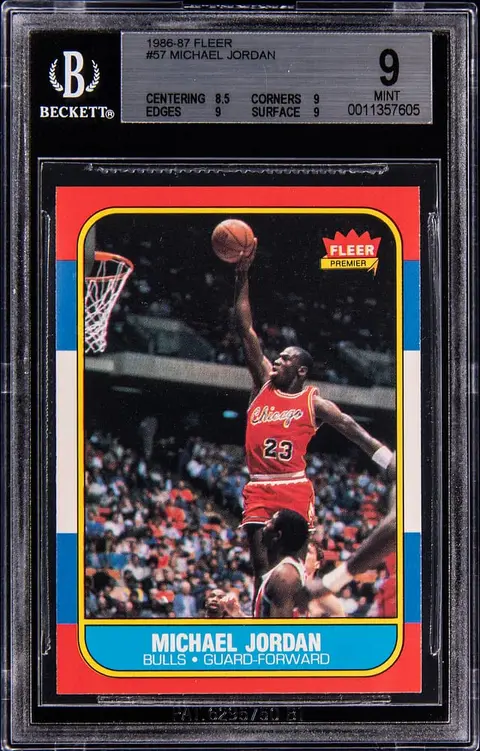
Sold Card
1986-87 Fleer #57 Michael Jordan Rookie Card - BGS MINT 9
Sale Price
Platform
Goldin1986-87 Fleer #57 Michael Jordan Rookie Card – BGS MINT 9 Sells for $17,298 on Goldin
On March 15, 2026, a 1986-87 Fleer #57 Michael Jordan rookie card graded BGS MINT 9 sold for $17,298 through Goldin. For many collectors, this is one of the core, set-defining basketball cards of the entire hobby, so every notable sale helps us understand where the market stands.
In this breakdown, we’ll walk through what this card is, why it matters, and how this result fits into recent price data.
The card at a glance
- Player: Michael Jordan
- Team: Chicago Bulls
- Year: 1986-87
- Set: Fleer Basketball
- Card number: #57
- Card type: Flagship rookie card (widely treated as Jordan’s key pack-issued rookie)
- Grading company: Beckett Grading Services (BGS)
- Grade: 9 – MINT
- Attributes: Standard base card from the set, no autograph or patch; iconic red, white, and blue border design.
The 1986-87 Fleer release is regarded as a cornerstone basketball set. It reintroduced mainstream basketball cards after a gap in widely distributed NBA products, and it features multiple Hall of Famers. Jordan’s #57 is the clear headliner and has become one of the most recognizable sports cards in the world.
Why this card matters to collectors
Flagship rookie status
While Michael Jordan has earlier cards from 1984-85 Star Company and various regional issues, the 1986-87 Fleer #57 is broadly accepted in the hobby as his flagship rookie card. In practice, that means:
- It was widely distributed in packs at the time.
- It anchors one of the most collected basketball sets ever made.
- It’s the default Jordan card referenced when people talk about “his rookie.”
For newcomers, owning this card is often seen as “planting a flag” in vintage–era basketball, even in mid grades. For advanced collectors, condition and eye appeal become the real battleground: centering, print quality, and color can separate an average copy from a standout one.
Era, scarcity, and condition
The 1986-87 Fleer set sits in an interesting middle ground:
- It’s not ultra-limited like modern short prints, but it also predates true mass-production “junk wax” levels.
- Cards are condition-sensitive. The colored borders and centering issues make high grades noticeably tougher.
This is why the grade matters so much. A BGS 9 appears plentiful compared with lower grades, but when you look at population reports (the number of copies graded at each level), the jump from a solid 8.5 to a clean 9 still represents a meaningful improvement in condition.
The grading: BGS MINT 9
BGS uses a 1–10 scale with subgrades for centering, edges, corners, and surface. A BGS 9 (MINT) typically indicates:
- Strong centering (or at least within BGS’ mint tolerances).
- Sharp corners and clean edges.
- No major print flaws on the surface.
Within BGS 9s, collectors will sometimes pay premiums for:
- Centering that visually matches or approaches “gem mint” standards.
- Strong subgrades, especially on centering and surface.
- A front presentation that “pops” even relative to the numeric grade.
This specific sale did not publicly list detailed subgrades, so any premium or discount tied to those factors won’t show up in the headline price alone.
Recent market context for 1986 Fleer Jordan rookies
The 1986 Fleer Jordan rookie has a long and well-documented sales history across major marketplaces, so we’ll focus on a few key themes rather than individual outlier prices.
BGS 9 vs. other grades
When looking at “comps” (recent comparable sales used for reference, not predictions), collectors generally compare across grading companies and grades:
- BGS 9 vs. PSA 9: Historically, PSA 9 copies tend to be more liquid and usually command somewhat higher prices than BGS 9, especially when PSA’s population and registry demand are factored in.
- BGS 9 vs. BGS 9.5: The step from BGS 9 to 9.5 (GEM MINT) is often a large price jump. GEM-level examples attract a different tier of competition and can trade at a strong multiple of MINT 9 sales.
- Mid grades (PSA/BGS 7–8 range): These give more accessible entry points and have their own, often more stable, collector base.
Within this framework, a BGS 9 sits in the upper-middle of the graded population—premium over most mid grades, but below the true gem and pristine tiers.
How this $17,298 sale fits
At $17,298, this BGS 9 sale:
- Lands in a range consistent with a mature, heavily traded card where buyers and sellers generally understand historical pricing.
- Reflects the broader cooling from peak pandemic-era prices but still shows strong underlying demand for clean, graded copies.
- Sits below record highs for this grade, which were reached during earlier, more speculative phases of the market, but above many earlier-cycle sales from years ago.
Because this card has traded so frequently over time on platforms like Goldin and other auction houses, individual results tend to form bands rather than single, precise numbers. Variations in centering, subgrades, eye appeal, and even auction timing can easily move a single result up or down within that band.
Rather than reading this sale as a “signal” of a new trend on its own, it makes more sense to view it as one more data point confirming where buyers are currently comfortable for BGS MINT 9 copies.
Historical significance and long-term place in the hobby
Several factors keep the 1986 Fleer Jordan rookie in constant focus:
- Player legacy – Jordan remains the benchmark for NBA greatness. New fans continue to discover his career, and established collectors often measure other stars against him.
- Set importance – 1986-87 Fleer is a hobby landmark, featuring multiple Hall of Famers in their key early cards. Set builders, Jordan collectors, and general basketball fans all intersect here.
- Iconic design – The bold border and in-action dunk photo make the card instantly recognizable, even to casual observers.
- Documented sales history – Because this card sells so regularly, it often serves as a reference point for vintage and early modern basketball pricing.
In other words, this isn’t just another key card; it’s one of the hobby’s primary benchmarks.
What this means for different types of collectors
New or returning collectors
- A sale like this helps you anchor expectations. A clean, graded copy in a strong but not gem grade (BGS 9) is currently trading in the mid-five-figure range.
- Lower graded or ungraded copies will come at different price points, but this gives a sense of where the upper middle of the market is.
Active hobbyists
- If you already track Jordan rookies, this Goldin result on March 15, 2026, fits into an ongoing pattern rather than breaking it.
- When you look at comps, compare not only the grade label but also images, centering, and, if available, subgrades. Eye appeal can justify differences even within the same numeric grade.
Small sellers and traders
- This sale reinforces how important clear identification is: card, set, grade, and any subgrade details. Buyers in this segment are very sensitive to condition.
- When evaluating your own Jordan rookies, it’s helpful to frame them along a spectrum: raw or low grade, middle grade, MINT / GEM, and then premium labeling tiers (e.g., special review labels, exceptional subs, or strong centering). Each sits in its own market pocket.
Key takeaways from the Goldin sale
- A 1986-87 Fleer #57 Michael Jordan rookie card, BGS MINT 9, sold for $17,298 at Goldin on March 15, 2026 (UTC).
- The card remains one of the hobby’s most important and most tracked issues, serving as a reference point for vintage and early modern basketball prices.
- This result fits within the established range for BGS 9 copies in today’s environment, below prior peaks but supported by consistent long-term demand.
- Grade, eye appeal, and grading company differences continue to play a major role in how individual copies are valued.
For collectors at any level, following sales like this is less about chasing headlines and more about building a grounded picture of how an iconic card behaves over time. The 1986 Fleer Jordan rookie keeps offering that kind of clarity.