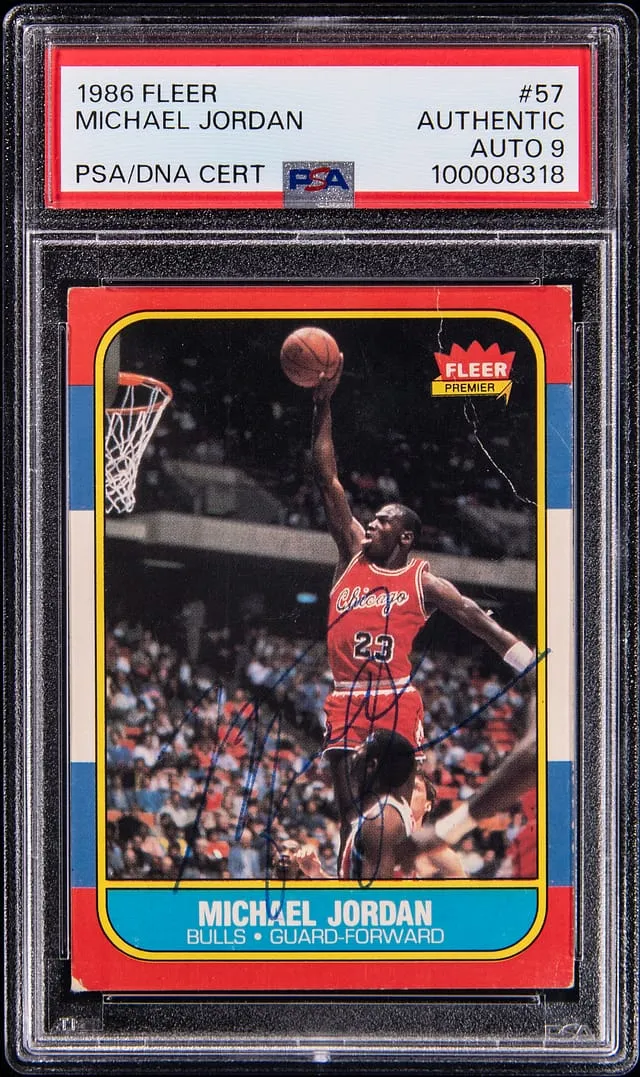
1986 Fleer Michael Jordan Auto Rookie Sells for $54,900
Breakdown of the 1986-87 Fleer #57 Michael Jordan signed rookie card that sold for $54,900 at Goldin on March 15, 2026, and what it means for collectors.
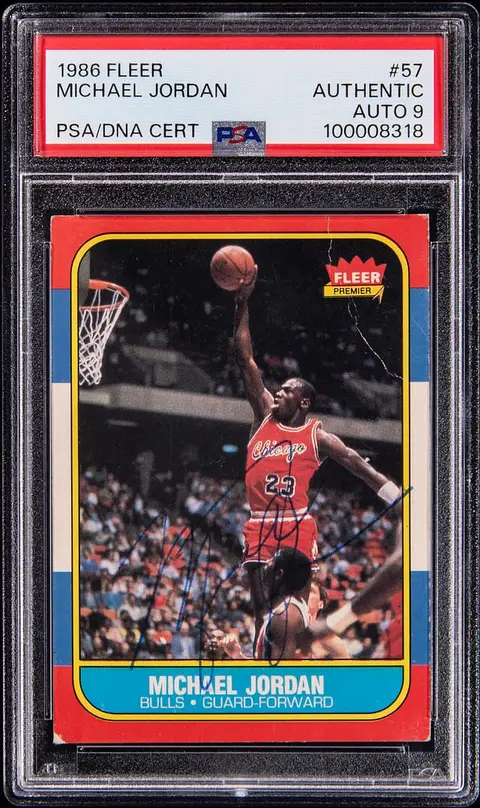
Sold Card
1986-87 Fleer #57 Michael Jordan Signed Rookie Card - PSA Authentic, PSA/DNA MINT 9
Sale Price
Platform
Goldin1986-87 Fleer #57 Michael Jordan Signed Rookie Card – PSA Authentic, PSA/DNA MINT 9
On March 15, 2026, Goldin sold a 1986-87 Fleer #57 Michael Jordan Signed Rookie Card, graded PSA Authentic with a PSA/DNA MINT 9 autograph, for $54,900. For collectors, this is a helpful data point in a market where Jordan’s iconic Fleer rookie remains one of the key measuring sticks for vintage basketball.
In this post, we’ll break down what this card is, why it matters, and how this sale fits into the broader price picture for signed Jordan rookies.
The card at a glance
- Player: Michael Jordan (Chicago Bulls)
- Year: 1986-87
- Set: Fleer Basketball
- Card number: #57
- Type: Flagship rookie card (commonly considered Jordan’s main pack-issued rookie)
- Autograph: On-card signature, authenticated by PSA/DNA
- Card grade: PSA Authentic (card is confirmed genuine but not assigned a numerical condition grade)
- Autograph grade: PSA/DNA MINT 9 (high-grade signature quality)
The 1986-87 Fleer #57 is widely treated as Jordan’s defining rookie card. While there are earlier Star Company issues, the Fleer is the mainstream pack-pulled rookie that anchored 1980s basketball products and still shows up in almost every “all-time” list.
In this case, the card itself is labeled PSA Authentic rather than receiving a number like PSA 7 or PSA 8. That means PSA has confirmed the card is genuine, but did not assign a numerical condition grade (often due to condition, alterations such as trimming, or simply because the submitter chose authentication only). The signature, however, was graded separately by PSA/DNA and received a MINT 9, which places it near the top tier for autograph quality.
Why collectors care about the 1986-87 Fleer Jordan
A cornerstone of 1980s basketball
The 1986-87 Fleer basketball set is one of the hobby’s foundational modern-era releases. It reintroduced mainstream basketball cards in pack form after a gap in widely distributed NBA sets. It also happens to be loaded with Hall of Famers and key rookies, but Jordan’s #57 is the unquestioned headliner.
Collectors value this Jordan for several reasons:
- Flagship rookie status: It’s the most recognized pack-issued rookie for the player many consider the greatest of all time.
- Era significance: The mid-1980s “return” of basketball cards makes this set historically important beyond a single player.
- Set design and nostalgia: The bold red, white, and blue border is instantly recognizable and often associated with classic 1980s hobby culture.
Autographed rookie vs. unsigned copies
The standard, unsigned 1986-87 Fleer Jordan rookie has been heavily tracked and studied for years. Autographed copies add another layer of scarcity and appeal:
- On-card autograph: Jordan’s signature is directly on the original 1986-87 card, not on a later reprint or a sticker-based autograph insert.
- Authenticity and grading separation: PSA authenticates the card and, via PSA/DNA, grades the autograph. A high autograph grade like MINT 9 signals strong eye appeal: bold, clean ink placement, good flow, no visible skips.
Because Fleer never packed these as signed cards, every autographed Jordan rookie exists due to aftermarket signing—private signings, in-person events, or show signings. That means volume is much lower than for modern, pack-inserted autograph cards.
Market context: where does $54,900 fit?
When hobbyists talk about “comps,” they mean comparable recent sales of similar items, used as a reference for current pricing. For a card like this, relevant comps include:
- Other 1986-87 Fleer #57 Jordan rookies signed and authenticated by PSA/DNA, with similar autograph grades (MINT 9 or GEM MINT 10).
- The same card unsigned, in similar card-condition ranges.
Across recent years, the unsigned 1986-87 Fleer Jordan has fluctuated significantly, with PSA 8s, 9s, and 10s varying widely in value during different market cycles. Autographed versions sit in their own lane, influenced by:
- Card condition (when numerically graded)
- Autograph grade
- Signature placement and ink color
- Certification (PSA vs. other grading companies)
This particular copy is PSA Authentic for the card and PSA/DNA MINT 9 for the signature, which typically places it below the very top tier of numerically graded, high-condition signed copies, but comfortably within the group of premium autographed rookies.
At a sale price of $54,900 in a major auction setting (Goldin, March 15, 2026), this result lands in a range that aligns with the idea of a strong, but not record-breaking, outcome for a Jordan rookie auto where the autograph is the main driver of value.
Instead of treating this as a “peak” or “floor,” it’s more useful to view it as a recent reference point for:
- High-grade autographed Jordan rookies where the card itself is not in pristine, numerically graded condition.
- Signed vintage-era flagship rookies authenticated and graded by PSA/DNA.
Autograph grade vs. card grade: why it matters
For newer collectors, it can be confusing to see two different grades on the same slab: one for the card and one for the autograph.
- PSA Authentic (card): Confirms the card is real, but does not state whether it is, for example, EX-MT 6 or NM-MT 8. Collectors often rely on eye appeal or auction descriptions for a sense of condition.
- PSA/DNA MINT 9 (auto): A 1–10 scale just for the signature. A MINT 9 typically means a bold, clean signature with minimal flaws.
Many collectors of signed rookies prioritize the autograph more than the card’s corners or centering, especially on iconic cards from the 1980s. In that sense, the MINT 9 autograph here is the key attribute that supports this level of pricing.
How this sale fits into the broader Jordan rookie picture
A single auction result doesn’t define the market, but it does provide another data point:
- Demand for signed Jordan rookies remains steady. Even as prices for some modern ultra-modern cards move up and down, there is consistent interest in on-card signed copies of key vintage and 1980s issues.
- Authentication continues to matter. PSA/PSA-DNA’s combined slab (card + auto) is widely accepted, which helps establish confidence for buyers and sellers.
- Price tiers are forming more clearly. Unsigned, numerically graded rookies have their own ladder (PSA 5 through PSA 10). Signed copies, especially with high autograph grades, appear to be consolidating into recognizable ranges depending on card eye appeal and inscription details.
What collectors can take away
For newcomers, returning collectors, and small sellers:
- Treat this sale as a reference, not a rule. It’s a helpful benchmark for what a PSA Authentic / PSA-DNA MINT 9 Jordan rookie auto can bring at a major auction, but individual copies will still vary.
- Pay attention to the specifics. The difference between “PSA Authentic / Auto 9” and “PSA 7 / Auto 10” can be material in terms of price, even if both look strong at a glance.
- Use multiple comps where possible. When you evaluate your own card or a potential purchase, look at several recent sales rather than anchoring to a single result.
The role of major auction houses
That this card sold through Goldin on March 15, 2026 (UTC) is part of the context. Large auction platforms tend to:
- Attract a wide audience of serious Jordan collectors.
- Offer detailed descriptions and high-resolution images.
- Create a competitive bidding environment that can surface a realistic, market-driven price.
For many sellers of high-end Jordan rookies, this kind of venue is where they look to establish notable public sales that then inform private deals and future listings.
Final thoughts
The 1986-87 Fleer #57 Michael Jordan Signed Rookie Card remains a centerpiece item for many basketball collectors. While unsigned graded copies are more commonly tracked, this PSA Authentic, PSA/DNA MINT 9 example sold by Goldin on March 15, 2026 adds a clear, recent marker for the signed segment of the market.
For collectors building a Jordan-focused collection or those simply trying to understand how key vintage and 1980s cards behave over time, watching results like this—alongside a range of comparables—offers a grounded way to follow the hobby without relying on predictions or hype.