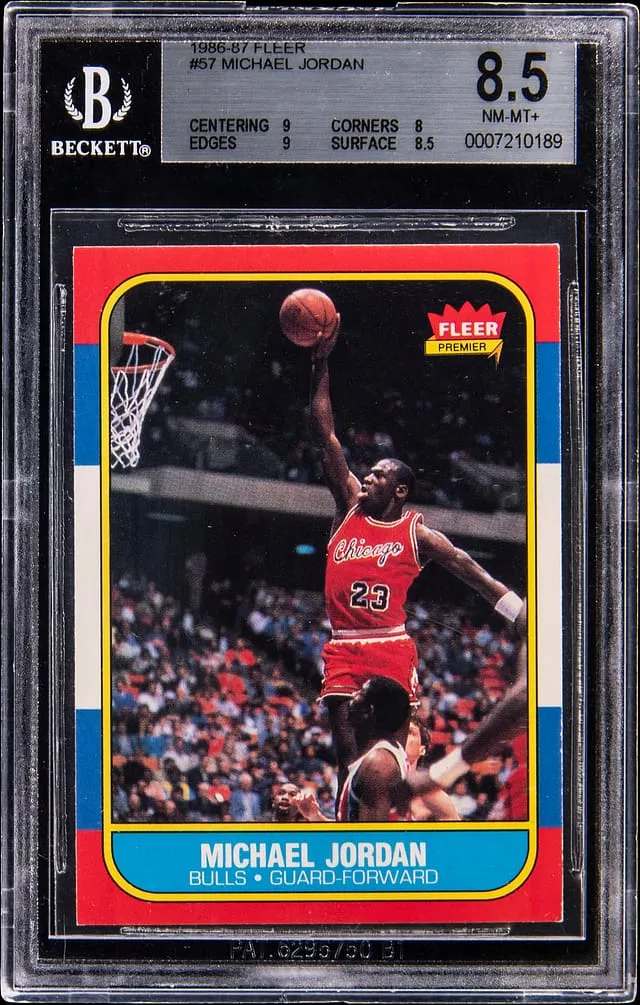
1986-87 Fleer Michael Jordan BGS 8.5 sells for $12K
Goldin sold a 1986-87 Fleer #57 Michael Jordan rookie card BGS 8.5 for $12,289 on May 22, 2026. See how this price fits recent comps and hobby trends.
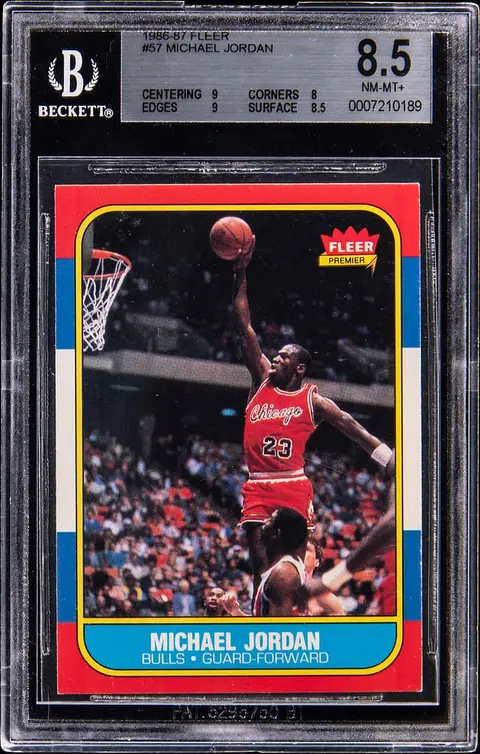
Sold Card
1986-87 Fleer #57 Michael Jordan Rookie Card - BGS NM-MT+ 8.5
Sale Price
Platform
Goldin1986-87 Fleer #57 Michael Jordan Rookie Card (BGS 8.5) Sells for $12,289 at Goldin
On May 22, 2026, Goldin closed the sale of a 1986-87 Fleer #57 Michael Jordan rookie card graded BGS NM-MT+ 8.5 for $12,289. For many collectors, this is the defining basketball card of the modern hobby, so every auction result helps anchor where the market sits.
In this breakdown, we’ll look at what this card is, why it matters, and how this sale fits into recent price trends.
The card at a glance
- Player: Michael Jordan
- Team: Chicago Bulls
- Year / Set: 1986-87 Fleer Basketball
- Card number: #57
- Key status: Widely considered Jordan’s flagship rookie card
- Grading company: Beckett Grading Services (BGS)
- Grade: NM-MT+ 8.5
- Attributes: Standard base rookie (no autograph, no patch, no serial numbering)
The 1986-87 Fleer release is one of the most important basketball sets ever made. It arrived after several years with no major fully licensed NBA card set, so it captured true rookie cards for multiple stars, with Jordan’s #57 leading the checklist.
While Jordan does have earlier regional and niche issues (like Star Company), this Fleer #57 is widely treated as his mainstream, pack-pulled rookie that unified collectors across the hobby.
Why this card matters to collectors
A few key factors keep this card at the center of basketball collecting:
Historic player: Michael Jordan is still the reference point for greatness in basketball. Collectors who came in during the 1980s and 1990s see this card as the cornerstone of modern hoops.
Flagship rookie: In hobby language, a "flagship rookie" is the main, widely recognized rookie card from a major manufacturer. For Jordan, that’s Fleer #57.
Set importance: 1986-87 Fleer is a landmark set. It includes rookies of Jordan, Charles Barkley, Karl Malone, Hakeem Olajuwon, and more. It’s often the starting point for vintage-to-modern basketball collections.
Era and condition challenges: This is considered a "junk wax era" adjacent card—print runs were not truly scarce—but quality control, centering, and storage over decades mean high-grade copies remain relatively tough.
Cross-era demand: Unlike many stars whose markets move mostly with performance, Jordan’s market is driven by legacy, nostalgia, and his place in sports history. That tends to keep interest steady even when hobby sentiment shifts.
Understanding a BGS 8.5 grade
BGS (Beckett Grading Services) uses a 1–10 scale with half-point increments, plus subgrades on centering, corners, edges, and surface. An overall BGS 8.5 (NM-MT+) typically means:
- Very clean overall appearance
- Mild wear on corners or edges
- Possible minor centering or surface issues
It sits between a solid mid-grade collector copy and the high-end investment-level 9s and 9.5s. For many collectors, BGS 8.5 represents a balance between eye appeal and cost.
Price context: where $12,289 fits
This Goldin sale closed at $12,289. To understand that, collectors usually look at “comps”—recent comparable sales of the same card and grade across platforms like Goldin, PWCC, Heritage, and major marketplaces.
While exact numbers move with time and market conditions, the pattern around this card has generally looked like this in recent years:
- PSA 10s (gem mint) are the true headline cards. In peak periods they reached six-figure prices, with some record results well above $700,000 at market highs. More recently, prices have settled into a much lower—but still premium—band compared to the peak.
- BGS 9 / PSA 9 typically form the next tier. They can trade at a significant discount to PSA 10s, but still command strong five-figure prices when demand is healthy.
- BGS 8.5 / PSA 8 usually live in the middle ground: collector-friendly, with prices that reflect condition but are far below top-pop premiums.
Within that structure, a BGS 8.5 around low-to-mid five figures has been a common range in a more balanced market, especially through the post-boom correction phase. The $12,289 result at Goldin:
- Sits comfortably in that low five-figure band many collectors associate with clean but non-gem copies.
- Lines up with the idea that the Jordan rookie has cooled off from boom-era highs but remains a core, liquid card with steady interest.
Because the market moves month to month, it’s helpful to think of this as another data point rather than a precise benchmark. For buyers and sellers, it reinforces that strong but not speculative pricing still exists for iconic cards in solid mid–high grades.
How grading and label differences matter
When digging into comps, it’s worth remembering that not all slabs are treated equally by the market:
- PSA vs BGS: For many vintage and key rookies, PSA often carries a pricing premium at the same numerical grade, partly because of registry competition and brand perception. BGS still commands strong respect, especially with subgrades visible.
- Subgrades within 8.5: A BGS 8.5 with better centering and corners will generally be more desirable than one carried by surface or edges, even at the same overall grade.
- Crossover potential: Some buyers look for BGS 8.5s that might cross to PSA 8 or better. The eye appeal of the specific copy becomes more important than the label alone.
For this particular sale, only the overall grade and the BGS 8.5 label are known, so the price can be viewed as a fair reflection of a presentable, mid–high-grade example.
Collector significance beyond the price
Regardless of day-to-day price shifts, the 1986-87 Fleer Jordan rookie plays a distinct role in collections:
- PC cornerstone: Many collectors call this a “PC goal card”—a long-term personal collection target that anchors a basketball or GOAT-themed display.
- Set-building piece: Complete 1986-87 Fleer sets are still aggressively chased, and Jordan #57 is the clear centerpiece and cost driver.
- Cross-hobby familiarity: Newer collectors who entered via modern Prizm, Exquisite, or ultra-modern inserts still tend to recognize this card as the vintage-style Jordan to own.
Demand is influenced not by current performance (Jordan is long retired) but by:
- Ongoing media exposure (documentaries, retrospectives, NBA anniversaries).
- Nostalgia from collectors who watched him play live.
- The card’s role as a measuring stick for the broader basketball card market.
What this sale might signal
A single auction result is never a forecast, but this $12,289 BGS 8.5 sale at Goldin on May 22, 2026, suggests a few things:
- Stability at key price tiers: The Jordan rookie continues to find buyers at known levels across grades, even after broader hobby corrections.
- Ongoing liquidity: Despite being widely graded, the card still sees frequent transactions at major auction houses, which helps keep pricing discoverable.
- Collector-first positioning: The BGS 8.5 tier in particular looks well suited for collectors who prioritize owning the card itself over label-chasing the very top grades.
For newcomers, that’s useful context: you can follow results in 8, 8.5, and 9 to get a realistic sense of how the hobby values condition for iconic, widely held cards.
Takeaways for different types of hobbyists
If you’re new to collecting:
The 1986-87 Fleer Jordan rookie is a textbook example of how the hobby treats legendary players: the main, pack-issued rookie in a key set becomes the reference card. Watching results in different grades is a good way to learn how condition, grading company, and auction platform influence pricing.
If you’re a returning collector from the 80s/90s:
The raw copies you might remember in shop cases are now parsed heavily by condition and grading. A BGS 8.5 at $12,289 shows how much the market has matured around this card.
If you’re an active hobbyist or small seller:
This sale adds another comp to the BGS 8.5 lane. It’s useful when you’re evaluating raw candidates for grading, deciding where to submit (PSA vs BGS), or setting expectations if you’re consigning a similar copy through an auction house like Goldin.
Final thoughts
The 1986-87 Fleer #57 Michael Jordan rookie remains one of the clearest mirrors of basketball card sentiment. This BGS 8.5 example selling for $12,289 at Goldin on May 22, 2026 reinforces the card’s role as a stable, central piece of the hobby.
For figoca collectors tracking the long arc of key cards, this sale is another reminder that while prices move, the importance of certain issues—like Jordan’s flagship rookie—tends to endure.