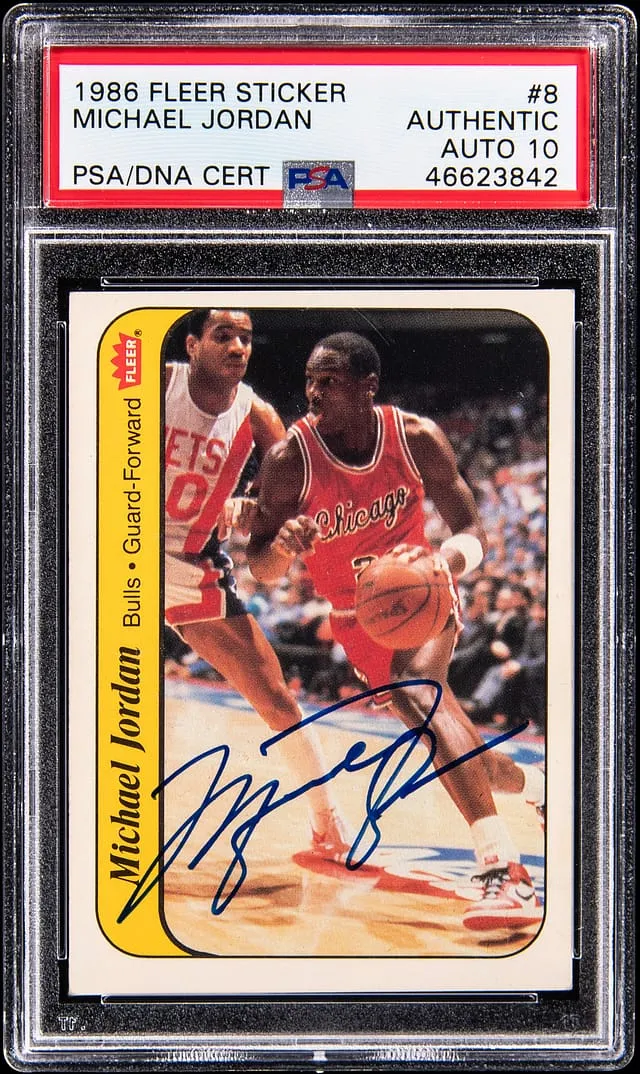
1986-87 Fleer Jordan Signed Sticker Sells for $62K
Goldin sold a PSA Authentic 1986-87 Fleer Sticker #8 Michael Jordan with PSA/DNA GEM MT 10 auto and UDA COA for $62,220. Here’s the market context.
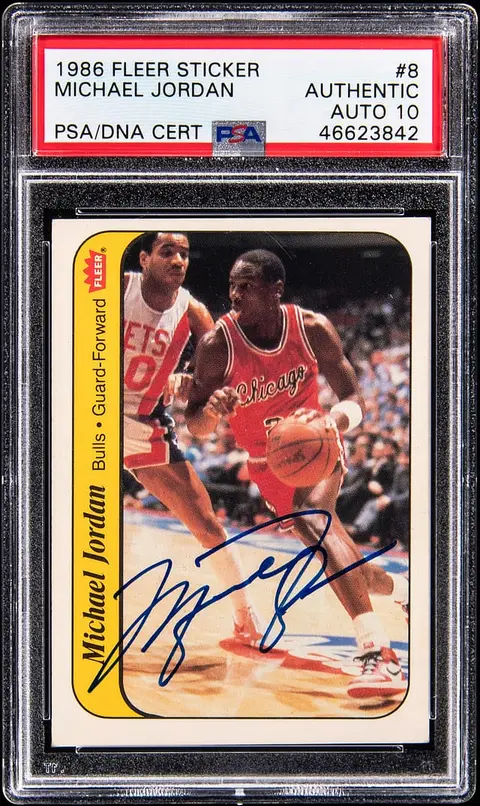
Sold Card
1986-87 Fleer Sticker #8 Michael Jordan Signed Rookie Card - PSA Authentic, PSA/DNA GEM MT 10, UDA COA
Sale Price
Platform
Goldin1986-87 Fleer Sticker #8 Michael Jordan Signed Rookie Card – Market Notes on a $62,220 Sale
On June 7, 2026, Goldin closed a notable sale for a key Michael Jordan piece: a 1986-87 Fleer Sticker #8 Michael Jordan rookie-era card, signed by Jordan, graded PSA Authentic for the card and PSA/DNA GEM MT 10 for the autograph, with an Upper Deck Authenticated (UDA) certificate of authenticity. The final price landed at $62,220.
For collectors who track Jordan’s early issues closely, this result offers a useful data point at the intersection of three powerful factors: the 1986-87 Fleer run, on-card Jordan ink, and high-end autograph grading.
Card breakdown: what exactly sold?
Let’s pin down the card itself:
- Player: Michael Jordan
- Team: Chicago Bulls
- Year / Product: 1986-87 Fleer Sticker insert set
- Card number: #8
- Rookie context: This is Jordan’s first mainstream Fleer sticker from his iconic 1986-87 Fleer rookie year. It’s widely treated as a “rookie-year sticker” companion to the base #57 rookie.
- Attributes:
- On-card autograph by Michael Jordan
- Card graded PSA Authentic (i.e., slabbed and confirmed genuine, but not assigned a numerical card grade)
- Autograph graded PSA/DNA GEM MT 10 (highest standard grade for the sig)
- Upper Deck Authenticated (UDA) COA, which is Jordan’s official signing partner
While the unsigned 1986-87 Fleer Jordan sticker is a classic in its own right, combining this issue with a verified, GEM MT 10 autograph pushes it into a more specialized lane of the Jordan market: authenticated, high-quality signature pieces from his true rookie era.
Why the 1986-87 Fleer sticker matters
The 1986-87 Fleer release is often called the modern foundation set for basketball cards. Jordan’s base #57 rookie is the headliner, but the 11-card sticker insert set—led by Jordan’s #8—has become a key parallel track for collectors.
People care about the Jordan sticker because:
- It’s part of the same landmark release as his flagship rookie.
- Stickers are usually tougher in high grade due to centering, edges, and the nature of sticker stock.
- It offers an accessible but historically significant companion to the base #57 for collectors building 1986-87 Fleer runs.
When you add a verified Jordan autograph on top of that, you’re no longer comparing it directly to unsigned sticker comps alone—you’re looking at a hybrid of early-issue significance and premium autograph content.
Grading, signatures, and UDA
There are three layers of authentication/quality to consider in this card:
PSA Authentic (card):
- PSA is confirming the card itself is genuine and encapsulating it, but not assigning a numeric grade (e.g., PSA 6, PSA 8).
- For some collectors, especially with signed rookie-era pieces, the focus shifts from the card grade to the overall eye appeal and the quality of the autograph.
PSA/DNA GEM MT 10 (autograph):
- PSA/DNA is PSA’s autograph authentication and grading arm.
- A GEM MT 10 grade indicates a clean, bold, well-placed signature with no apparent flaws.
- For autograph-focused collectors, this is the top outcome and can be a major price driver.
UDA COA (Upper Deck Authenticated):
- UDA has long been Jordan’s official autograph partner. Their COA is an additional layer of confidence that the signature is legitimate and properly witnessed or tracked.
- A combination of UDA plus PSA/DNA GEM MT 10 is effectively a “belt and suspenders” authentication package—an attractive detail for buyers who value certainty.
Recent market context and comparable sales
Within the Jordan market, there are a few relevant comparison lanes for this card:
Unsigned 1986-87 Fleer Jordan stickers
- Numerically graded, unsigned stickers can vary widely in price depending on condition.
- High-end examples (PSA 9s and PSA 10s) command a premium due to the well-known difficulty of centering and surface on this insert.
- These comps help set a baseline for the raw card component but do not capture the autograph premium.
Signed 1986-87 Fleer Jordan stickers (various grades)
- Sales data for signed stickers spans a broad range, influenced by:
- Whether the card is numerically graded or simply “Authentic.”
- Autograph grade (e.g., PSA/DNA 9 vs. GEM MT 10).
- Presence or absence of UDA documentation.
- Recent publicly visible comps in this category (across major auction houses and marketplaces) tend to fall somewhere in the mid-five-figures range for strong examples, with top-tier combinations (clean card, GEM MT 10 auto, strong provenance) moving into the higher five figures and occasionally beyond.
- Sales data for signed stickers spans a broad range, influenced by:
Signed 1986-87 Fleer Jordan base rookies (card #57)
- While not the same card, the signed base rookie is the closest cousin from a market-structure standpoint.
- In strong autograph grades, these can reach well into the five-figure and six-figure territory, especially when paired with high numeric card grades.
At $62,220, this Goldin result sits in the upper band of what’s generally seen for strong signed 1986-87 Fleer Jordan stickers. The combination of:
- PSA/DNA GEM MT 10 autograph,
- UDA COA,
- and the overall presentation as an authenticated, slabbed rookie-year piece
helps explain why the sale landed at this level versus more modest signed examples that might lack one or more of these attributes.
How this sale fits into the broader Jordan market
Jordan’s market has matured into a layered ecosystem:
- Flagship unsigned rookies (especially the 1986-87 Fleer #57 base)
- Key inserts and parallels from the 1990s
- On-card autographs, particularly those from early or iconic sets
- Game-used memorabilia cards
This card sits in a niche that combines two of those layers:
- Rookie-era core issue (the 1986-87 Fleer sticker)
- Premium on-card autograph content with top-tier grading
For collectors tracking long-term patterns rather than single spikes, a sale like this serves as another reference point for the value of early Jordan autographed pieces relative to:
- Unsigned high-grade copies of the same card
- Signed copies of his base rookie
- Later Upper Deck autograph issues that may be more plentiful but lack the true rookie-year context
What collectors can take away from this sale
For newcomers and returning collectors, here are a few practical observations:
Autograph grade matters
- A PSA/DNA GEM MT 10 grade is not just a line on the label. It can materially separate a card from other signed copies with lower grades or no autograph grade at all.
Authentication stack builds confidence
- PSA encapsulation plus PSA/DNA plus UDA COA creates a high-confidence package. That confidence can support stronger bidding in auction settings.
Card grade vs. autograph focus
- In the signed rookie-era Jordan lane, some buyers prioritize the autograph quality and overall presentation more than a numeric card grade.
- That’s why a PSA Authentic card with a GEM MT 10 auto and strong provenance can still command a five-figure-plus result.
1986-87 Fleer continues to anchor the market
- Even as modern and ultra-modern cards with patches, serial numbers, and flashy designs come and go, the 1986-87 Fleer run remains a central reference point for basketball collectors.
How this might guide your own collecting
This article is not financial advice, but there are a few ways to use a sale like this to refine your own approach:
If you collect Jordan:
- Decide whether you prioritize unsigned flagship rookies, signed rookie-era pieces, or later autograph issues.
- Use sales like this to benchmark the premium that signed pieces with GEM MT 10 autographs and strong authentication can command over unsigned or lower-grade autograph examples.
If you’re newer to the hobby:
- Study how condition, autograph quality, and authentication layers interact to shape prices.
- Compare multiple recent sales—"comps"—instead of relying on a single record. Comps are simply comparable recent transactions that help you understand a reasonable range for a card.
If you sell occasionally:
- When you have a premium autograph piece, consider whether having both an autograph grade and robust authentication (PSA, UDA, etc.) could expand your potential buyer pool and support stronger auction interest.
Closing thoughts
The June 7, 2026 Goldin sale of the 1986-87 Fleer Sticker #8 Michael Jordan signed rookie-era card at $62,220 is a meaningful data point in a mature, well-watched segment of the hobby. It underscores the ongoing demand for early Jordan pieces that combine true-era significance with high-end signature presentation.
For collectors, this result doesn’t rewrite the Jordan market, but it does refine the picture: rookie-year signed stickers with top-tier autograph grades and strong provenance continue to be treated as serious, premium items alongside the more famous base rookie.
As always, the most useful way to engage with sales like this is as reference material, not a prediction—another marker on the path of how the hobby values one of basketball’s most important cards and signatures.