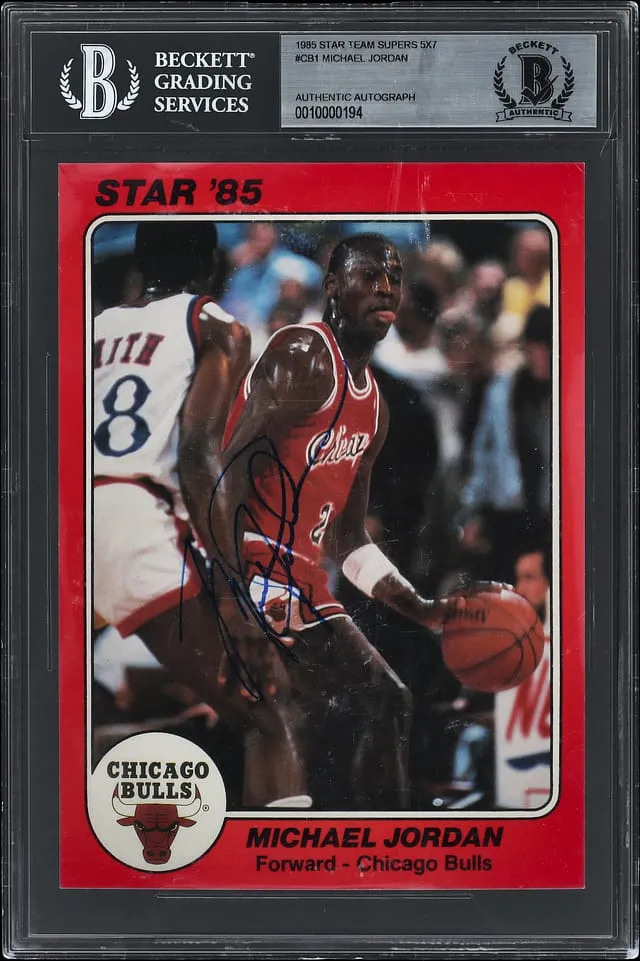
1985 Star Team Supers Jordan Auto Sells for $27.8K
Goldin sold a 1985 Star Team Supers 5x7 #1 Michael Jordan signed rookie-era card for $27,755. A fresh data point for early Jordan Star autographs.
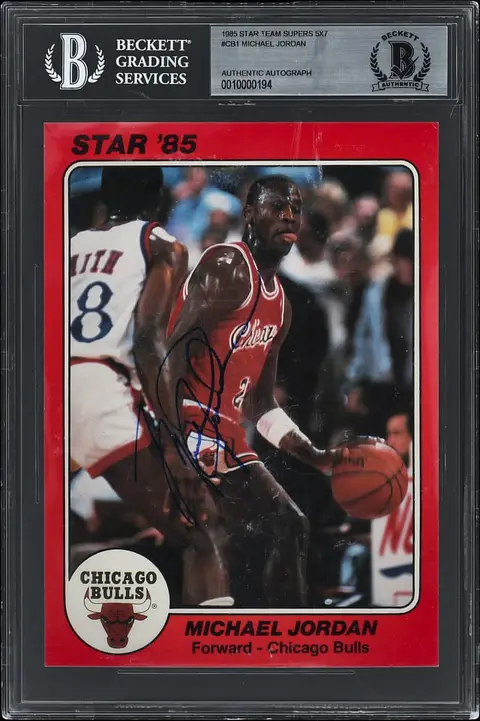
Sold Card
1985 Star Team Supers 5 x 7 #1 Michael Jordan Signed Rookie Card - BGS Authentic, Beckett Authentic
Sale Price
Platform
GoldinThe 1985 Star Team Supers 5 x 7 #1 Michael Jordan Signed Rookie Card just recorded a notable auction result, offering another data point for collectors who track early Jordan issues.
In March 2026, Goldin sold a 1985 Star Team Supers 5 x 7 #1 Michael Jordan Signed Rookie Card for $27,755. The card was authenticated by Beckett (noted as “BGS Authentic” / “Beckett Authentic”), confirming the originality of both the card and Michael Jordan’s signature.
Below is a breakdown of what this card is, why it matters, and how this sale fits into recent price context for similar Jordan pieces.
Card overview: what exactly sold?
- Player: Michael Jordan
- Team: Chicago Bulls
- Year: 1985
- Set: Star Company – Team Supers 5 x 7 (oversized issue)
- Card number: #1
- Type: Early Michael Jordan Star issue from his rookie-era; this oversized card is often treated as a key companion to his core Star releases
- Attributes: On-card autograph authenticated by Beckett
- Grading / authentication: BGS / Beckett Authentic (card and auto authenticated; no numerical grade on the slab)
- Auction house: Goldin
- Sale date (UTC): 2026-03-15
- Sale price: $27,755
This is an oversized 5" x 7" Star Company release rather than a standard 2.5" x 3.5" base card. The autograph is signed directly on the card (often called an “on-card auto”), and Beckett has encapsulated it as authentic.
Why the 1985 Star Team Supers Jordan matters
Early Star-era Jordan
For many collectors, the mid-1980s Star Company issues represent Michael Jordan’s true early Bulls cards. While the 1986–87 Fleer is widely recognized as his flagship mainstream rookie, Star’s 1984–85 and 1985 releases are earlier and were distributed very differently—often in team bags or specialty sets rather than wax packs.
The 1985 Team Supers set added an oversized, premium feel to those early Bulls-era images. For collectors building a more complete early Jordan run, this 5 x 7 Star Team Supers card is a recognizable piece alongside:
- 1984–85 Star #101 (often labeled his Star “XRC” or extended rookie)
- 1984–85 Star subsets (Rookie of the Year, Court Kings, etc.)
- 1985 Star additional Bulls and team-focused issues
Autographed and authenticated
Unsigned 1985 Star Team Supers Jordans are already niche items due to their distribution and condition sensitivity (oversized cards are easily damaged). Adding an authenticated on-card signature shifts the card into a different lane:
- The value is driven by both the underlying early Jordan issue and the authenticity and presentation of the autograph.
- Beckett’s “Authentic” label confirms the signature and card origin, even though there is no numeric grade attached.
For collectors who prioritize early-era signatures rather than later pack-issued autographs, these early Star signed pieces hold special interest.
Market context and comps
In hobby language, “comps” are comparable recent sales used as reference points. For a card like this, true one-to-one comps can be limited, so collectors often look at:
- Other 1985 Star Team Supers Jordan signed examples (across Beckett, PSA, or JSA authentication where available).
- Unsigned 1985 Star Team Supers Jordans in graded holders.
- Other early Jordan Star autographs from roughly the same period.
Across major marketplaces and auction houses, these patterns have been visible in recent years:
- Unsigned, graded 1985 Star Team Supers Jordan cards can sell at a fraction of fully authenticated signed versions. The premium comes from the autograph plus trusted authentication.
- Signed early Star Jordans—including various 1984–85 and 1985 Star issues—have shown a wide range of realized prices depending on:
- Eye appeal of the autograph (boldness, placement, color)
- Whether the auto itself is graded
- Slabbing company (Beckett, PSA, etc.)
- Any additional notation (for example, inscriptions) or provenance
Against that backdrop, the $27,755 Goldin result on March 15, 2026, lands in a range that fits a serious, but not extreme, price tier for an authenticated early Jordan Star autograph on a recognizable issue.
Because exact same-card/ same-holder comps for this precise configuration (1985 Star Team Supers 5 x 7 #1, Jordan, signed, Beckett Authentic) are relatively thin, collectors generally view each new sale as another reference point rather than a firm benchmark. The most practical use of this sale is as one more data anchor when you line it up with:
- Other early Jordan Star signed cards
- Other oversized Jordan autographs from the mid-to-late 1980s
- Modern pack-issued Jordan autos (where available) that occupy similar price brackets
Set characteristics and scarcity factors
Star Company distribution
Star Company products from the mid-1980s were not released in the same way as mainstream wax-pack issues. They were often:
- Sold as team or subset bags
- Distributed through hobby channels rather than mass retail
That distribution model, coupled with later concerns about reprints and counterfeit Star cards in the hobby, has made third-party authentication critical. This is part of why Beckett, PSA, and other graders play such a large role in the perceived security of Star-era Jordans.
Oversized condition challenges
The 5 x 7 format introduces specific condition and storage issues:
- Corners and edges are more vulnerable than on a standard-size card.
- Many examples were not stored in rigid top loaders or sleeves sized for 5 x 7, leading to bends or edge wear.
Even though this particular card is labeled as “Authentic” rather than carrying a numerical grade, the eye appeal of both the card and autograph still matters to most buyers.
Collector significance
From a collector’s perspective, this card sits at the intersection of several themes:
- Era: It is a mid-1980s, pre-mainstream Jordan issue—what many would group into the “early Star era” rather than the junk wax explosion that followed later in the decade.
- Player: Michael Jordan remains the central figure in basketball card collecting, and demand for his key early pieces tends to be resilient over time.
- Format: The oversized 5 x 7 format separates this from core rookie cards. It is more of a premium companion or display piece than a checklist cornerstone.
- Autograph: Early, on-card signatures tied directly to playing-days images continue to hold appeal, especially when encapsulated and authenticated.
For newer collectors, it is useful to differentiate between:
- Flagship rookies (such as the 1986–87 Fleer #57 Jordan), which most collectors treat as the main base rookie.
- Extended rookie / early issues (like Star Company Jordans), which predate or sit just around his widely accepted rookie but weren’t mass-distributed in the same way.
This 1985 Star Team Supers signed card belongs more in the second category—an important early-era, niche-format Jordan piece that adds depth to a collection rather than serving as the universal cornerstone.
How this Goldin sale fits into the broader picture
The March 15, 2026 Goldin sale at $27,755 confirms a few ongoing themes for the Jordan market:
Continued respect for authenticated early Star autographs
Even as the hobby’s attention cycles through modern rookies and ultra-modern parallels, early Jordan autos tied to Star issues continue to find strong bidders when properly authenticated.Importance of clear authentication
With Star, collectors focus heavily on credible third-party verification. A Beckett Authentic slab reduces a major area of uncertainty for buyers, which in turn supports realized prices.Data point rather than a hard benchmark
Because exact comps for this exact configuration are not plentiful, this sale should be viewed as part of a range. Collectors assembling pricing views will typically place it alongside:- Other recent early Jordan Star autos
- Oversized Jordan autographs from similar years
- Key modern Jordan auto sales that occupy similar price territory
Takeaways for collectors and small sellers
For collectors:
- If you collect Jordan’s early career, this card is a meaningful but specialized piece—especially appealing if you value oversized displays and on-card signatures.
- When reviewing potential purchases, pay close attention to:
- Authentication company and label
- The look of the signature (centered, bold, smudge-free or not)
- Any Star-related authenticity notes from trusted hobby references
For small sellers:
- Sales like this highlight how niche, authenticated items can realize strong results even when they sit outside the standard rookie card lanes.
- Detailed listing data—mentioning the Star set, oversized 5 x 7 format, early Bulls context, and Beckett Authentic designation—helps buyers understand what they are looking at.
As always, individual cards can sell above or below recent sales depending on timing, eye appeal, and who shows up in a given auction. The Goldin result on March 15, 2026, adds another useful reference point for anyone tracking the market for early Michael Jordan Star autographs, especially in the distinctive 1985 Team Supers 5 x 7 format.