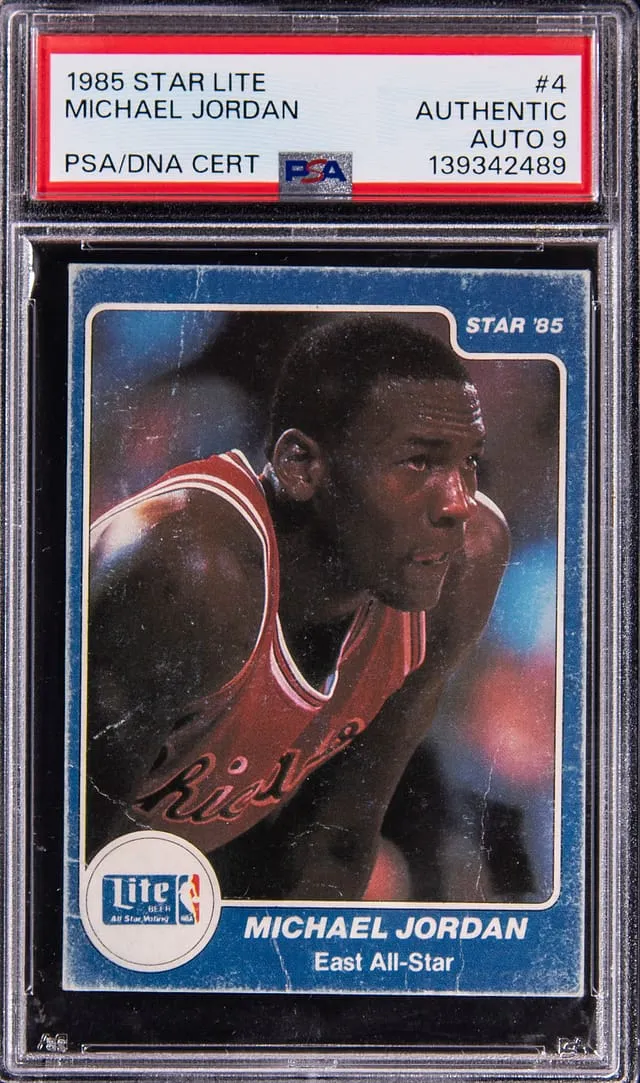
1985 Star Lite All-Stars Jordan Auto Sold for $13.5K
Breakdown of Goldin’s $13,542 sale of a 1985 Star Lite All-Stars #4 Michael Jordan signed rookie-era card, PSA Authentic with PSA/DNA MINT 9 auto.
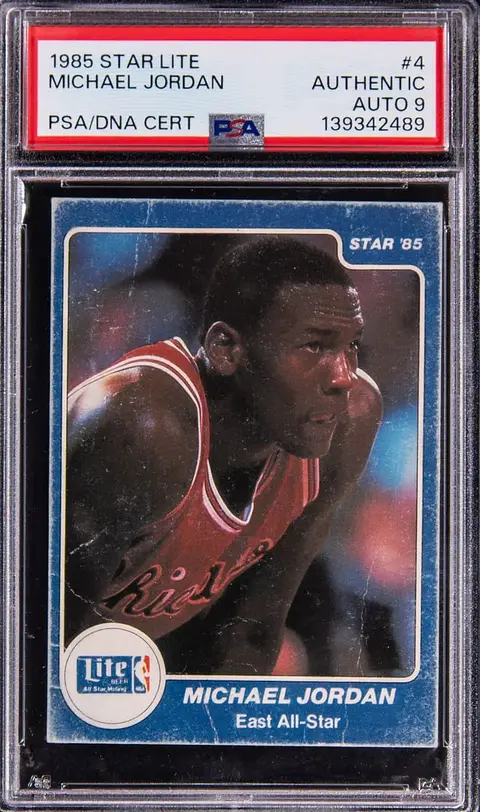
Sold Card
1985 Star Lite All-Stars #4 Michael Jordan Signed, Inscribed Rookie Card - PSA Authentic, PSA/DNA MINT 9
Sale Price
Platform
Goldin1985 Star Lite All-Stars #4 Michael Jordan Signed Rookie: What This $13,542 Sale Tells Us
On March 15, 2026, Goldin sold a 1985 Star Lite All-Stars #4 Michael Jordan Signed, Inscribed Rookie Card for $13,542. Slabbed by PSA as “Authentic” for the card and PSA/DNA MINT 9 for the autograph, this piece sits at the intersection of three important lanes in the Jordan market: Star Company issues, early-career MJ, and high-grade on-card signatures.
For newer collectors and returning hobbyists, this sale is a useful case study in how the market treats non-1986 Fleer Jordan rookies, Star cards in particular, and autographed vintage/early-issue pieces.
The Card: 1985 Star Lite All-Stars #4 Michael Jordan
Key details:
- Player: Michael Jordan
- Team: Chicago Bulls
- Year: 1985
- Set: Star Lite All-Stars
- Card number: #4
- Type: Early-career Star Company issue, widely treated by collectors as a “rookie-year/rookie-era” card rather than the main flagship rookie
- Attributes: On-card autograph with inscription
- Grading: PSA Authentic (card), PSA/DNA MINT 9 (autograph)
The 1985 Star Lite All-Stars release is a regional-leaning and hobby-distributed Star Company set that came out before Jordan’s iconic 1986 Fleer #57. While Fleer is considered the mainstream, pack-issued flagship rookie, Star’s various Jordan cards (1984–1986) are important to collectors who focus on early MJ and niche 1980s issues.
This specific copy is not just a raw Star card: it’s signed and inscribed by Jordan, with PSA/DNA grading the autograph MINT 9. In the autograph world, a MINT 9 grade generally indicates a clean, bold, well-placed signature with no major skips or smudges.
Why Star Company Jordan Cards Matter
Star Company produced NBA-licensed cards in the mid-1980s, before Fleer’s 1986 return to the basketball market. Their Jordan issues are significant because they capture MJ before his hobby “breakout” in Fleer.
Collectors pay attention to Star Jordan cards for a few reasons:
- Early timeline: Many Star Jordans pre-date or sit alongside the 1986 Fleer rookie, giving a closer look at his true early days.
- Smaller print and distribution: These sets were not mass-packed in the same way as late-1980s and 1990s products. Distribution was often hobby-oriented and regional.
- Condition challenges: Production and storage from that era can make high-grade examples tougher than many junk-wax cards.
The Star Lite All-Stars subset is not the most famous of the Star Jordan run (the 1984–85 Star #101 is usually the headliner), but it’s still a recognized early Jordan card. Adding an authenticated, high-grade autograph on top of that moves the card into a more premium niche.
Autograph and Inscription: Why the PSA/DNA MINT 9 Matters
Not all signed vintage or early-era cards are equal in the market. Collectors tend to sort them into:
- Raw autographs: Signed but not authenticated or graded.
- Authenticated only: The autograph is confirmed as real, but no grade is given.
- Graded autographs: The ink itself is graded on a scale (often 1–10). Higher grades usually indicate stronger eye appeal.
In this case, PSA/DNA graded Jordan’s signature a MINT 9 and labeled the card itself as Authentic. That means the autograph is considered high-end in quality, even if the card isn’t receiving a numeric grade.
Inscriptions (such as a jersey number, a brief note, or a personalization) can sometimes increase collector interest. They aren’t universally preferred—some buyers want a clean signature only—but in many PC (“personal collection”) builds, a unique inscription is seen as an extra layer of character.
Market Context: Where Does $13,542 Fit?
This Goldin result of $13,542 (price in USD after converting from 1,354,200 cents) needs to be seen against a few baselines:
1986 Fleer Jordan autograph comps
Autographed 1986 Fleer Jordan rookies with strong autograph grades (often 9 or 10) and a decent card grade can range well above this Star Lite All-Stars sale, depending on condition and eye appeal. Those cards, however, are the flagship rookie and live in a different price tier.Other Star Jordan signed issues
Signed Star Jordan cards vary significantly in price by specific card, population, and eye appeal. High-profile Star Jordans (like the 1984–85 #101) with premium autographs tend to command stronger numbers. More niche Star subsets, including Lite All-Stars, usually trade at a discount to the very top Star Jordan cards.Unsigned Star Lite All-Stars #4 Jordans
Unsigned, graded copies of this card generally sell at a much lower level than this result, reflecting the premium collectors place on a verified, high-grade MJ autograph layered on an early-career issue.
Recent public auction results for this exact combination—1985 Star Lite All-Stars #4, Jordan, signed and inscribed, PSA Authentic with PSA/DNA MINT 9—are relatively thin. That makes one-to-one “comps” (short for comparables, or recent similar sales used as reference) limited. Instead, auction houses and buyers likely leaned on nearby data: other signed Star Jordans, autograph-only Jordan pieces from the mid-1980s, and the broader autographed MJ rookie/rookie-era market.
Given that context, this $13,542 sale sits in a mid-range niche: clearly above unsigned Star copies, below the very top Jordan rookie and Star grails, and roughly in line with what experienced collectors might expect for a strong autograph on a secondary-but-respected early MJ issue.
Why Collectors Care About This Card
A few themes help explain the appeal of this specific example:
- Early Jordan window: Anything from Jordan’s first few NBA seasons draws attention, especially when it’s not just another mass-produced card from the late 1980s and 1990s.
- Star-era mystique: Star Company’s run has always sat slightly off to the side of the mainstream. That gives these cards a certain “specialist” appeal—knowledgeable collectors often enjoy digging into the nuances of sets like Lite All-Stars.
- Autographed vintage and early issues: The hobby has increasingly differentiated between modern pack-issued autographs and true on-card signatures applied years later to earlier cards. The latter often feel closer to memorabilia than to pure trading cards.
- Graded, authenticated signature: PSA/DNA’s MINT 9 label provides a form of quality assurance that many buyers look for now, especially at four- and five-figure price levels.
Era and Scarcity Considerations
The mid-1980s predate what hobbyists often call the “junk wax era” (the heavily overproduced late 1980s–early 1990s). Star cards don’t share the same mass-print levels as some later sets, and the way they were distributed adds to the difficulty of finding well-preserved copies.
Additionally, not every surviving Star Jordan has been signed, and not every signed copy has passed authentication with a strong grade. That creates layered scarcity:
- Fewer total surviving Star Lite All-Stars MJ cards than mass-era products.
- A smaller subset of those that are signed.
- A smaller subset still that carry a PSA/DNA MINT 9 autograph grade.
Population reports (“pop reports”) from grading companies track how many copies of a specific card and grade exist in their holders. While full, precise population numbers for this exact signed-and-graded configuration are limited in public tools, the general pattern in the Jordan autograph market is clear: high-grade autographs on key early issues do not surface constantly.
Could Recent Hobby or MJ News Be a Factor?
Jordan’s legacy is well-established by now. Most of the demand for pieces like this is driven less by current events and more by long-term collector interest in MJ as one of the defining figures in basketball history.
Occasional boosts in attention can come from:
- Documentaries and media (such as renewed interest after "The Last Dance")
- Hall of Fame anniversaries or NBA milestone celebrations
- Broader waves of interest in 1980s and 1990s basketball collecting
However, this specific Goldin sale appears to fit within the ongoing trend of collectors targeting:
- earlier-career MJ pieces, and
- authenticated, high-quality on-card autographs.
How Collectors Might Use This Sale as a Reference
For hobbyists and small sellers, this $13,542 Goldin result on March 15, 2026 serves as a reference point, not a guarantee of future values. It can help in a few ways:
Benchmarking: If you own a similar Star Jordan card (signed or unsigned), you can use this sale as one data point when evaluating where your card might fit in the broader hierarchy, while remembering that grade, inscription, centering, and eye appeal always matter.
Understanding the autograph premium: Comparing this price to recent sales of unsigned Star Lite All-Stars Jordans gives a rough sense of what the market is currently willing to pay for a PSA/DNA MINT 9 MJ autograph on an early card.
Context for other Star issues: Even if you focus more on 1984–85 Star #101 or other Star subsets, this sale adds to the overall picture of how collectors are valuing signed Star-era Jordan cards.
Takeaways
- The card is a 1985 Star Lite All-Stars #4 Michael Jordan, signed and inscribed, graded PSA Authentic with a PSA/DNA MINT 9 autograph.
- It sold at Goldin on March 15, 2026 for $13,542.
- This result sits below the elite tier of Jordan’s flagship rookie autographs but comfortably above unsigned Star counterparts, reflecting the premium on authenticated, high-quality MJ signatures on early cards.
- For collectors, the sale reinforces ongoing interest in Star-era Jordans, especially when they combine early-career photography with strong autograph grades.
As always, this is one sale in an evolving market. It helps map the current landscape for Jordan collectors, but it’s best used alongside other recent results and your own collecting goals rather than as a prediction of what any single card "should" be worth.