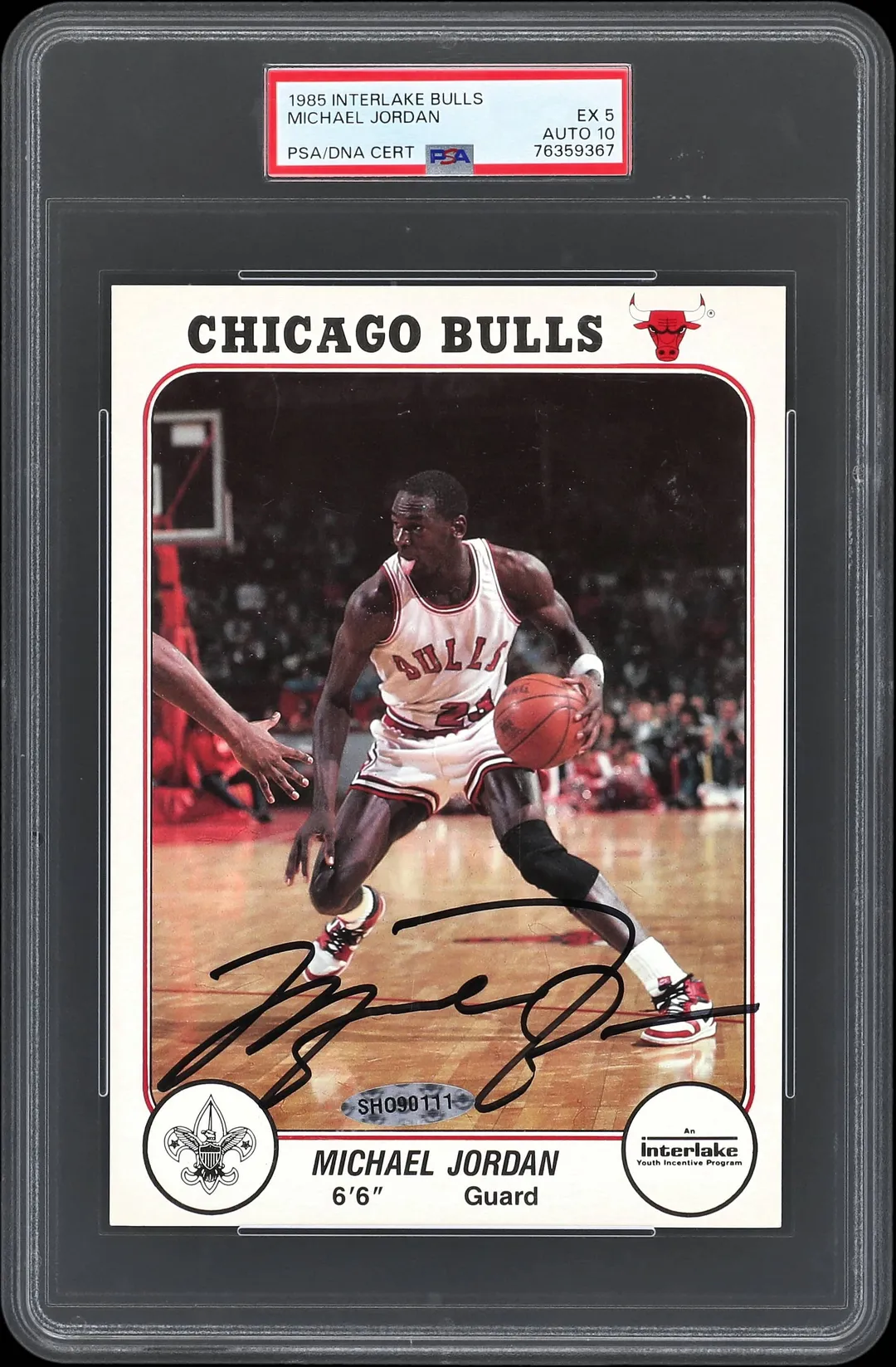
1985 Interlake Michael Jordan Auto Sells for $67,710
Breaking down Goldin’s $67,710 sale of a 1985 Interlake Bulls Michael Jordan signed card, PSA 5 with a PSA/DNA 10 auto and UDA provenance.
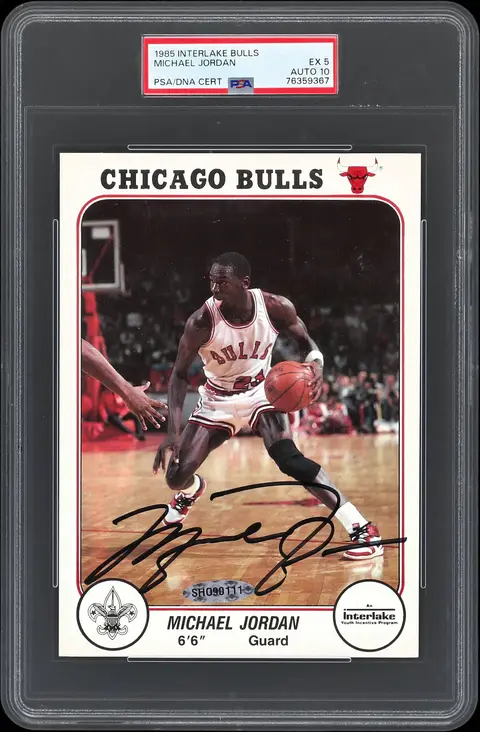
Sold Card
1985 Interlake Bulls Michael Jordan Signed Card - PSA EX 5, PSA/DNA GEM MT 10, UDA
Sale Price
Platform
GoldinThe 1985 Interlake Bulls Michael Jordan signed card has long sat in a unique lane of Jordan collecting: pre-rookie, regional, and autographed. On February 8, 2026, Goldin sold a PSA EX 5 copy with a PSA/DNA GEM MT 10 autograph and Upper Deck Authenticated (UDA) provenance for $67,710, a result that helps clarify where this issue currently sits in the broader Jordan market.
What exactly is this card?
- Player: Michael Jordan
- Team: Chicago Bulls
- Year: 1985
- Set: Interlake Bulls (regional promotional issue)
- Card status: Widely treated as a pre-rookie/early Bulls card rather than a mainstream rookie
- Autograph: On-card, blue ink, PSA/DNA GEM MT 10 (highest auto grade)
- Card grade: PSA EX 5 (Excellent)
- Additional authentication: Upper Deck Authenticated (UDA)
The 1985 Interlake Bulls card is a regional release distributed around the Chicago area, often described as a promo piece tied to the Interlake Youth Incentive Program. Because it predates Jordan’s 1986–87 Fleer rookie, many collectors treat it as one of his earliest Bulls issues.
Most surviving examples show handling wear: light corner rounding, edge chipping, and surface marks are common. As a result, high-grade copies are scarce. Autographed examples introduce another layer of rarity, particularly when the signature is bold and well-centered.
Why collectors care about the 1985 Interlake Jordan
This card matters for several overlapping reasons:
Pre-rookie status:
It captures Jordan right at the start of his Bulls tenure, before the mainstream rookie cards appeared. For collectors who like origin stories and early images, that timeline matters.Regional and low-distribution:
Unlike national products from Topps, Fleer, or later Upper Deck, the Interlake was a local handout. That typically means fewer surviving copies and a wider range of condition.On-card signature with dual authentication:
The combination of PSA card grading, PSA/DNA autograph grading, and UDA provenance is important. PSA/DNA GEM MT 10 indicates the autograph itself is virtually flawless, and UDA adds another layer of comfort around authenticity and chain of custody.Jordan’s broader market role:
Michael Jordan remains the central figure in basketball card collecting. Early, distinctive, and authenticated pieces like this sit in a long-term lane of interest, even when broader hobby cycles move up and down.
Understanding the grades: PSA EX 5 and PSA/DNA GEM MT 10
PSA EX 5 (Excellent):
A PSA 5 shows moderate wear: visible corner softness, small surface marks, and light creasing or printing flaws can be present. For a mid-1980s regional card that wasn’t treated as a collectible at the time, a 5 is very much in the “respectable, presentable” range.PSA/DNA GEM MT 10 Autograph:
This is the highest auto grade PSA assigns. It signals a strong, clean, well-struck signature without noticeable smearing, fading, or skips. With autograph cards, many collectors will accept a lower card grade when the signature quality is elite.
Market context and recent sales
When collectors talk about “comps,” they mean comparable recent sales that help frame where a card currently trades. For this specific card, the most useful comps are:
- Other 1985 Interlake Bulls Jordan cards with both card and auto graded.
- Copies with similar card grades (PSA 4–6) and high autograph grades (PSA/DNA 9–10).
- Higher or lower graded Interlake autos to see how condition affects price.
Across major auction houses and marketplaces over the past couple of years, signed Interlake Jordans with third-party authentication have tended to:
- Trade well below the six-figure range unless the card grade is especially high (for example, PSA 8 or better) or the piece has some unique provenance.
- Show a steep curve between mid-grade and high-grade cards, both in terms of card condition and autograph grade.
Against that backdrop, the $67,710 Goldin result for a PSA 5 / PSA/DNA 10 / UDA copy lands in what can reasonably be described as the upper range for mid-grade signed Interlakes, but still short of the major record prices seen for top-condition copies or for Jordan’s key mainstream rookies.
Because this is a relatively niche regional issue, the population (or “pop report”—the number of graded copies recorded by PSA and other graders) remains modest compared to mass-release cards. That low population means there are fewer direct head-to-head comps than you might see for a standard 1986 Fleer Jordan.
How this sale fits into the Jordan market
Jordan’s market has gone through multiple cycles:
- A strong run-up in the late 2010s and early 2020s,
- A correction as speculative money left the hobby,
- A more selective environment where unique, historically meaningful, and well-documented pieces have tended to hold better than more common cards.
Within this environment, the 1985 Interlake sits in a niche between:
- Core flagship rookies (like the 1986 Fleer and its key parallels), and
- Later premium inserts and autographs from the late 1990s and 2000s.
This Goldin sale suggests that:
- Collectors remain willing to pay a meaningful premium for early, authenticated, on-card auto Jordans with strong provenance.
- Even in mid card grades, a GEM MT 10 autograph and UDA backing can command serious attention.
- The card continues to be treated as a significant early Jordan issue, but not necessarily in the same pricing tier as his most iconic rookie and high-end insert cards.
What newcomers and returning collectors can take from this
If you’re newer to the hobby or just getting back in, this sale highlights a few practical points:
Grade the card and the autograph separately in your mind.
A PSA 5 card might sound low at first, but when the autograph is a PSA/DNA GEM MT 10 and the piece has UDA provenance, the overall package can be quite desirable.Understand regional and pre-rookie issues.
Not every early Jordan card is a true “rookie card” in the traditional sense. The Interlake is better understood as a pre-rookie regional issue—important to many collectors, but in a different category from his mainstream NBA-licensed rookies.Use comps as context, not guarantees.
Recent sales help you understand the current range, but they’re not promises about future prices. Condition details, auction timing, and who happens to be bidding all matter.Authentication layers matter for autos.
For signed vintage or pre-rookie pieces, collectors often look for:- A reliable grading company (PSA, BGS, SGC, etc.),
- A clear autograph grade, and
- Additional provenance from a recognized source like UDA.
Final thoughts
The February 8, 2026 Goldin sale of the 1985 Interlake Bulls Michael Jordan Signed Card – PSA EX 5, PSA/DNA GEM MT 10, UDA at $67,710 reinforces how this early regional issue fits into the modern Jordan landscape.
It remains:
- A serious target for advanced Jordan and Bulls collectors,
- A notable example of how mid-grade cards with elite autographs can perform, and
- A reminder that early, authenticated, and distinctive Jordan pieces continue to find strong support when they surface at major auction houses.
For collectors tracking key Jordan cards, this sale is another useful data point: not a guarantee of where prices are headed, but a clear snapshot of how the market currently values a mid-grade, gem-mint-signed, UDA-backed copy of one of his most interesting pre-rookie-era issues.