1985 Interlake Michael Jordan Auto BGS 9 Sells at Goldin
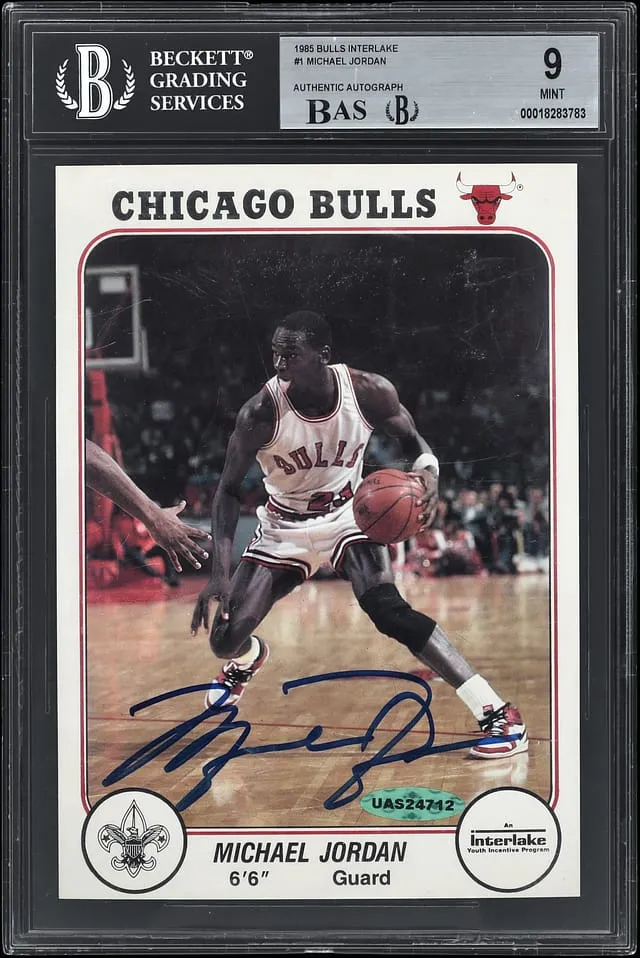
Figoca reviews Goldin’s $107,204 sale of a 1985 Interlake Bulls #1 Michael Jordan signed rookie card, graded BGS 9 with Beckett 10 auto and UDA.
Sold Card
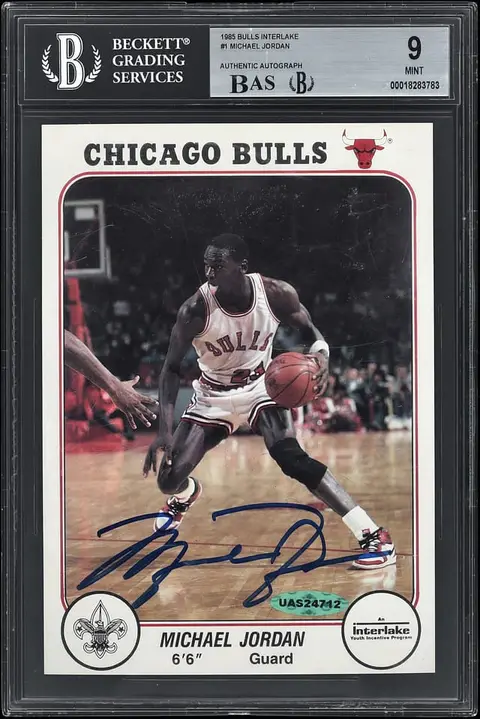
1985 Interlake Bulls #1 Michael Jordan Signed Rookie Card - BGS MINT 9, Beckett 10, UDA
Sale Price
Platform
Goldin1985 Interlake Bulls #1 Michael Jordan Signed Rookie Card – BGS MINT 9, Beckett 10, UDA
On June 7, 2026, Goldin auctioned a key early Michael Jordan issue: a 1985 Interlake Bulls #1 Michael Jordan signed rookie card, graded BGS MINT 9 with a Beckett 10 autograph and Upper Deck Authenticated (UDA) certification. The card realized $107,204.
For collectors, this sale sits at the intersection of three powerful factors: early Jordan, on-card autograph, and strong third-party grading. Let’s unpack what that means.
Card overview
Card details
- Player: Michael Jordan
- Team: Chicago Bulls
- Year: 1985
- Set: Interlake Bulls (regional issue)
- Card number: #1
- Category: Early Bulls-era Michael Jordan, often treated as a key rookie-year–adjacent issue
- Autograph: On-card Michael Jordan signature
- Authentication: Upper Deck Authenticated (UDA)
- Grading company: Beckett Grading Services (BGS)
- Card grade: MINT 9
- Autograph grade: 10 (Beckett)
The 1985 Interlake Bulls card is a regional release, distributed around the Chicago area rather than as a mass-market NBA set. It predates or closely parallels Jordan’s mainstream 1986–87 Fleer rookie and is one of the earliest widely recognized Bulls-licensed Jordan cards.
Because of its timing and limited distribution, many collectors group this Interlake card among Jordan’s most important early issues. It is not a pack-pulled NBA flagship card in the way the 1986 Fleer is, but it occupies an important niche: team-issued, early-career, and historically significant.
What makes this copy special?
Several layers of provenance and grading matter here:
BGS MINT 9
Beckett’s MINT 9 is a high-end grade for a mid-1980s regional paper stock card. These Interlake issues were not produced or stored with long-term preservation in mind. Centering, corner wear, and minor print issues are common.Autograph grade 10 (Beckett)
Beckett’s 10 auto grade signifies a clean, bold, well-struck signature with no significant streaking or fading. For signed vintage and 1980s cards, autograph presentation heavily influences demand, especially on a blue-ink Jordan auto that stands out clearly on the card.Upper Deck Authenticated (UDA)
UDA has long been one of the core authentication sources for Michael Jordan autographs. A UDA-backed Jordan signature gives the card an extra layer of comfort for buyers who want both a high technical grade and a trusted autograph origin.
Put together, a BGS 9 / 10 auto / UDA combination places this example in the upper tier of Interlake Jordans, even before you look at population counts.
Market context and recent sales
While specific, up-to-the-minute population report figures and an exhaustive list of all recent comps (short for “comparables,” or similar recent sales) can fluctuate, a few patterns around this card and its peers are consistent in the hobby:
- Unsigned 1985 Interlake Jordan cards in strong grades (for example, BGS 8.5–9.5 or PSA 8–10) typically sell for a healthy but significantly lower figure than fully authenticated, high-grade autographed copies. The autograph and UDA provenance add a major premium.
- Signed Interlake Jordans with weaker eye appeal (off-center, surface issues, or lower autograph grades) generally trade at a discount to examples like this one, which combine strong card grade and a 10 autograph.
- High-end Michael Jordan rookie and early-career pieces—including 1986 Fleer PSA 10s, star regional issues, and on-card autographs—have established a long history of strong results at major auction houses. Early Jordan autos, especially on period-correct cards, are in a different pricing tier than most modern issues.
Within that broader landscape, a $107,204 sale price at Goldin for a BGS 9, Beckett 10 auto, UDA 1985 Interlake Jordan reflects the premium segment of the market. It aligns with the idea that collectors place substantial value on:
- Early Jordan imagery from his initial Bulls years
- A clean, authenticated signature from UDA
- High technical grading from a major grader
Because the Interlake is less common than mainstream pack-issued sets, exact comps for this precise configuration (BGS 9, auto 10, UDA) can be thin. That thin data is typical for niche but important regional issues; price discovery tends to happen in jumps when strong copies surface at major houses like Goldin.
Why collectors care about the 1985 Interlake Bulls Jordan
Early-career snapshot
The card captures Jordan close to the beginning of his NBA journey with the Bulls. For many hobbyists, early regional and team-issued cards feel like snapshots from before the global superstar era. They are part of a small group of issues that show Jordan as a rising player rather than a completed legend.
Regional and team-issued appeal
Interlake Bulls cards were not part of a national NBA trading card release. That regional origin has two main effects:
- Scarcity in high grade: They are often found with handling wear, pinholes, or surface damage, making mint examples challenging.
- Nostalgia factor: Chicago-area collectors who remember local promotions and team giveaways view these cards as a piece of local sports history as much as hobby history.
On-card autograph vs. modern signed cards
Modern sets feature an abundance of pack-issued autographs across numerous products every year. By contrast, an on-card signature on an early, non-autograph-era Jordan card feels fundamentally different. Collectors are not just buying a signed card; they are buying a true crossover piece between vintage-style collecting and the modern autograph market.
A few key differences stand out:
- Era: The card originates from 1985, well before the modern autograph boom.
- Authenticity stack: UDA provenance plus Beckett grading and a 10 autograph grade create layered verification.
- Supply: There is no structured, pack-pulled print run of autographed Interlake cards; signed copies exist because Jordan later signed an originally unsigned regional issue.
How this sale fits into the Jordan market
Michael Jordan’s card market is broad and tiered:
- Flagship rookie: 1986–87 Fleer is the mainstream, pack-issued rookie that anchors many collections.
- Star and regional issues: Earlier or parallel-era cards (such as Star Company and team/regional releases) fill in the historical picture and attract collectors who want something beyond just the Fleer.
- Autographed vintage/early cards: Period cards signed later, especially with strong authentication and grading, form a hybrid category with both historical and autograph appeal.
This 1985 Interlake sale sits in that third lane. It is not trying to replace the Fleer rookie; instead, it offers a different angle on Jordan’s earliest Bulls days, enhanced by a premium autograph.
For active collectors, the sale adds one more data point to a long-running pattern:
- High-end, early Jordan pieces tied to major authenticators and grading companies continue to command significant attention and strong bids at established auction houses.
- Thin supply of truly top-tier examples (for example, BGS 9 with a 10 auto) means prices are set not by a steady stream of identical comps, but by occasional appearances at auction.
Takeaways for collectors and small sellers
If you are new or returning to the hobby and looking at this card as a reference point, a few practical observations can help frame it:
Context matters more than just the number
$107,204 is a large headline figure, but what matters to most collectors is why this particular example sold where it did: early Jordan, regional issue, strong grade, and layered autograph authentication.Graders and authenticators shape liquidity
BGS, PSA, and SGC are the major grading companies. For autographs, UDA and other leading authenticators add comfort. Cards that combine these layers generally see wider bidder participation at auction.Regional and early issues can behave differently than mainstream rookies
Price histories can be less linear and more dependent on a few standout results because the population of high-end copies is smaller and turns over less frequently.Use comps as a guide, not a promise
When you research similar cards, look at grade, autograph quality, authentication, and sale venue (major auction house versus fixed-price marketplace). Recent sales give context but are not guarantees of future prices.
Final thoughts
The June 7, 2026 Goldin sale of the 1985 Interlake Bulls #1 Michael Jordan signed rookie card—BGS MINT 9 with a Beckett 10 autograph and UDA certification—underscores how much weight collectors place on early Jordan pieces that blend history, condition, and a premium signature.
For the broader hobby, it is another reminder that not all high-end Jordan cards are the 1986 Fleer. Regional and team-issued cards like the Interlake offer alternate paths for building a serious Jordan collection, especially when they surface in grades and configurations that rarely come to market.
As always, this result is a data point, not a forecast. For collectors, it is a useful marker in understanding how the market currently values one of the more distinctive early Michael Jordan autographed cards.