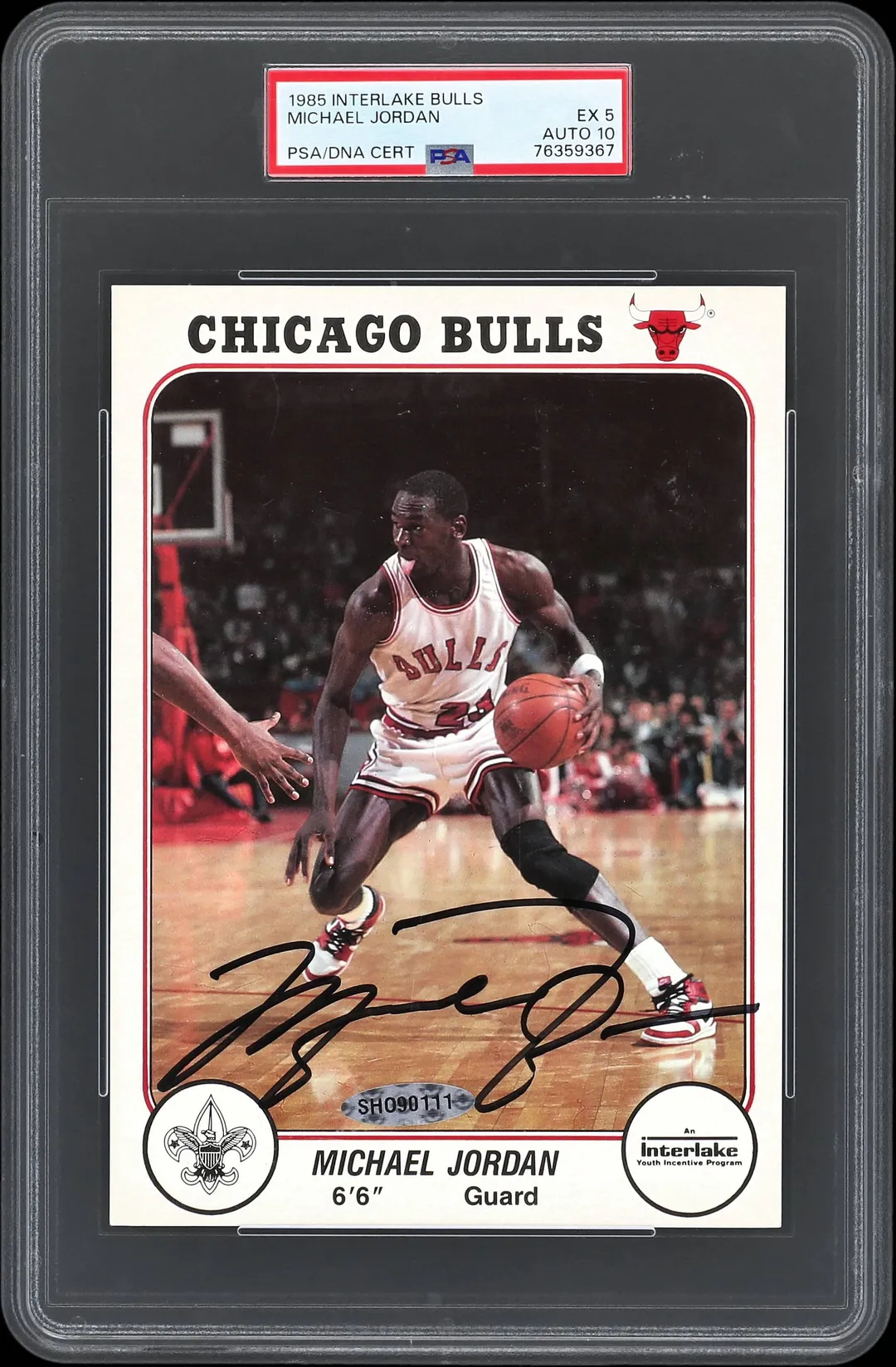
1985 Interlake Bulls Michael Jordan UDA Auto Sells
A PSA 5, PSA/DNA 10, UDA 1985 Interlake Bulls Michael Jordan signed card sold for $67,710 at Goldin on 2/08/26. Here’s what it means for collectors.
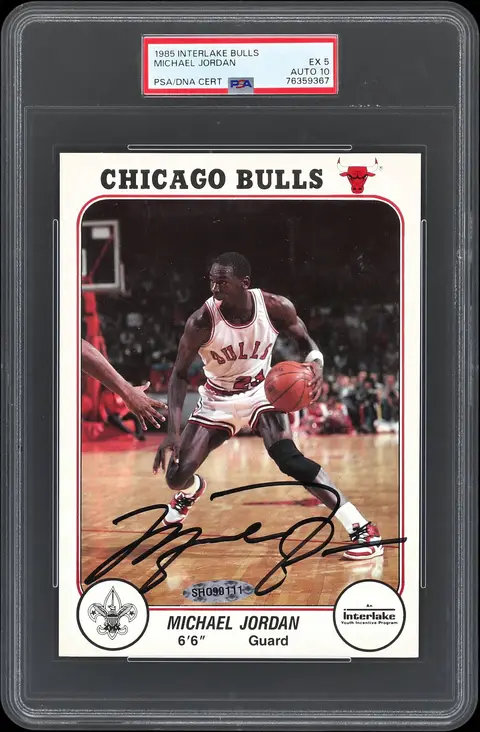
Sold Card
1985 Interlake Bulls Michael Jordan Signed Card - PSA EX 5, PSA/DNA GEM MT 10, UDA
Sale Price
Platform
GoldinA signed 1985 Interlake Bulls Michael Jordan card just closed at Goldin for $67,710 on 2/08/26, adding another strong data point to one of MJ’s most interesting early issues.
The card at a glance
- Player: Michael Jordan
- Team: Chicago Bulls
- Year: 1985
- Set: Interlake Bulls (regional issue)
- Card type: Oversized team-issue card, widely treated as a key early Jordan issue
- Autograph: On‑card, Upper Deck Authenticated (UDA)
- Card grade: PSA EX 5
- Auto grade: PSA/DNA GEM MT 10
The 1985 Interlake Bulls card is not Jordan’s mainstream rookie (that’s the 1986–87 Fleer), but many collectors view it as one of his most important early pieces. It’s a regional, oversized release distributed around Chicago, which means it never had the print runs or national reach of flagship products.
Why the 1985 Interlake Jordan matters
Regional, early-career Jordan
The Interlake Bulls card captures Jordan at the very beginning of his NBA career in a team‑issued format that predates or runs alongside his first widely recognized NBA cards. Because it was a regional giveaway with a non‑standard size, it was rarely stored like a traditional trading card. That has two big consequences:
- Condition is tough. Corners, edges, and surfaces often show wear from years of casual handling.
- Survivorship is limited. Far fewer examples survived in high grade compared to mass‑produced 1986 Fleer.
For many Jordan collectors, that combination—early career, regional scarcity, and condition difficulty—makes the Interlake one of the core “pre‑rookie” or early‑issue targets.
Autograph and dual authentication
This particular copy is signed and carries:
- PSA EX 5 for the card itself. EX (Excellent) means visible wear, but a structurally intact card.
- PSA/DNA GEM MT 10 for the autograph grade, indicating a bold, high‑quality signature.
- Upper Deck Authenticated (UDA) holo and paperwork, which has long been one of the most trusted sources for authenticated Jordan autographs.
That combination—PSA card grade, PSA/DNA auto grade, and UDA provenance—adds confidence and collectability. In the Jordan market, documented authenticity matters as much as numerical grade.
How this $67,710 sale fits recent market context
When collectors talk about “comps,” they mean comparable recent sales that help frame price expectations for a card.
For the 1985 Interlake Jordan, the market splits into several lanes:
- Unsigned, graded copies (PSA, BGS, SGC)
- Signed copies with third‑party authentication (PSA/DNA, Beckett, JSA)
- Top‑tier autographed examples with strong card grades, GEM‑graded autos, and UDA ties
Within that third lane, population is low and sales are relatively infrequent. Most transactions surface through major auction houses rather than fixed‑price marketplaces, which can make exact comps sparse.
Based on recent public results for similar Interlake Jordan signed cards:
- Higher‑grade card examples (for example, PSA 7–8) with strong autos and UDA or equivalent authentication have reached well into the mid‑ to high‑five‑figure range.
- Lower‑grade card examples with clean autos generally trade at a discount to those higher grades, but still command a substantial premium over unsigned cards because authenticated Jordan ink is a major driver of demand.
At $67,710, this PSA 5 / PSA/DNA 10 / UDA example sits in the upper tier of known sales for lower‑ to mid‑grade card copies with top‑notch autographs. It doesn’t press into the all‑time record territory reserved for the absolute highest card grades or unique provenance pieces, but it is clearly a strong result in the current environment.
That suggests a few things about the current Jordan market:
- Autograph quality and provenance are heavily rewarded. A GEM MT 10 grade on the signature, plus UDA backing, is a meaningful value driver even when the card itself is only EX.
- Early, non‑Fleer Jordan issues are still respected. While 1986 Fleer remains the flagship, serious Jordan collectors continue to pay up for well‑documented early pieces.
- Auction houses remain the primary venue. Big, authenticated Interlake autos tend to surface in places like Goldin, where there is enough bidder depth to set new benchmarks.
Condition, grading, and population context
Grading companies like PSA evaluate both the card and, when requested, the autograph:
- PSA 5 (EX) implies corner and edge wear, possible light creasing or surface issues, and generally noticeable but not severe defects. In an oversized, mid‑1980s team issue, this is not surprising.
- GEM MT 10 auto means the ink is clean, bold, and free of smudges, streaks, or noticeable flaws.
For oversized and regional releases, population reports (“pop reports”)—the count of how many graded copies exist at each grade—tend to be thin compared to mainstream sets. While exact numbers fluctuate as new submissions arrive, PSA’s pop report historically shows far fewer Interlake Jordans than 1986 Fleers. Autographed, dual‑graded examples are scarcer still.
Because so many Interlake cards were handled casually, a card graded only EX 5 can still be quite competitive in the context of the set, especially when paired with a flawless autograph.
Collector significance vs. the rest of the Jordan market
Jordan’s card market has multiple “pillars” that collectors gravitate to:
- 1986–87 Fleer rookie (and its key parallels and stickers)
- Star Company issues from the mid‑1980s (depending on each collector’s comfort level with their history)
- Early regional/team issues like Interlake
- 1990s inserts and serial‑numbered parallels
- High‑end autographs with strong provenance
The 1985 Interlake Bulls card checks two of those boxes:
- It is an early regional/team issue.
- This copy is a high‑end autograph with dual third‑party validation.
Because of that, this sale matters less as a standalone headline number and more as another reference point for how the market currently values:
- Early, non‑flagship Jordan pieces
- Strong autographs on tougher, condition‑sensitive stock
Possible drivers of demand (without speculating)
Jordan’s market is not tied to active on‑court performance the way modern players’ markets are. Instead, key drivers tend to be:
- Long‑term GOAT status and cultural relevance
- Documentaries, media, and nostalgia cycles
- The supply of high‑end pieces actually coming to market
- Broader movements in high‑end sports collectibles
This Goldin sale fits into a pattern where well‑documented, early Jordan items with strong eye appeal continue to find willing buyers at healthy levels. It doesn’t require short‑term hobby news to make sense; it’s more about sustained demand for historical Jordan pieces.
Takeaways for collectors and small sellers
For collectors considering this lane:
- The Interlake Bulls card is a foundational early Jordan for many player collectors. Autographed, authenticated copies sit near the top of that segment.
- Condition on the card is often secondary to the autograph when the auto is this strong and well documented. A GEM MT 10 signature with UDA backing can offset a mid‑grade card.
- Comps can be sparse. Because high‑end Interlake autos don’t sell every week, each major auction becomes an important reference point rather than a routine transaction.
For small sellers:
- Documentation matters. If you handle any Jordan autograph, strong third‑party authentication (PSA/DNA, Beckett, JSA) and, when applicable, UDA provenance, can significantly influence interest.
- Know your format. Oversized and regional cards grade differently from standard issues. Soft corners or edge chipping are more common, and buyers generally understand that in their bidding behavior.
This $67,710 sale at Goldin on 2/08/26 won’t reset the entire Jordan market by itself, but it reinforces a consistent theme: early, authenticated Jordan pieces with strong autos and clear provenance remain key targets—and the 1985 Interlake Bulls signed card sits comfortably within that group.