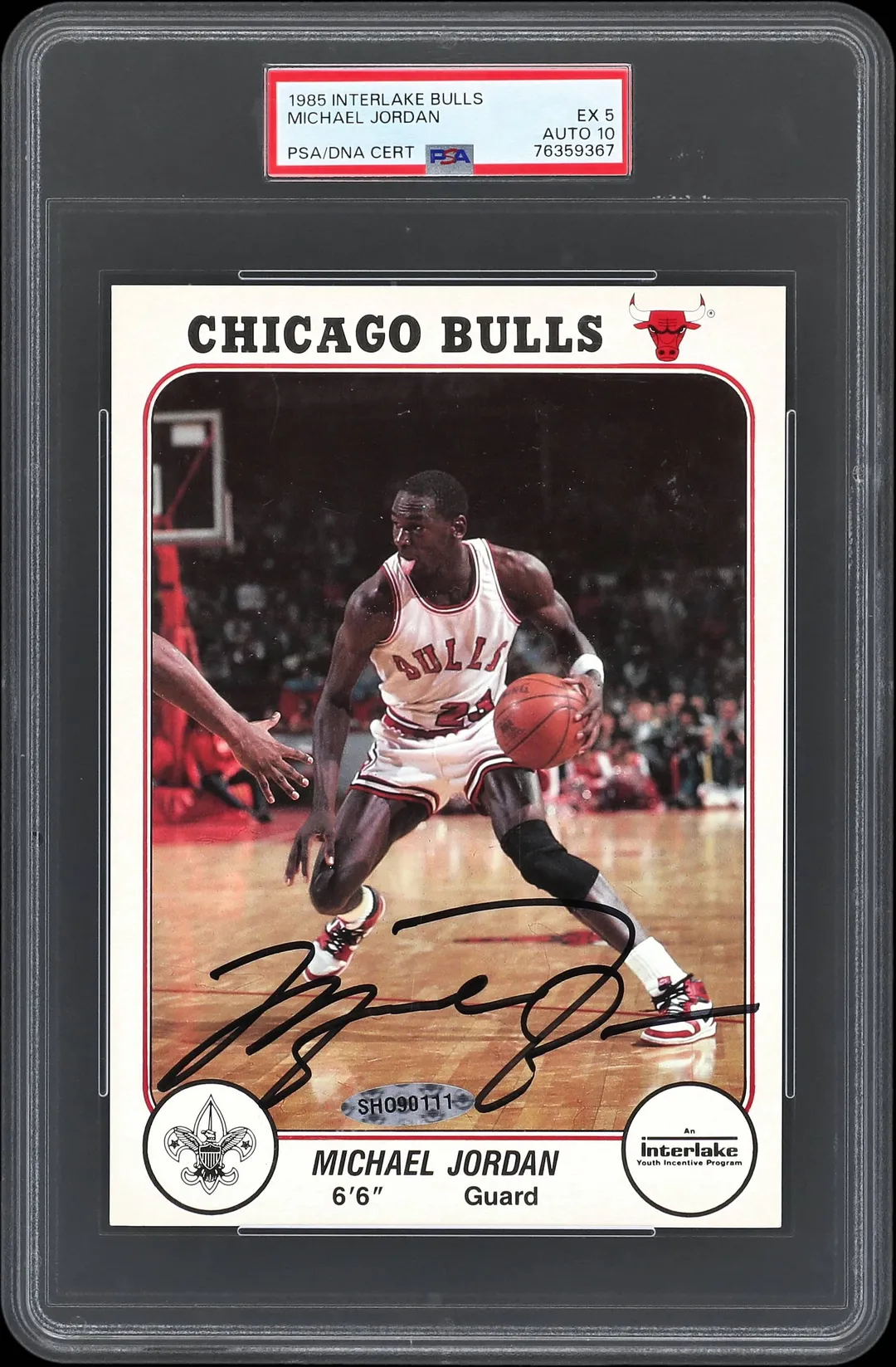
1985 Interlake Bulls Michael Jordan Auto Sells for $67K
Goldin sold a 1985 Interlake Bulls Michael Jordan PSA 5 with PSA/DNA 10 auto and UDA for $67,710. See what this early MJ issue means for collectors.
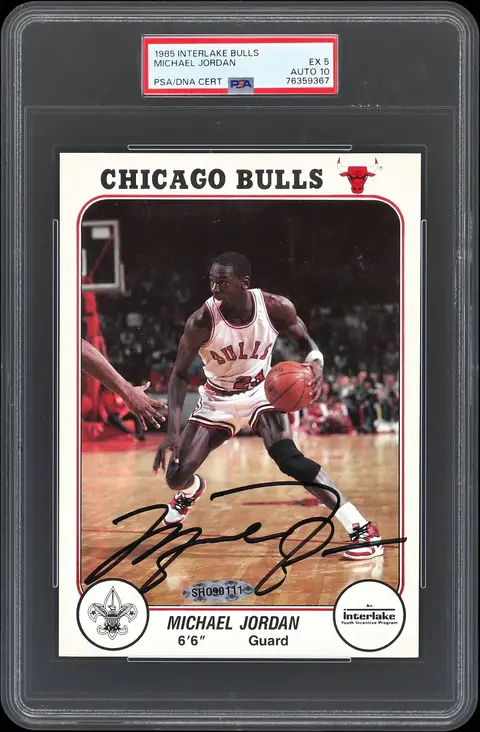
Sold Card
1985 Interlake Bulls Michael Jordan Signed Card - PSA EX 5, PSA/DNA GEM MT 10, UDA
Sale Price
Platform
Goldin1985 Interlake Bulls Michael Jordan Signed Card – Why This $67,710 Sale Matters
On February 8, 2026, Goldin closed a notable Michael Jordan sale: a 1985 Interlake Bulls Michael Jordan signed card, graded PSA EX 5 with a PSA/DNA GEM MT 10 autograph and Upper Deck Authenticated (UDA) provenance, sold for $67,710.
For a regional-issue MJ card from the mid‑1980s, that’s a meaningful number. Let’s unpack what this card is, why collectors care about it, and how this sale fits into the broader market.
The Card at a Glance
- Player: Michael Jordan
- Team: Chicago Bulls
- Year: 1985
- Set: Interlake Bulls (regional team-issue set)
- Card Type: Early Bulls issue featuring Jordan (often treated as a key pre‑rookie/oddball issue)
- Autograph: On‑card signature
- Autograph Authentication: PSA/DNA GEM MT 10 (perfect auto grade)
- Card Grade: PSA EX 5
- Additional Authentication: Upper Deck Authenticated (UDA)
This is not the 1986 Fleer flagship rookie that most collectors know, but it’s one of the important early Michael Jordan cards that predates or sits right alongside his mainstream rookie. The Interlake Bulls set was a regional, team‑issued release rather than a national pack‑pulled product. That makes it a bit of an “oddball” in hobby terms: not a traditional base set card, but an early and historically interesting piece.
The combination of:
- early MJ Bulls image,
- on‑card signature,
- PSA/DNA GEM MT 10 auto, and
- UDA provenance
creates an attractive profile for collectors who focus on Jordan’s early years and premium autographs.
Why the 1985 Interlake Bulls Jordan Matters
Early Jordan Issue
In hobby language, a “key issue” is a card that matters historically even if it isn’t the official rookie. This 1985 Interlake Bulls Jordan sits in that lane. It comes from Jordan’s early Chicago years, close to the start of his NBA career, and gives collectors a snapshot of MJ before the full global superstardom of the 1990s.
While the 1986 Fleer is generally accepted as the flagship rookie, serious Jordan collectors often build out a run of important pre‑Fleer and alternate‑issue cards. The Interlake is one of the better‑known pieces in that run, alongside Star Company issues and regional team releases.
Regional, Not Mass‑Market
Because Interlake was a regional Bulls issue, it didn’t have anywhere near the print run or distribution of a major national set. That doesn’t automatically make it ultra‑scarce, but it does mean:
- Fewer copies entered long‑term collections in the same way as mainstream base cards.
- Surviving examples can show more wear, given that they weren’t always treated as traditional trading cards from day one.
That shows up in grading. Higher technical grades (like PSA 8–10) tend to be notably tougher on these regional issues than on some mass‑produced 1990s or 2000s sets.
Autograph and UDA Provenance
The key differentiators here are the autograph and the provenance:
- On‑card autograph: The signature is directly on the card, not on an added sticker or label.
- PSA/DNA GEM MT 10 auto: A GEM MT 10 autograph grade means PSA/DNA deemed the signature itself essentially flawless in presentation.
- Upper Deck Authenticated (UDA): UDA handled much of Jordan’s official autograph program. When a Jordan piece carries UDA provenance, it reassures collectors that the signing was controlled and documented.
For high‑end Jordan collectors, that combination of PSA/DNA 10 and UDA is a strong trust signal. Even if the card grade is only EX 5, the auto and provenance do a lot of the heavy lifting in terms of desirability.
Market Context and Price Comparison
The Goldin sale closed at $67,710. To understand that number, it helps to think in terms of “comps” – short for comparable sales. Comps are recent sales of the same card (or very similar cards) that give a sense of the current price range.
For this card, relevant comps include:
- Other 1985 Interlake Bulls Michael Jordan cards with on‑card autographs and PSA/DNA authentication.
- Similar cards where the autograph grade is 10 but the card grade varies (from lower‑grade examples up through higher‑grade copies).
- Key early Jordan issues from the mid‑1980s with premium autograph and provenance across major auction houses.
Recent public auction results (across major platforms) for this exact configuration – Interlake Bulls, PSA EX 5, PSA/DNA GEM MT 10 auto, UDA – tend to fall in a similar band, with price movement based on:
- Card grade: EX 5 sits in the middle of the grading spectrum; sharper copies command a premium, while lower‑grade examples trend below this level.
- Autograph strength: A GEM MT 10 auto is the top of the scale and typically outsells 9s or ungraded autos.
- Presentation: Centering, signature placement, and eye appeal matter, especially on oversized or regional pieces.
Within that framework, $67,710 is in line with what collectors have been willing to pay for strong, authenticated, early Jordan autos on important oddball issues. It is not an outlier on par with record‑setting rookie sales, but it’s a substantial, data‑aligned result that reinforces demand for high‑quality early MJ autographs.
If you zoom out to other premium Jordan pieces – like 1986 Fleer rookies in elite grades, or high‑end UDA autos on premium surfaces – this sale sits comfortably in the mid‑tier of the Jordan high‑end market. It’s meaningfully valuable, but still well below the six‑ and seven‑figure territory that the absolute top Jordan grails can command.
Grade Breakdown: PSA EX 5 vs. GEM MT 10 Auto
It’s important to separate card grade and autograph grade:
Card Grade (PSA EX 5):
EX 5 (Excellent) indicates visible wear: potentially corner and edge rounding, minor surface issues, and general handling. For a mid‑1980s regional issue that wasn’t always stored in sleeves or holders right away, EX 5 is not unusual.Autograph Grade (PSA/DNA GEM MT 10):
GEM MT 10 is the top score for the signature. Even collectors who usually prefer higher card grades will often prioritize a GEM MT 10 auto on iconic players like Jordan.
From a market standpoint, a strong auto on a mid‑grade card is often more approachable price‑wise than a strong auto on a high‑grade card, while still delivering the core appeal of owning a premium Jordan autograph on an important early card.
Era and Hobby Positioning
The 1985 Interlake Bulls Jordan sits in a transitional era for basketball cards:
- Pre‑boom vintage/early modern: This isn’t 1960s or 1970s vintage, but it’s also before the late‑1980s “junk wax” boom where print runs exploded.
- Condition sensitivity: Regional and team issues from this window often have lower average grades than mainstream flagship cards, simply because of how they were handled and stored.
Collectors who focus on Jordan’s early career have increasingly treated these mid‑1980s regional issues as historically important side pieces to the mainstream rookie. As the hobby matures and more collectors look beyond just one or two “main” cards, these alternative early issues have drawn consistent attention.
What This Sale Signals for Collectors
A single sale never tells the whole story, but the February 8, 2026 Goldin result offers a few takeaways:
- Sustained demand for early MJ autos: High‑quality, authenticated Michael Jordan autographs on meaningful early cards continue to attract serious bidding.
- Autograph quality matters: The GEM MT 10 auto and UDA provenance are doing a lot of the work here. Collectors are clearly willing to pay for clean, well‑documented signatures.
- Card grade is important, but not everything: An EX 5 would limit value on a non‑autographed 1980s card, but in this context, the autograph and significance of the issue keep it in strong territory.
For newcomers and small sellers, this sale is a reminder that:
- Provenance and authentication are critical. For Jordan in particular, PSA/DNA and UDA carry real weight with buyers.
- Oddball and regional issues can be important. Not every key card comes from a mass‑market set. Regional and team‑issued pieces can have meaningful collector demand when the player and context are strong.
- Price context comes from comps, not promises. As always, values move with the broader market, player perception, and the flow of similar cards to auction.
Final Thoughts
The 1985 Interlake Bulls Michael Jordan signed card that sold at Goldin on February 8, 2026 for $67,710 is a solid data point in the ongoing story of Jordan’s high‑end market. It shows how collectors continue to prioritize early‑career context, strong autograph quality, and trusted authentication.
For collectors building a Jordan PC (personal collection), this sort of piece often sits alongside the 1986 Fleer rookie rather than replacing it – a complementary, historically interesting card that captures MJ in the early Bulls years, with a premium on‑card signature that has been graded and authenticated at the highest level.