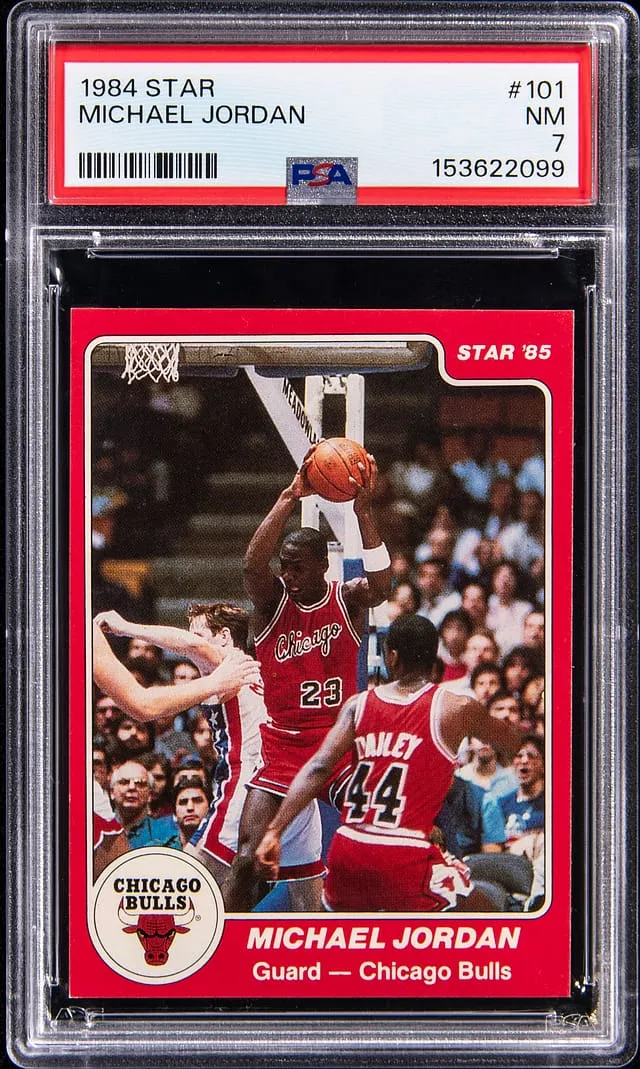
1984-85 Star #101 PSA 7 Michael Jordan Sells for $95K
Goldin sold a 1984-85 Star #101 Michael Jordan rookie card PSA 7 for $95,160. See where this key early MJ issue fits in today’s market.
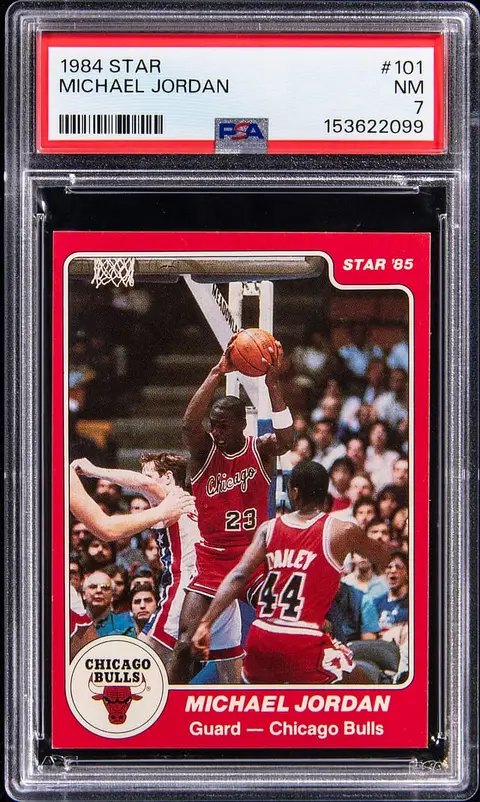
Sold Card
1984-85 Star #101 Michael Jordan Rookie Card - PSA NM 7
Sale Price
Platform
Goldin1984-85 Star #101 Michael Jordan Rookie Card (PSA 7) Sells for $95,160 at Goldin
On April 10, 2026, Goldin recorded a notable sale for one of the most debated but historically important Michael Jordan issues in the hobby: a 1984-85 Star #101 Michael Jordan rookie card graded PSA NM 7, closing at $95,160.
For figoca collectors tracking key Jordan markets, this sale offers a useful data point in the ongoing conversation about Star Company cards, early MJ rookies, and how grading-company policies shape prices.
The card at a glance
- Player: Michael Jordan
- Team: Chicago Bulls
- Year: 1984-85
- Set: Star Company, often referred to as “1984-85 Star”
- Card number: #101
- Status: Widely treated as Jordan’s first NBA-licensed card and an important early rookie issue
- Grading company: PSA (Professional Sports Authenticator)
- Grade: PSA NM 7 (Near Mint)
- Attributes: Standard base card, no autograph, no patch, no serial-numbering
While many collectors still refer to the 1986-87 Fleer #57 as Jordan’s “flagship rookie” (his first mainstream pack-issued rookie card), the 1984-85 Star #101 predates it and represents his earliest major NBA-licensed card.
Why the 1984-85 Star #101 matters
The Star #101 sits at the intersection of three important hobby themes:
Earliest major MJ card:
This is Jordan’s first NBA-licensed card distributed during his rookie season. That alone makes it historically significant, even for collectors who still prioritize Fleer.The Star Company era:
Star produced team sets and small-run products in the mid-1980s, before Fleer’s 1986 comeback. Distribution was different from wax packs: cards were sold in sealed team bags and specialty sets, which affects both population and condition.Grading and authenticity history:
For years, PSA did not grade Star Company cards due to concerns about counterfeits and reprints. BGS (Beckett Grading Services) became the de facto standard for Star-graded Jordans. PSA’s gradual re-entry into grading certain Star issues has added a new layer of demand and price discovery.
Because of those factors, the Star #101 is both historically important and structurally complex. Collectors often discuss it separate from the more straightforward 1986 Fleer #57 market.
Market context and recent sales
When collectors talk about “comps” (short for comparables), they mean recent sales of the same card in similar condition to help frame a current price.
For the 1984-85 Star #101, it’s helpful to look at:
- Other PSA-graded copies in similar grades, where data is still developing.
- BGS-graded copies, which have a longer, more established sales history.
- The broader Jordan rookie ecosystem, especially 1986-87 Fleer #57 in mid-to-high grades.
Within the constraints of publicly available auction results up to my knowledge cutoff (late 2024), the general pattern for Star #101 has been:
- BGS 8–9 copies often realizing strong premiums due to scarcity and eye appeal.
- Mid-grade BGS 6–7 copies trading at a noticeable discount to high-grade examples but still commanding significant sums compared with most 1980s cards.
- PSA slabs just beginning to establish their own price tiers, with low populations and less long-term data than BGS.
This Goldin sale at $95,160 for a PSA 7 fits into the narrative of:
- A thin, volatile market where even a single strong or weak auction result can move perceived value.
- Ongoing price discovery around PSA-graded Star Jordans, as collectors decide how to weigh PSA vs. BGS for this specific issue.
Because PSA’s population report (often called a “pop report,” a tally of how many copies exist in each grade) is still relatively small for Star #101, each graded copy in a public auction has outsized influence on short-term comps.
How this sale compares
With Star #101, exact, up-to-the-day comps can be sparse because:
- The card is not mass-submitted like mainstream base rookies, so populations are lower.
- Many high-end copies trade privately, never hitting public auction records.
- PSA’s involvement with Star is comparatively recent, so PSA 7 data is especially limited.
Placed in that context, a $95,160 sale:
- Confirms that mid-grade examples of this card still sit firmly in the high-end Jordan market, well above most 1980s basketball issues.
- Shows that PSA-graded copies can compete with established BGS price ranges, though the exact premium or discount is still being sorted out by the market.
Rather than treating this as a “new normal,” collectors will likely watch the next several PSA 6–8 sales to see whether this price becomes an outlier or part of a tighter band of realized prices.
Set and era considerations
The 1984-85 Star release comes from the early 1980s basketball era, often discussed separately from the late-1980s “junk wax” period where overproduction became a major issue.
Key points about this era and set:
Lower print runs than late-1980s mass-produced sets:
While not ultra-short-printed by modern standards, Star’s distribution is modest compared with 1989–1992 basketball products.Condition challenges:
Team bag distribution and handling over 40 years means many surviving copies show centering and corner wear, making strong grades more notable.Hobby recognition over time:
For a long time, the mainstream hobby conversation revolved around the 1986 Fleer Jordan as “the” rookie. Over the past decade, more collectors have learned the nuances of Star issues and given the #101 a more defined place in the Jordan timeline.
PSA 7: what the grade signals
A PSA NM 7 is described by PSA as Near Mint:
- Slight wear visible at the corners or edges.
- Possible minor print or surface imperfections.
- Decent overall eye appeal with no major damage.
For a 1984 issue that was not pack-pulled in the traditional sense, a 7 is a solid mid-grade, often attractive enough for display while still well below the price levels of true top-pop (top population) grades.
Because PSA’s Star #101 population is limited, collectors also watch how many additional raw copies get submitted over the next several years and how harshly they grade. If the pop report for PSA 7 remains small, that can keep pressure on prices in this range, though it does not guarantee any particular outcome.
Collector significance
From a collector’s perspective, this card checks multiple boxes:
- Historical: Jordan’s earliest major NBA-licensed card, from his playing-era rookie season.
- Iconic player: MJ remains one of the most collected athletes across all sports, with a deep worldwide fan base.
- Hobby narrative: The card sits at the center of ongoing discussions about what “rookie card” means, how to treat regional or non-pack releases, and how grading policies shape demand.
For newcomers and returning collectors:
- The 1986 Fleer #57 is easier to understand and more liquid (bought and sold frequently), with well-defined price tiers by grade.
- The 1984-85 Star #101 is more specialized: fewer copies, more nuance, and a heavier emphasis on understanding authenticity and grading history.
Both cards are important, but they play slightly different roles in the Jordan market.
What this Goldin sale tells us
This $95,160 sale at Goldin on April 10, 2026, reinforces several themes:
High-end Jordan demand remains deep: Even mid-grade early MJ issues continue to attract serious bidders when authenticated and graded by a leading company.
PSA’s role in Star markets is still evolving: Each PSA-graded Star Jordan that reaches a major auction helps define future expectations. Collectors now have one more reference point when they evaluate offers or list their own copies.
Thin markets can move quickly: With limited public sales for specific grade/company combinations, a single strong auction can move short-term comps. Collectors watching this space may want to track not just this sale, but the next few results.
How collectors might use this information
None of this is financial advice, but from a hobby perspective, here are a few practical takeaways:
For collectors building a Jordan run: This sale underscores that the Star #101 is in a different tier, both in price and complexity, than most other 1980s cards. It may sit alongside, not behind, the Fleer rookie in a serious MJ PC (personal collection).
For small sellers: If you encounter raw Star Jordan cards, authentication and grading decisions may matter more than usual, due to the card’s history with counterfeits and reprints. Doing careful homework on provenance and submission options is essential.
For newcomers: Understanding why this card sells for nearly six figures in NM 7 helps you see how history, scarcity, and grading-company policies can all interact to shape prices.
As more PSA-graded Star #101s surface at Goldin and other major auction houses, figoca will continue tracking the data so collectors can see where this early Jordan cornerstone is headed in the broader market.