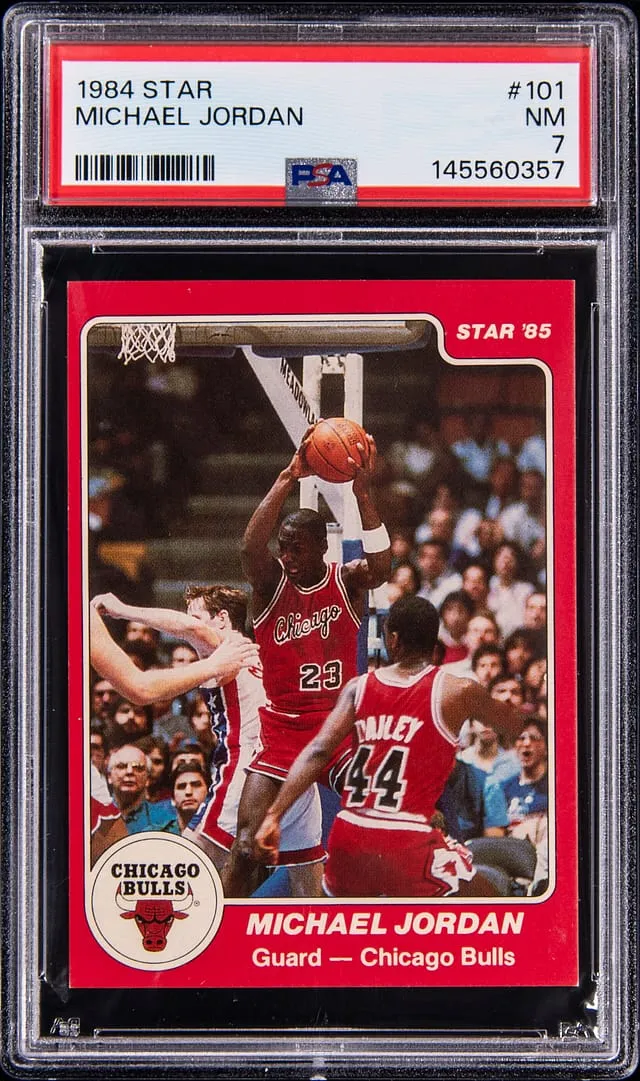
1984-85 Star #101 Michael Jordan PSA 7 sells at Goldin
A PSA NM 7 1984-85 Star #101 Michael Jordan rookie-era card sold for $98,820 at Goldin on March 15, 2026. Here’s what it means for collectors.
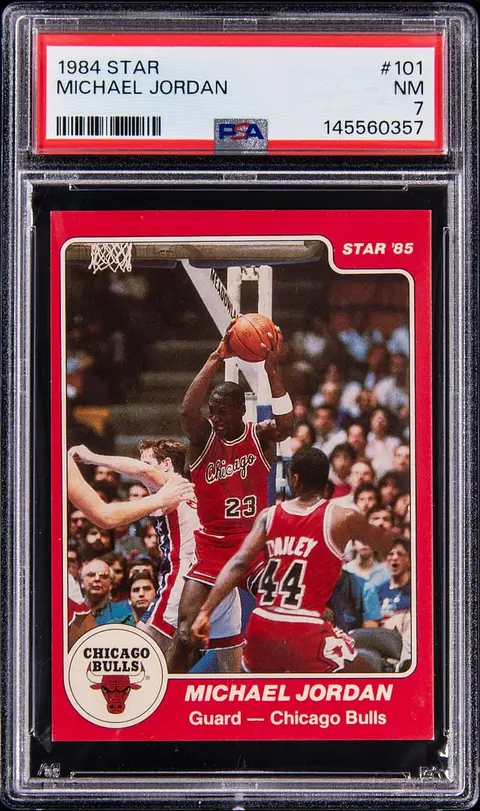
Sold Card
1984-85 Star #101 Michael Jordan Rookie Card - PSA NM 7
Sale Price
Platform
Goldin1984-85 Star #101 Michael Jordan Rookie Card (PSA NM 7) Sells for $98,820 at Goldin
The 1984-85 Star #101 Michael Jordan is one of the most talked‑about Jordan cards in the hobby, and a key piece of the broader MJ rookie conversation. On March 15, 2026, Goldin auctioned a PSA NM 7 copy for $98,820, a result that reinforces how serious collectors continue to view this early Jordan issue.
In this breakdown, we’ll look at what this card is, why it matters, and how this sale fits into recent market data.
The Card at a Glance
- Player: Michael Jordan
- Team: Chicago Bulls
- Year: 1984-85
- Set: Star Company (commonly called 1984-85 Star)
- Card number: #101
- Type: Early Bulls card, widely treated as a key rookie‑era card
- Grading company: PSA (Professional Sports Authenticator)
- Grade: NM 7 (Near Mint)
- Attributes: Standard base card, no autograph, no patch, no serial numbering
Star Company held the NBA’s card license in the mid‑1980s, before Fleer’s classic 1986-87 set. That’s why many collectors think of the 1984-85 Star #101 as Jordan’s first mainstream Bulls card, even if the hobby still gives the “flagship rookie” label to the 1986 Fleer #57.
This particular copy is graded PSA NM 7, which means:
- Corners, edges, and surface are solid but may show light wear on close inspection.
- Centering may be slightly off but still within PSA’s Near Mint standards.
Because Star cards had printing and distribution quirks, clean, unaltered examples are not as straightforward as many later‑era issues.
Why the Star #101 Matters to Collectors
Early Jordan, Pre‑Fleer Era
The 1984-85 Star #101 predates the 1986 Fleer Jordan by two full seasons. It captures Jordan at the very start of his NBA career with the Bulls, when he was still a young guard with massive potential rather than a six‑time champion.
For that reason, many collectors consider Star #101 a “true rookie‑era” card, even if there are different opinions about how to label it compared to Fleer. It’s part of a small group of mid‑80s Star issues that form the backbone of Jordan’s earliest NBA cardboard.
Scarcity and Condition Challenges
Compared with modern ultra‑printed sets, Star Company cards are relatively scarce:
- They were distributed in team bags, not in mass‑market wax packs.
- Quality control was inconsistent, leading to centering and surface issues.
- The line between authentic, altered, and counterfeit Star cards has been an ongoing area of focus for graders and advanced collectors.
Because of this, credible grading from a major company like PSA commands a significant premium, especially at higher grades.
PSA’s Role and the Star Conversation
For years, grading and authentication of Star Jordan cards were contentious topics. PSA’s more recent handling of Star issues has added structure and confidence around population reports (often abbreviated as “pop report,” meaning how many copies are graded at each grade level).
As PSA‑graded examples appear in major auction houses, the market gets clearer signals about how collectors value different grades of this card.
Market Context: How $98,820 Fits In
This Goldin sale closed at $98,820 on March 15, 2026.
To put that into perspective, here’s how collectors often think about price context:
- Comps: Short for “comparables,” meaning recent sales of the same card (or very similar versions) that help form a price range.
- Grade ladders: Looking at how pricing steps up or down as grades improve or decline (for example, comparing PSA 6, 7, 8, 9, etc.).
Recent public auction and marketplace data (for the same card and other grades) has shown:
- Lower‑grade examples of the Star #101 selling for less, but still commanding strong premiums over ungraded copies because of authentication.
- Higher‑grade examples (especially in the PSA 8–9 range, where they appear) often selling at a significant multiple of mid‑grade copies, reflecting the challenge of finding truly high‑end Star Jordans.
Within that spectrum, a PSA NM 7 in the high five‑figure to low six‑figure range has been a reasonable outcome in recent periods, depending on auction house, timing, and card eye appeal.
This $98,820 result at Goldin sits in that upper mid‑tier band:
- It confirms that authenticated, mid‑to‑upper‑grade Star #101s remain firmly established as premium Jordan pieces.
- It supports a well‑defined gap between graded, authenticated copies and raw Star Jordans, where authenticity and condition risk are higher.
While every auction is its own snapshot of supply and demand, this sale does not look like an outlier spike from the broader pattern. Instead, it continues a trend of serious collector demand for PSA‑graded Star Jordans, especially in solid, collector‑friendly grades like NM 7.
Comparing to Other Jordan Rookies
The 1986 Fleer #57 is still the hobby’s central Jordan rookie—it’s widely recognized, visually iconic, and easier for the broader market to understand. However, the Star #101 fills a different role:
- Timeline: It’s Jordan’s earlier major Bulls card.
- Distribution: Team bag product vs. traditional wax.
- Scarcity profile: Generally less plentiful and more condition‑sensitive than Fleer.
Collectors who focus on “firsts” or on deeper Jordan runs often pair the Fleer rookie with at least one early Star Jordan, and #101 is at the top of that list.
Grading, Eye Appeal, and Pop Report
Because raw Star cards come with added risk, PSA’s label does more than just assign a number. It signals:
- Authenticity screening against known counterfeits and alterations.
- Standardized condition assessment, useful for comparing your copy to recent sales.
Within PSA 7, not every card presents the same way. Centering, color richness, and print quality can nudge bidders to pay up for an especially attractive copy, even if it shares the same numeric grade as another example.
Checking the PSA population report (the official count of how many copies are graded at each level) is a useful habit if you’re tracking scarcity by grade. While exact counts change as new cards are submitted, the broad pattern has held: higher‑grade Star #101s are relatively thin on the ground compared with many later‑era Jordan cards.
What This Sale Means for Collectors
For active hobbyists, returning collectors, or newer buyers trying to understand the Jordan market, this Goldin result offers a few takeaways:
Jordan’s early‑career cards still anchor a deep part of the market.
Even outside the 1986 Fleer, early issues like the Star #101 continue to attract serious bidding.Authentication and grading are central with Star.
The price spread between PSA‑graded examples and raw copies reflects both condition and collector desire for certainty.Mid‑to‑high grades remain competitive.
A PSA NM 7 landing at $98,820 suggests ongoing demand for strong but not necessarily top‑pop grades, which can be more attainable than 8s and 9s while still feeling premium.Each auction helps refine the price range.
Single sales don’t guarantee future prices, but they add useful data points when you’re looking at comps and making your own collecting decisions.
How to Use This Information as a Collector or Small Seller
If you’re a collector:
- Clarify your lane. Decide whether you want a flagship rookie (like the Fleer #57), an earlier Star Jordan, or both. Each tells a different part of Jordan’s story.
- Study recent sales. Look at comparable PSA grades and note the spreads between 6, 7, 8, and 9. This helps you judge whether a particular asking price feels in line with recent auction results.
- Look beyond the label. When possible, compare eye appeal—centering, color, print quality—among cards in the same grade.
If you’re a small seller:
- Lean on established auction houses and marketplaces when you’re dealing with high‑end Star Jordans. Their authentication standards and bidder base can materially affect outcomes.
- Document your card well. Clear, high‑resolution images and a precise description (set, card number, grade, cert information) build buyer confidence, especially with Star issues.
Final Thoughts
The $98,820 sale of a 1984-85 Star #101 Michael Jordan Rookie Card – PSA NM 7 at Goldin on March 15, 2026 (UTC) is another data point in a long‑running story: Jordan’s earliest Bulls cards remain central to the high‑end basketball market.
For collectors, it’s a reminder that understanding set history, grading nuances, and recent comps can matter as much as the player on the front of the card. For those building an MJ run, the Star #101 continues to stand out as a cornerstone piece from the very beginning of his NBA journey.
figoca will keep tracking notable Jordan sales across grades and auction houses so you can follow how this cornerstone card evolves over time.