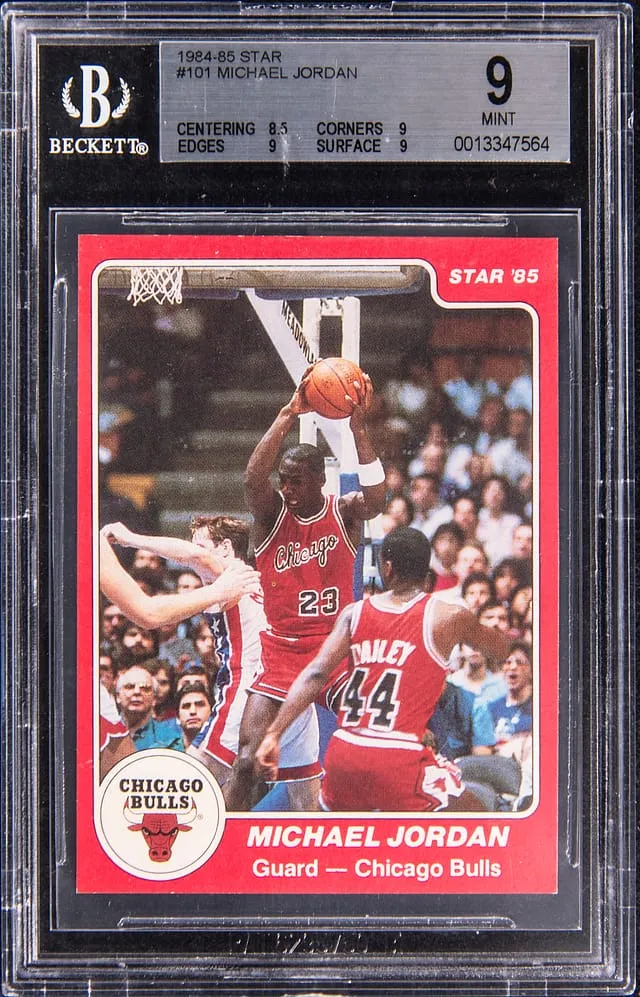
1984-85 Star #101 Michael Jordan BGS 9 sells at Goldin
Goldin sells a 1984-85 Star #101 Michael Jordan rookie card BGS 9 for $251,320 on March 8, 2026. See how this result fits recent comps and hobby context.
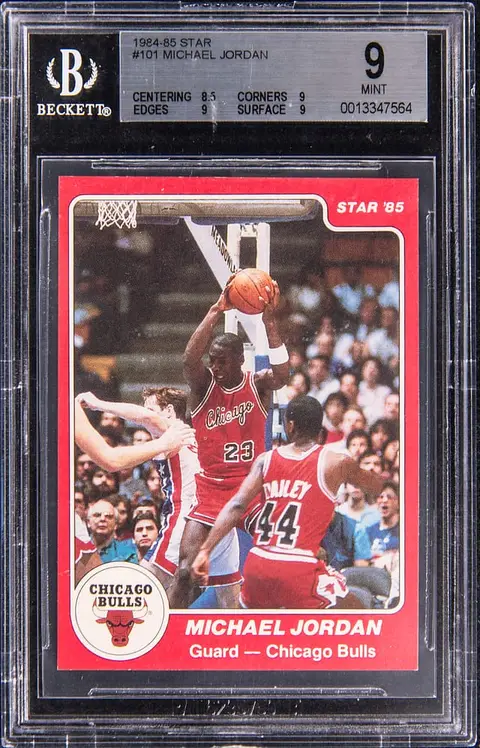
Sold Card
1984-85 Star #101 Michael Jordan Rookie Card - BGS MINT 9
Sale Price
Platform
Goldin1984-85 Star #101 Michael Jordan Rookie Card BGS 9 Sells for $251,320
On March 8, 2026, Goldin closed a key sale for one of the most discussed Jordan cards in the hobby: a 1984-85 Star #101 Michael Jordan Rookie Card graded BGS MINT 9, which realized $251,320.
For collectors who focus only on 1986 Fleer, this might seem like just another 1980s insert. In reality, the 1984-85 Star #101 has a strong claim as Michael Jordan’s first NBA-licensed trading card and sits at the center of an ongoing conversation about what counts as his “true” rookie.
Below, we break down what this card is, why it matters, and how this result fits into recent market data.
What exactly is the 1984-85 Star #101 Jordan?
• Player: Michael Jordan
• Team: Chicago Bulls
• Year: 1984-85
• Set: Star Company 1984-85 Bulls Team Issue
• Card number: #101
• Status: Widely regarded as Jordan’s first licensed NBA card and a key early issue
• Grading company: Beckett Grading Services (BGS)
• Grade: MINT 9
This card comes from Star Company’s Bulls Team Bagged set, released during Jordan’s actual rookie season (1984-85). Unlike 1986 Fleer, which is a mainstream, widely distributed pack product, Star sets were team-specific polybag releases with more limited and less consistent distribution.
Because of that distribution and long-standing concerns over counterfeits and reprints, major grading companies were historically cautious with Star cards. BGS is the primary grader for authentic 1984-85 Star #101s, and their population reports (abbreviated as “pop report,” a count of how many copies exist in each grade) are the main reference for scarcity.
A BGS 9 is considered a high-end copy of this card. In the Star 101 population, top grades like BGS 9.5 and BGS 10 are extremely scarce, and even 9s do not exist in the kind of volume you see with 1986 Fleer Jordans.
Market context: where does $251,320 fit in?
This Goldin sale at $251,320 USD sits in the upper tier of recent results for this card but well below the all-time highs reached during the 2020–2021 boom.
Looking across recent public auction and marketplace data for the same card and grade (BGS 9), the pattern looks roughly like this:
• During the peak hobby run-up (around 2021), some BGS 9 copies of Star #101 pushed well into the mid- to high-six-figure range.
• As the broader market cooled, realized prices retraced, settling meaningfully below those peaks but still far above pre-2020 levels.
• In the more recent period leading up to this March 2026 sale, BGS 9 results have tended to cluster in a lower six-figure band, with individual outcomes influenced by eye appeal, subgrades, and auction venue.
Within that context, a $251,320 sale:
• Lands toward the stronger side of recent BGS 9 results, not a distressed or clearance-type price.
• Still leaves a clear gap between current pricing and prior record levels.
• Reinforces that serious demand remains for high-grade Star 101s, even in a more rational, data-driven market environment.
When collectors talk about “comps” (short for comparables), they mean recent sales of the same or very similar items used for rough price context. Recent comps in nearby grades generally show a predictable curve:
• BGS 8 / 8.5: Typically much lower than BGS 9, reflecting more visible flaws and higher population.
• BGS 9: Sits at a premium due to condition scarcity and collector focus on “mint or better.”
• BGS 9.5 and above: Often leap again in price because very few copies exist in gem-mint territory.
The exact numbers move with the market, but the structure of that grade ladder has stayed consistent.
Why collectors care about Star #101
Several factors keep this card near the center of high-end basketball collecting:
First NBA-licensed Jordan card
1984-85 Star #101 predates Jordan’s 1986 Fleer and is tied directly to his rookie season. For collectors who care about chronology and true firsts, that makes it a foundational piece.Scarcity and grading history
Star Company’s production methods and distribution were not on par with the later mass-produced Fleer era. Bags were handled, stored, and opened in inconsistent ways, and the cards themselves can show a range of print and condition issues.
For years, concerns over counterfeiting and reprints meant that some grading companies either avoided Star issues or applied heavy scrutiny. BGS emerged as the primary grader for authenticated copies. As a result, population numbers remain modest relative to Jordan’s 1986 Fleer rookie.
- Era and set importance
This card sits between what many call “vintage” and the “junk wax” (mass-production) era. It is clearly pre-junk-wax and occupies a narrow window of 1980s basketball where production was still comparatively low and brand structures were in flux.
While 1986 Fleer is the flagship pack-pulled Jordan rookie, Star 101 is an essential counterpart: earlier, less accessible, and tied to a small manufacturer that briefly carried the NBA license.
- Ongoing hobby debate
Collectors still actively discuss:
• Whether 1984-85 Star #101 should be called Jordan’s true rookie over 1986 Fleer.
• How to weigh bagged team sets versus mainstream packs.
• How to treat Star population and authenticity risks compared to widely graded, widely traded Fleer copies.
This ongoing debate has kept the card in the spotlight. It is not just a static blue-chip; it is a piece that shapes how the hobby defines and ranks early Jordan issues.
Auction house and timing: why Goldin on March 8, 2026 matters
Goldin has been one of the main venues for six-figure and seven-figure Jordan sales across different eras and grading tiers. Their cataloging, marketing reach, and bidder base often help set the “headline” numbers that collectors refer back to as reference points.
This March 8, 2026 sale:
• Adds a new data point for BGS 9 Star 101 pricing in a mature, post-boom market.
• Helps refine expectations around where mint copies can clear in a competitive auction environment.
• Gives collectors and small sellers a concrete, date-stamped comp from a major auction house.
When you see pricing conversations about Star 101 going forward, this Goldin result will likely join the short list of recent high-confidence sales people use to frame the card’s current range.
How this compares with other Jordan rookies
Without making price predictions, it helps to place this sale alongside Jordan’s broader rookie ecosystem:
• 1986 Fleer #57 Jordan (PSA 10 / BGS 9.5): Still the most visible Jordan rookie in mainstream collecting, with heavier population and wider price swings.
• 1984-85 Star #101 (BGS 9 and above): Lower population, more nuanced due to authenticity concerns, but firmly established as a serious, historically important card.
Over the last few years, the market has tended to:
• Treat Star 101 as a premium, earlier-time-stamp complement to Fleer rather than a direct replacement.
• Assign a scarcity premium to higher BGS grades, especially where subgrades and visual appeal are strong.
What this means for different types of collectors
For newcomers and returning collectors:
• This sale is a reminder that not all Jordan “rookie” cards are the same.
• The distinction between first-year team sets (Star) and later flagship pack issues (Fleer) is worth understanding before making big purchases.
• Population reports, authenticity history, and auction provenance matter a lot at this level.
For active hobbyists and small sellers:
• A $251,320 BGS 9 comp from Goldin in March 2026 is a useful anchor when evaluating lower grades or raw Star 101s—recognizing that condition, authentication, and eye appeal heavily influence value.
• It also reinforces that the premium end of the Jordan market is still liquid, but more data-driven and selective than in peak-boom years.
For advanced Jordan and high-end collectors:
• This result sits as another confirmation print in the recalibrated, post-boom landscape.
• The relative spacing between BGS 8–9–9.5 levels, and the spread versus 1986 Fleer in equivalent grades, continues to define how the hobby prices early Jordan history.
Key takeaways from the Goldin sale
• Card: 1984-85 Star #101 Michael Jordan
• Grade: BGS MINT 9
• Auction house: Goldin
• Sale date: March 8, 2026 (UTC)
• Realized price: $251,320 USD
This sale does not rewrite the record books, but it does reinforce the place of Star #101 as a core Jordan card with durable demand. In a more measured market, a strong six-figure result for a BGS 9 copy signals that collectors continue to treat this issue as an essential part of Jordan’s cardboard story, even as opinions differ on labels like “true rookie.”
As always, this information is best used as context, not a promise. Markets evolve, and each card’s story depends on condition, authenticity, and timing—but for now, this Goldin sale is one of the clearest current benchmarks we have for a mint 1984-85 Star #101 Michael Jordan.