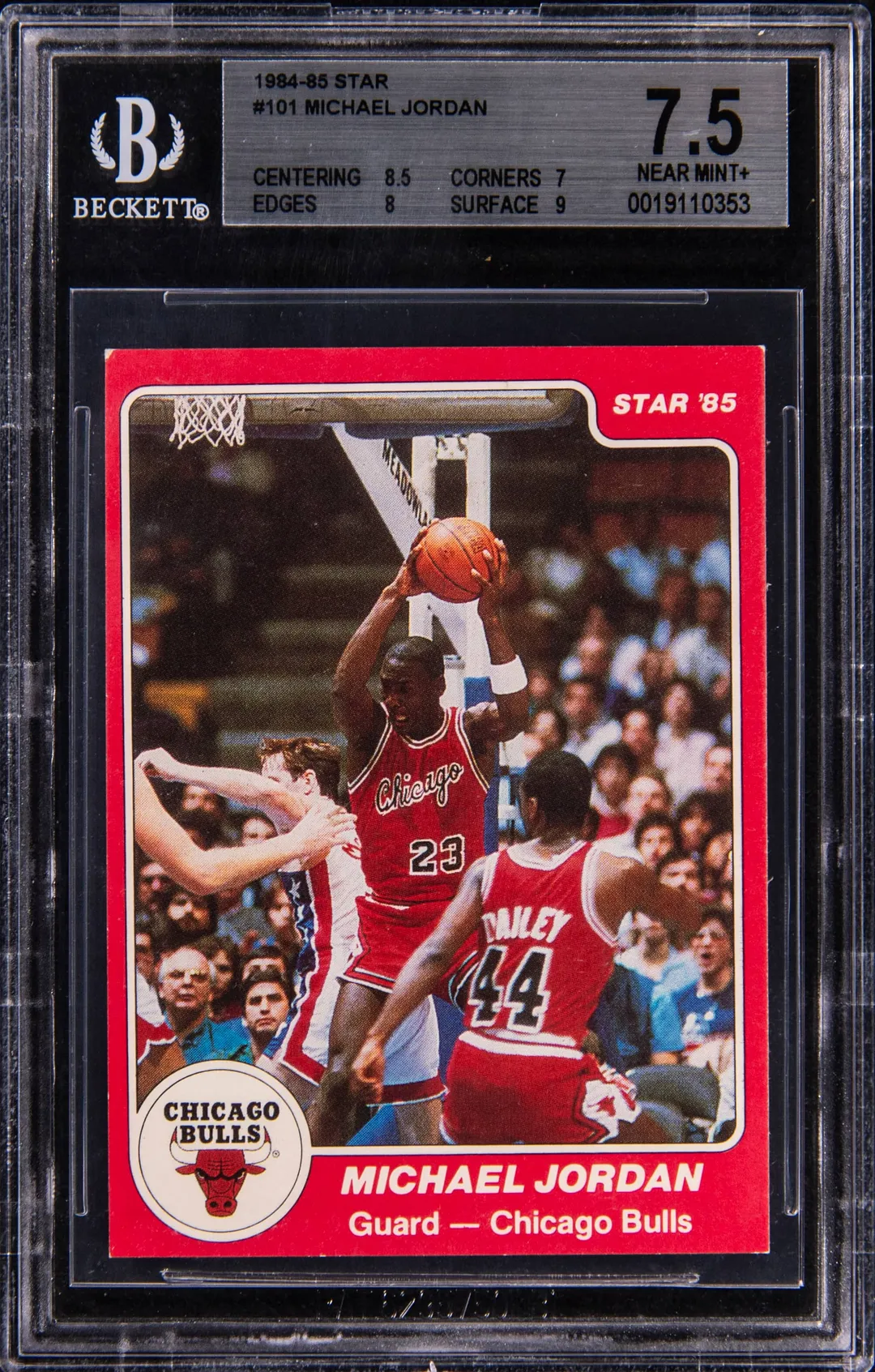
1984-85 Star #101 Michael Jordan BGS 7.5 Sale
Goldin sold a 1984-85 Star #101 Michael Jordan BGS 7.5 rookie for $40,260 on Feb 8, 2026. See how this key early Jordan card fits current market trends.
Sold Card
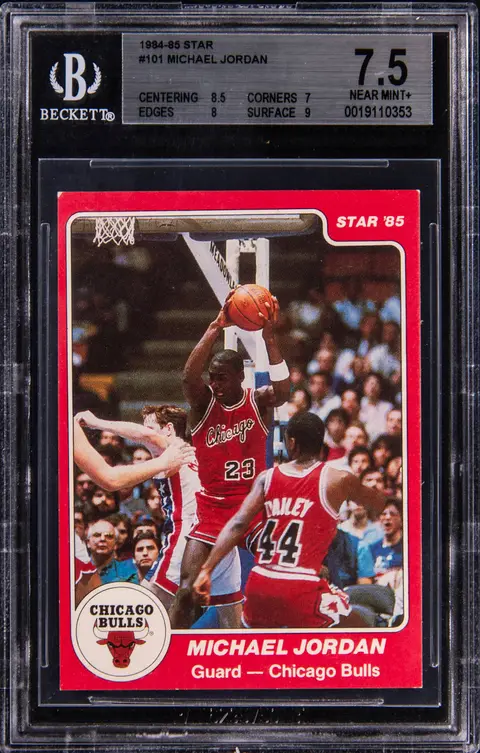
1984-85 Star #101 Michael Jordan Rookie Card - BGS NM+ 7.5
Sale Price
Platform
Goldin1984-85 Star #101 Michael Jordan Rookie Card Sells for $40,260 (BGS 7.5)
On February 8, 2026, Goldin sold a 1984-85 Star #101 Michael Jordan rookie card graded BGS NM+ 7.5 for $40,260. For collectors who track early Jordan markets, this is a meaningful data point in an often misunderstood corner of the hobby.
In this post, we’ll break down what this card is, why it matters, how this sale fits into recent pricing, and what collectors can reasonably take away from it.
The card at a glance
- Player: Michael Jordan
- Team: Chicago Bulls
- Year: 1984-85
- Set: Star Company (commonly called “1984-85 Star”)
- Card number: #101
- Type: Widely recognized as Jordan’s first NBA-licensed base card and a key early issue
- Grading company: Beckett Grading Services (BGS)
- Grade: NM+ 7.5 (Near Mint Plus)
- Attributes: Standard base card, no autograph or patch
This is not the 1986-87 Fleer Jordan that many casual fans think of as “the” rookie card. Instead, the 1984-85 Star #101 is Jordan’s first widely collected, NBA-licensed card that predates the Fleer issue by two seasons.
Why the 1984-85 Star #101 matters
An early, foundational Jordan issue
The Star #101 occupies a unique space in Jordan’s card timeline:
- It is contemporary with his true rookie NBA season (1984-85).
- It’s part of a team-issued style release, distributed in polybags rather than traditional retail packs.
- For many collectors, it represents Jordan’s earliest mainstream NBA card, even though hobby debates continue about labels like “true rookie.”
Regardless of terminology, the card is treated as a major early Jordan key. When people build a long-term Jordan collection, this card frequently sits near the center alongside the 1986 Fleer rookie, 1986 Fleer Stickers, and important 1990s inserts.
A product of the Star Company era
Star Company produced NBA-licensed cards from 1983 to 1986, before Fleer’s 1986-87 return. Their distribution model was narrower than mass-market wax of the late 1980s and 1990s. Cards came in team bags and small sets, not standard packs.
This has two important implications:
- Scarcity feels different. There is less of a clear print-run narrative compared to mass-produced “junk wax” era sets.
- Condition and authenticity matter a lot. Star’s production quality and later issues with counterfeit and reprinted cards made grading and verification especially important.
Ongoing grading and authenticity considerations
For many years, PSA did not grade Star Company cards due to concerns about authenticity and reprints. BGS became the main grader of record for Star issues, building the most established population data.
As a result, BGS-graded Star Jordans effectively set the market tone. A BGS 7.5 sits in the mid-grade range—solid eye appeal for many collectors, but well below high-end BGS 9 and 9.5 copies, which command much larger premiums.
The sale: $40,260 at Goldin (BGS 7.5)
- Final price: $40,260
- Auction house: Goldin
- Sale date (UTC): February 8, 2026
- Grade: BGS NM+ 7.5
Converted from the provided cents figure, this sale closed at just over $40k. To understand what that means, we need to look at comps (short for “comparables” – recent sales of the same or very similar card).
Price context and recent comps
Because Star cards do not transact as frequently as the 1986 Fleer Jordan, sales data is thinner and more volatile, especially across grades. Still, recent public auction results provide some structure:
- Higher grades (BGS 8.5–9): Historically, BGS 9 copies of the Star #101 have sold far above mid-grade territory, reflecting both condition scarcity and stronger investor demand.
- Mid grades (BGS 7–8): This tier tends to see a wider range of results, depending heavily on centering, color, and overall eye appeal, not just the number on the label.
- Lower grades (below BGS 7): These copies usually trade at a significant discount, often targeted by collectors who prioritize owning the card over condition.
Within that framework, a BGS 7.5 at $40,260 sits in a mid-range slot for an important but sensitive card. It is not at the extreme high end of historical Star #101 sales, but it is still a strong five-figure result for a mid-grade example.
Given the card’s grading history, population data, and the relative scarcity of clean, verified copies, the realized price is consistent with the idea that the market still treats this as a core Jordan key, even if the peak pricing levels seen during the most aggressive hobby spikes have cooled.
Because Star Jordans don’t appear at auction as often as Fleer rookies, individual sales can swing based on bidder competition, timing, and lot presentation. That makes each mid-grade sale a useful reference point, but not a definitive benchmark on its own.
Where this sale fits in Jordan’s broader market
In relation to the 1986 Fleer rookie
The 1986 Fleer #57 Jordan PSA 8, 9, and BGS equivalents trade far more frequently, providing a clearer, more liquid index of Jordan demand. Compared to those:
- The Star #101 is scarcer in population and transaction count, especially in authenticated, graded form.
- Price movements tend to be less smooth; a single strong or weak auction can shift perceived value more noticeably.
- Collectors often view the Star #101 as a specialized piece: essential for deep Jordan or Star-specific collectors, optional for casual fans.
This $40k BGS 7.5 result underlines that serious collectors still assign a significant premium to Star-era Jordan pieces, even if they focus more public attention on the Fleer flagship rookie.
Era and condition sensitivity
The 1984-85 Star set falls into what some call the early modern period—post-vintage but pre-mass “junk wax.” For this era:
- Card stock and printing were more fragile and variable than many later releases.
- Centering and edges are common issues, keeping truly high grades relatively tough.
- The combination of age, distribution, and condition sensitivity supports a tiered premium structure by grade, particularly from BGS 7.5 and up.
In that light, a BGS 7.5 result over $40k reinforces how the market values authenticated mid-grade examples as a meaningful step up from raw or lesser-verified copies.
Collector takeaways
Here are a few practical, non-speculative observations collectors can consider from this Goldin sale:
The Star #101 remains a recognized Jordan cornerstone. Even in mid-grade, its pricing shows that serious collectors continue to treat it as a foundational card in Jordan’s catalog.
Grading and verification are central to value. For Star cards in particular, buyers place a clear premium on trusted grading (historically BGS for this issue), reflecting long-running concerns about authenticity and condition.
Mid-grade does not mean marginal. While hobby attention often gravitates to top grades, this BGS 7.5 sale at $40,260 highlights that clean, honest mid-grade Star Jordans still command substantial demand.
Auction context matters. A major house like Goldin often attracts more eyes and underbidders, which can support stronger realized prices than low-visibility sales. When reviewing comps, it is important to consider not just the card and grade, but also where and when it sold.
Jordan’s long-term relevance supports steady interest. Jordan’s playing career, cultural impact, and ongoing presence in the hobby are well established. While prices can and do move in both directions, the underlying collector base for his key cards remains broad.
How small collectors and sellers can use this data
For collectors and small sellers, a five-figure auction result can still be useful information even if you’re not buying or selling at this level:
- Benchmarking: If you own lower-grade Star Jordans or are considering one, mid-grade results like this help frame the rough hierarchy of value across the grade scale.
- Research habits: This sale is a reminder to check not only the obvious Fleer rookies, but also Star-era comps when evaluating Jordan cards.
- Expectations: Instead of treating any single realized price as a promise, think of sales like this as part of a moving range that responds to market conditions, supply, and bidder competition.
At figoca, we try to place individual headline sales into a broader, data-aware context. The February 8, 2026 Goldin sale of the 1984-85 Star #101 Michael Jordan BGS 7.5 at $40,260 is another data point confirming that early, authenticated Star Jordans remain a serious part of the Michael Jordan market—especially for collectors who value historical placement and set-specific nuance.