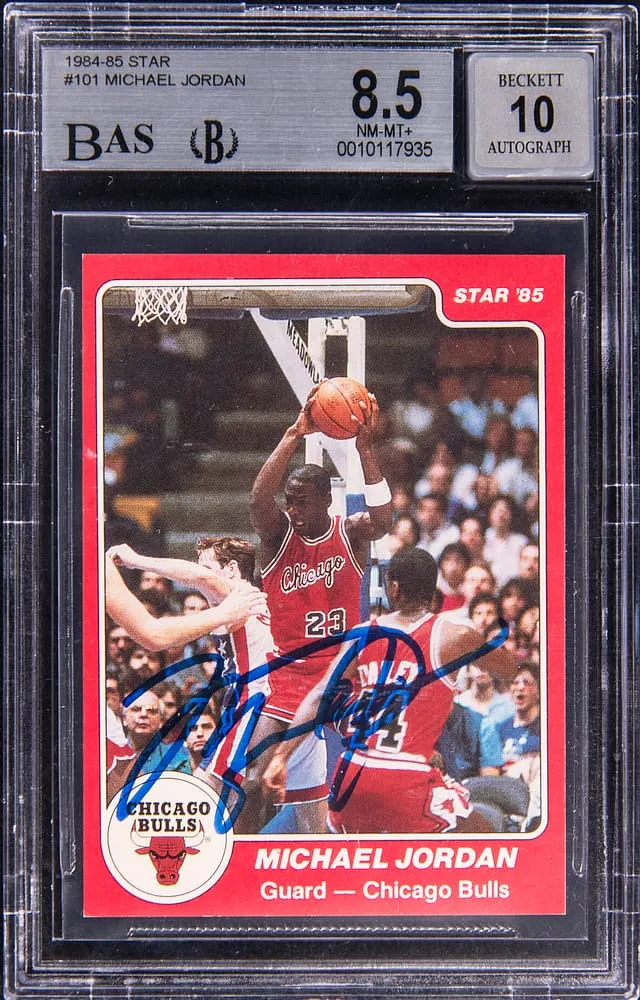
1984-85 Star #101 Michael Jordan Auto Sells for $542.9K
Goldin sold a BGS 8.5, Beckett 10 auto 1984-85 Star #101 Michael Jordan rookie for $542,900. See how this result fits the Jordan and Star Co. market.
Sold Card
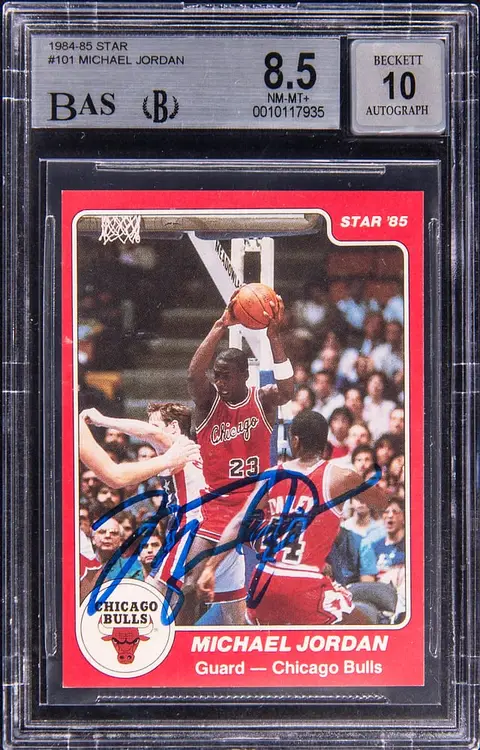
1984-85 Star #101 Michael Jordan Signed Rookie Card - BGS NM-MT+ 8.5, Beckett 10
Sale Price
Platform
Goldin1984-85 Star #101 Michael Jordan Signed Rookie Card Sells for $542,900
On March 8, 2026, Goldin closed a notable sale for one of the most debated and studied Jordan issues in the hobby: a 1984-85 Star #101 Michael Jordan signed rookie card, graded BGS NM-MT+ 8.5 with a Beckett 10 autograph. The final price landed at $542,900.
For collectors who follow Jordan markets and enjoy digging into set history, this sale sits at the intersection of three forces: the unique status of Star Co. cards, the ongoing premium for high-end Michael Jordan rookies, and the added layer of an on-card autograph with a perfect grade.
What exactly is this card?
Let’s break down the basics of the card that sold:
- Player: Michael Jordan
- Team: Chicago Bulls
- Year / Set: 1984-85 Star Company, card #101
- Type: Widely regarded as Jordan’s first NBA-licensed card and treated by many as a rookie issue
- Autograph: On-card signature, Beckett graded 10 (gem-mint autograph)
- Card Grade: BGS 8.5 (NM-MT+)
- Attributes: Early Star Co. Jordan, signed, dual-graded (card + auto)
While a lot of hobby shorthand calls this a “Star rookie,” it’s important context that the 1984-85 Star #101 predates the more universally recognized 1986-87 Fleer Michael Jordan rookie. Star’s distribution model (team bags, regional availability, and hobby-only channels) and later concerns about counterfeit and reprinted runs have always made these cards a little more complex than typical pack-pulled rookies.
Why the 1984-85 Star #101 matters
The 1984-85 Star #101 is significant for several reasons:
- Timeline – It is one of the earliest mainstream, NBA-licensed cards featuring Michael Jordan in a Chicago Bulls uniform, produced before the 1986-87 Fleer release.
- Set reputation – The Star Company sets from 1983–1986 fill a gap between early-1980s regional/oddball issues and the widely distributed Fleer era. That means these cards have a different scarcity profile than post-1986 mass-produced sets.
- Condition sensitivity – Many Star cards suffer from centering issues, edge wear from bagged distribution, and color chipping. High-grade examples—especially with strong eye appeal—do not appear in volume.
- Authenticity scrutiny – Due to historical concerns over counterfeit and reprinted Star cards, collectors often lean heavily on trusted authentication and grading from major companies. A BGS holder with a clear pedigree is particularly meaningful to many buyers.
That background helps explain why a signed, BGS-graded copy commands attention at the high end of the market.
Understanding the BGS 8.5 / Beckett 10 combination
Beckett grades both the card and the autograph. Here’s what those grades signal:
- BGS 8.5 (NM-MT+) – This is a high, but not elite, grade for a mid-1980s Star issue. It typically suggests only modest wear: perhaps slight corner touches, minor edge or surface issues, or centering that is a bit off but still very presentable.
- Beckett 10 Autograph – A perfect auto grade. This generally means:
- Strong, consistent ink flow
- No visible smudges or streaking
- Signature fully within the intended signing area
For many collectors of signed vintage and mid-1980s cards, the autograph grade can be as important as the card grade. A BGS 8.5 with a 10 autograph can be more attractive to some buyers than a slightly higher card grade with a weaker auto.
Market context and recent sales
Because Star Company Jordan cards occupy a more specialized corner of the hobby, they do not change hands as frequently as the 1986 Fleer rookie. That means the sample size of recent auction results—especially for signed, dual-graded copies of the exact 1984-85 Star #101 card—is relatively limited.
To build context, collectors usually look at two clusters of data:
Unsigned 1984-85 Star #101 Jordans in similar grades
These give a baseline for the card itself—how the market values the underlying piece of cardboard in different BGS grades.Signed or dual-graded Star #101 Jordans (BGS card + auto)
These are closer comparables because the autograph introduces a different demand profile: some collectors are specifically building signed runs or chasing high-grade autos.
Recent public auction data across major houses and marketplaces (Goldin, Heritage, PWCC, and other established platforms) show that:
- Unsigned BGS 8.5 copies have typically traded well below the price level achieved by this signed example.
- High-end signed Star Jordan cards, particularly with strong authentication and top autograph grades, have formed a smaller but noticeably premium tier over their unsigned counterparts.
Within that framework, the $542,900 sale price for this BGS 8.5 / Beckett 10 auto sits toward the upper range of what collectors have recently been willing to pay for high-grade, signed Star Jordan rookies. It reflects both the added value of an on-card signature with a perfect autograph grade and the ongoing willingness of the market to differentiate between routine copies and special examples.
Because exact, fully comparable prior sales (same card, same card grade, same auto grade) are still relatively scarce, it’s more accurate to treat this result as a strong data point within a broader range rather than a precise benchmark.
How this sale compares within the Jordan rookie ecosystem
To make sense of this result, it helps to place it alongside other key Jordan issues:
- 1986-87 Fleer #57 Jordan rookie (PSA 10 or BGS 9.5) remains the most widely recognized and liquid Jordan rookie. Its population is substantially larger, and comp data ("comps" are recent comparable sales used as reference points) is very robust.
- 1984-85 Star #101 Jordan has:
- Smaller populations in high grade
- More nuanced authentication concerns
- A more specialized, but very focused, collector base
Over the past several years, the market has increasingly acknowledged the importance of Star Jordan cards within the broader Jordan timeline. While the Fleer rookie drives the headlines, strong Star examples have begun to carve out clearer tiers of value, especially when they combine condition, provenance, and premium features (like an on-card autograph).
This Goldin sale reinforces that separation: not every Star Jordan commands this kind of number, but a high-grade, well-authenticated, perfectly autographed copy can attract capital that is closer to top-tier Fleer territory than to mid-tier Jordan inserts or later-era parallels.
Collector significance: who cares about this card and why?
Different collector groups view this card through slightly different lenses:
Jordan-focused collectors
For someone building a deep Michael Jordan collection—beyond just the Fleer rookie—this card represents an important checkpoint on the timeline: an early, NBA-licensed Bulls card with a premium autograph. The fact that it’s a well-presented example in a BGS 8.5 slab with a Beckett 10 autograph makes it eligible for long-term “centerpiece” status in a focused Jordan collection.Star Company specialists
Collectors who specialize in Star Co. see #101 as one of the set’s true anchors. Within that group, signed and high-grade copies add further layers of scarcity.High-end autograph collectors
Some collectors prioritize the look and quality of the signature even over the underlying card. A perfect auto grade from Beckett, on a historically meaningful Jordan issue, fits nicely into that lane.
Across all three groups, the consistent themes are:
- Early career Jordan
- Recognized, if nuanced, rookie-era status
- High confidence in authenticity and grading
- Visually strong presentation
Era and scarcity: where 1984-85 Star fits
The 1984-85 Star set falls into what many collectors now think of as the bridge between vintage and the modern “junk wax” boom:
- Pre-junk-wax distribution – Star sets weren’t mass-produced and widely distributed at retail in the same way late-1980s and early-1990s products were. They were sold as team bags through hobby channels.
- Condition and storage – Many of these cards did not benefit from the same level of early protection (penny sleeves, top loaders, grading) that later cards received.
- Population reports – Grading company population reports ("pop reports," which count how many copies exist in each grade) show that high-grade Star Jordans are relatively limited when compared to post-1986 flagship issues.
This structural scarcity is part of what supports premium pricing for strong examples, particularly when combined with a top-grade autograph.
Possible hobby influences around the time of sale
When a high-end Jordan card sells, collectors often look for short-term drivers—anniversaries, documentaries, Hall of Fame tie-ins, or renewed media attention. Jordan’s legacy is already well-established, so the bigger factor here is usually long-term collector behavior rather than sudden spikes.
Recently, hobby trends that may frame this sale include:
- A renewed interest in defining and revisiting true rookie cards, especially for stars whose early careers overlap multiple manufacturers and regional issues.
- A steady focus on quality over quantity—fewer cards, but better examples, with strong grading and eye appeal.
- Ongoing interest in on-card autographs from iconic players, as collectors differentiate them from sticker autos or later-era issues.
This Goldin result fits that broader pattern: a meaningful, early Jordan card with a premium autograph, selling for a strong but not unprecedented number within the high-end Jordan market.
What this means for collectors and small sellers
For most collectors, this sale is less about chasing a half-million-dollar card and more about understanding how the market values:
- Authenticity and confidence in grading
- The combination of card grade and autograph grade
- Historically significant issues, even when they sit slightly outside the standard flagship narrative
Some practical takeaways:
- Context matters more than any single sale. One auction at $542,900 is a data point, not a guarantee. Looking at a spectrum of results (high, mid, and low sales) provides a clearer picture of how a card is generally valued.
- Eye appeal and grading alignment matter. A balanced combination—strong card grade plus top autograph grade—often commands a noticeable premium.
- Documentation and provenance help. For sets with complicated histories like Star Co., buyers tend to favor examples with transparent grading, clear authentication, and an auction-house trail they trust.
If you’re a newer collector or a small seller, the lesson isn’t to chase this specific card—it’s to understand how the market layers value:
- Player and era
- Card importance within that player’s catalog
- Condition and grading
- Autograph quality (if applicable)
- Market confidence in authenticity and provenance
Final thoughts
The March 8, 2026 Goldin sale of the 1984-85 Star #101 Michael Jordan signed rookie card—BGS 8.5 with a Beckett 10 autograph—for $542,900 is another reference point in the ongoing story of high-end Jordan collecting.
It doesn’t rewrite the hobby, but it does quietly reinforce a few truths: early, well-authenticated Jordan issues continue to command attention; Star Company cards have carved out a stable, if nuanced, role in the Jordan hierarchy; and when strong grading and a perfect autograph come together on a meaningful card, the market is willing to pay a premium.
For collectors tracking long-term trends rather than short-term spikes, this sale is a useful marker of how the hobby currently values one of Jordan’s most important early cards.