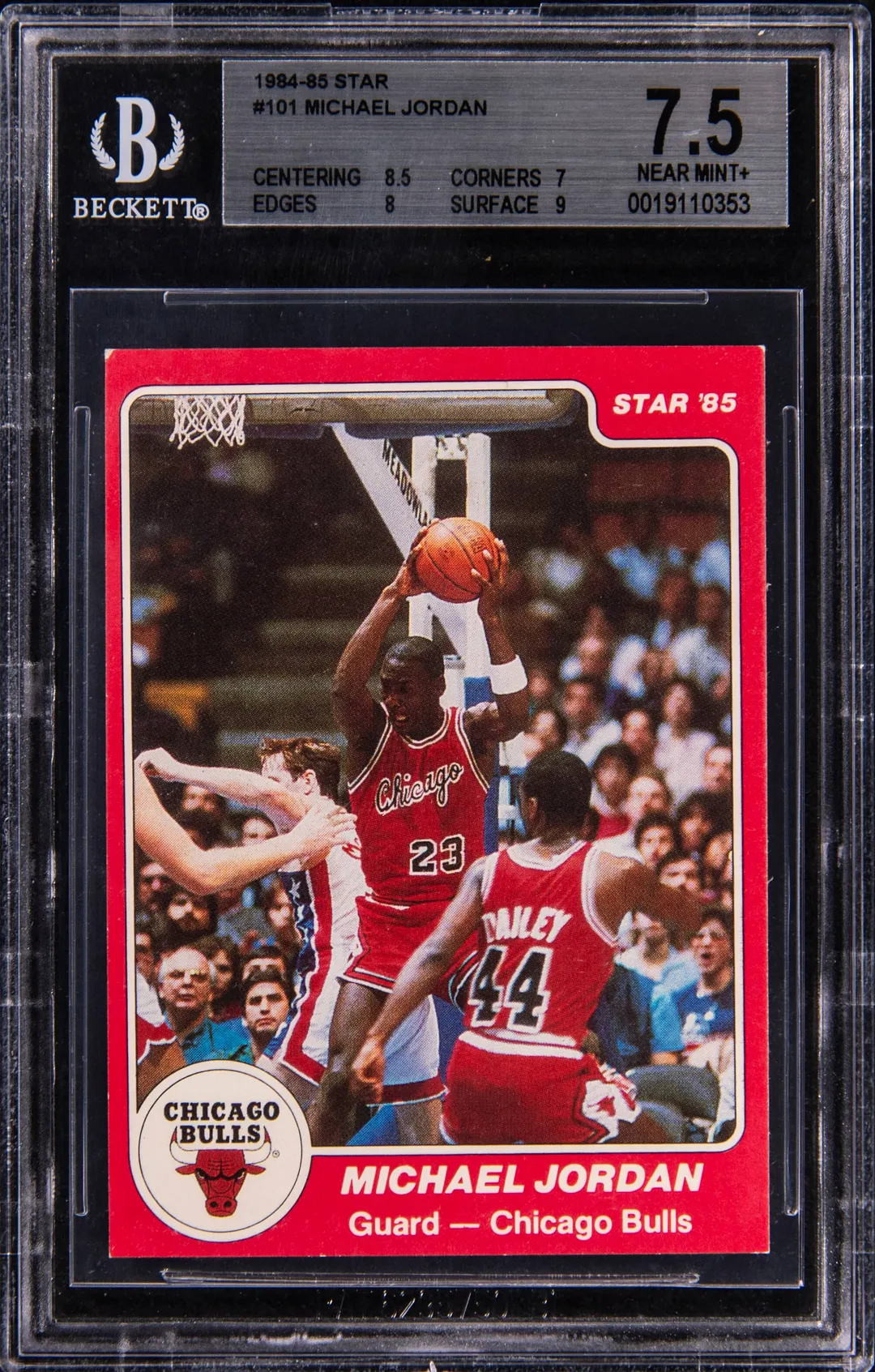
1984-85 Star #101 Jordan BGS 7.5 sells for $40,260
Goldin sold a 1984-85 Star #101 Michael Jordan rookie BGS 7.5 for $40,260. See how this key Jordan issue fits into today’s market context.
Sold Card
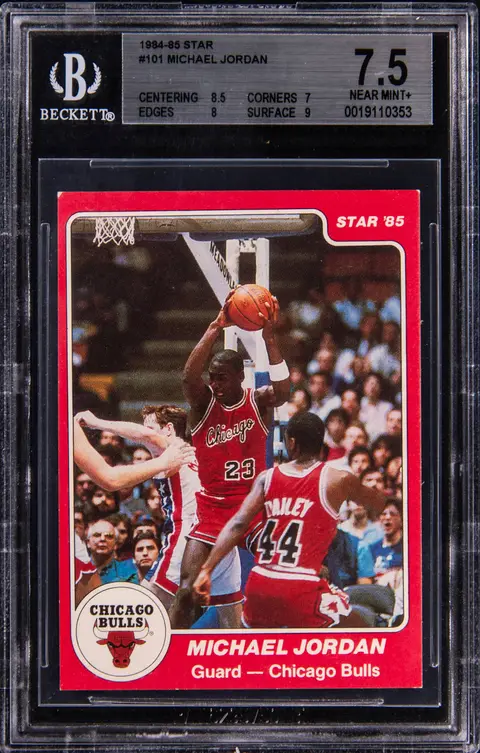
1984-85 Star #101 Michael Jordan Rookie Card - BGS NM+ 7.5
Sale Price
Platform
Goldin1984–85 Star #101 Michael Jordan Rookie Card (BGS 7.5) Sells for $40,260
On February 8, 2026, Goldin sold a 1984–85 Star #101 Michael Jordan rookie card graded BGS NM+ 7.5 for $40,260. For a card that sits outside the traditional “flagship” Jordan rookie lane, this is a meaningful data point for how the hobby currently values Star Company Jordans.
In this post, we’ll look at what this card is, why it matters to collectors, and how this sale fits into recent price context.
What exactly sold?
- Player: Michael Jordan
- Team: Chicago Bulls
- Year: 1984–85
- Set: Star Company, often referred to as “1984–85 Star”
- Card number: #101
- Type: Widely regarded as Jordan’s first NBA-licensed card and a key rookie issue
- Grading company: Beckett Grading Services (BGS)
- Grade: NM+ 7.5 (Near Mint Plus)
- Attributes: Standard base card from the team bag issue, no autograph or memorabilia
The 1984–85 Star #101 is not a parallel, insert, or serial-numbered card. It comes from Star Company’s poly-bagged Bulls team sets distributed in the mid-1980s, before Fleer’s 1986–87 set reintroduced mainstream NBA cards to a wide audience.
While there is ongoing debate in the hobby about how to label it—"true rookie" vs. “XRC” (extended rookie card)—most serious Jordan collectors treat the Star #101 as a foundational early Jordan card.
Why the 1984–85 Star #101 matters
A pre-Fleer Jordan rookie
For many collectors who grew up with the 1986–87 Fleer #57, that card feels like the Jordan rookie. But chronologically, the 1984–85 Star #101 comes first and is Jordan’s earliest widely recognized, NBA-licensed card in a standard card format.
The Star Company era (early to mid-1980s) is a bit different from 1986 Fleer and later:
- Cards were distributed mainly through team and year-specific bags, not wax packs found at every corner store.
- Surviving examples can suffer from issues related to storage, bag handling, and later re-bagging.
- For years, major grading companies approached Star cards cautiously due to concerns about reprints and distribution.
Because of this, high-confidence, third-party graded copies from established graders are especially important for collectors.
Era and scarcity
The 1984–85 Star Jordan is from what many consider the early-modern era of basketball cards, before the late-1980s “junk wax” boom. Production scales were significantly lower than the early-1990s mass production period.
That doesn’t make the card rare in an absolute sense, but compared with the later flood of Jordan cards, properly graded Star #101s are meaningfully less common, especially at higher grades.
Grading and condition
- BGS 7.5 NM+ signals a card that is clean but not high-end mint.
- Common condition issues for this card include soft corners, minor edge fraying from bag handling, centering, and occasional print defects.
For Star Jordans, collectors often focus not just on the overall grade, but also subgrades (centering, corners, edges, surface) when those are provided. Even in the mid-grade range (6–8), eye appeal can vary a lot.
Market context: where does $40,260 fit?
When collectors talk about “comps,” they mean recent comparable sales of the same card (or very close versions) used to get a sense of the current market range.
Because the market for Star Jordans has had periods of both intense interest and caution, comps can move around over time. Recent public auction data (across major houses and marketplaces) generally shows:
- Higher-grade BGS examples (8.5, 9, and above) selling at a strong premium to mid-grade copies.
- Mid-grade examples (6–8) forming a fairly active middle tier, where eye appeal and timing have a noticeable impact.
A BGS 7.5 is squarely in that mid-grade tier. A realized price of $40,260 at Goldin in early 2026 indicates:
- The card continues to command a meaningful premium over many later Jordan inserts and parallels that are technically rarer but less historically important.
- Collectors are still willing to pay up for authenticated, graded Star #101s, even when they are not in top-tier grades.
Without assuming a specific “correct” price, this sale lands in a range that aligns with the card’s status: more accessible than the elite high-grade population, but still clearly a key Jordan piece.
Comparing to related Jordan rookies
A simple way to think about this card is to place it next to its closest hobby cousins:
- 1986–87 Fleer #57 Michael Jordan Rookie – The widely recognized flagship rookie. High-grade PSA 9 and PSA 10 copies have historically sold for large five- and six-figure sums, depending on the market cycle.
- Other Star Jordans (e.g., 1984–85 Star #288, Star subsets) – Important early issues that tend to be valued below the #101 but still attract dedicated Jordan and Star specialists.
The Star #101 typically sits in a lane of its own: earlier than Fleer, more niche in distribution, and with a collector base that cares deeply about the card’s place in Jordan’s timeline.
Why collectors chase this card
Collectors and small sellers who focus on this card usually mention a few consistent reasons:
- Historical placement: It’s an early, NBA-licensed Jordan in Bulls uniform from his first pro season window.
- Set identity: Star Company represents a unique, shorter era between the classic Topps 1970s issues and the 1986 Fleer revival.
- Population and condition sensitivity: While not ultra-rare, graded populations are smaller than many later Jordan issues, and condition problems are common.
- Collector narrative: Owning a Star #101 often feels like owning a piece of pre-Fleer Jordan history rather than just another 1980s card.
What this Goldin sale tells us
This February 8, 2026 sale at Goldin doesn’t rewrite the record books, but it does provide a useful touchpoint for where a mid-grade, professionally graded Star #101 currently sits.
A few takeaways for collectors:
- Anchoring mid-grade values: For those tracking mid-grade Star Jordans, a BGS 7.5 at $40,260 helps frame expectations when looking at 6.5–8.0 copies.
- Condition still matters: Within the same grade band, eye appeal and subgrades can push prices higher or lower.
- Market remains card-specific: The Star #101 continues to behave differently from general 1980s base cards; its price is still driven by collector demand and historical importance rather than just print run.
How small sellers and returning collectors can use this info
If you’re coming back into the hobby or thinking about moving a Star Jordan:
- Look at multiple comps: Don’t rely on a single sale. Check several recent public auctions and fixed-price venues for the same card and grade.
- Cross-check grading: A BGS 7.5 won’t be directly comparable to a raw copy or a different grading company’s 7 or 8. Condition, authentication confidence, and brand reputation all play a role.
- Avoid assumptions: Past results, including this $40,260 Goldin sale, are useful references—not guarantees of future outcomes.
For collectors considering a Star Jordan, this sale reinforces that the 1984–85 Star #101 remains a central piece of Jordan’s cardboard story, even in a mid-grade slab.
At figoca, we track these kinds of sales because they help map the real-world behavior of key hobby cards—from vintage legends to modern stars. The 1984–85 Star #101 Michael Jordan in BGS NM+ 7.5 at $40,260 is one more data point in that ongoing picture.