1980 Topps Bird/Erving/Magic Multi-Signed RC Sale
Goldin sold a PSA 8, PSA/DNA 10 1980-81 Topps Bird/Erving/Magic multi-signed rookie card for $22,570. See the context behind this landmark card.
Sold Card
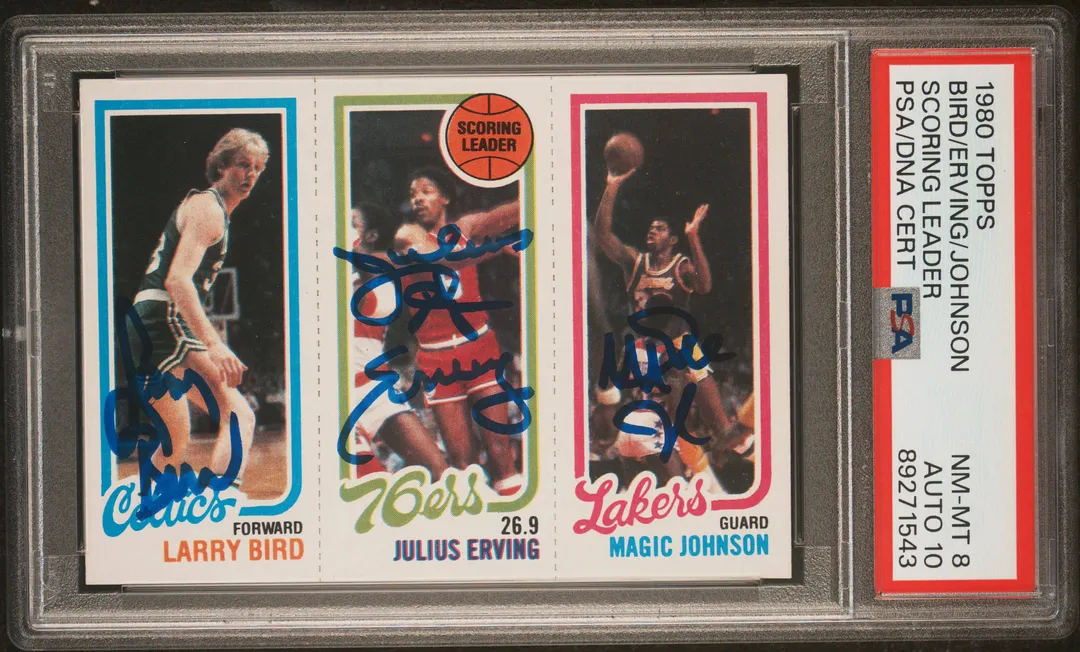
1980-81 Topps Scoring Leader Larry Bird/Julius Erving/Magic Johnson Multi-Signed Rookie Card - PSA NM-MT 8, PSA/DNA GEM MT 10
Sale Price
Platform
Goldin1980-81 Topps Scoring Leader Larry Bird/Julius Erving/Magic Johnson Multi-Signed Rookie Card - PSA NM-MT 8, PSA/DNA GEM MT 10 Sells for $22,570
On February 8, 2026, Goldin sold a hobby-favorite piece of early 1980s basketball history: a 1980-81 Topps Scoring Leader Larry Bird/Julius Erving/Magic Johnson multi-signed rookie card, graded PSA NM-MT 8 with a PSA/DNA GEM MT 10 autograph grade, for $22,570.
This card is one of the most recognizable basketball cards ever produced. When it’s signed by all three legends and graded strongly across both card and ink, it becomes a crossover piece that appeals to vintage set builders, autograph collectors, and high-end basketball-focused hobbyists.
In this breakdown, we’ll look at what exactly this card is, how this sale compares to recent market activity, and why this specific configuration matters so much to collectors.
The Card: 1980-81 Topps Scoring Leader Triple RC, Multi-Signed
Set and year
- 1980-81 Topps Basketball
- Known for its unusual three-player, perforated card design
Card specifics
- Card: 1980-81 Topps Scoring Leader Larry Bird / Julius Erving / Magic Johnson
- Often cataloged as the Bird/Erving/Magic Rookie, or simply the “1980 Topps Triple RC”
- All three players appear on one card:
- Left panel: Larry Bird (Boston Celtics) – rookie panel
- Center panel: Julius Erving (Philadelphia 76ers)
- Right panel: Magic Johnson (Los Angeles Lakers) – rookie panel
Card type and significance
- Considered the key rookie card for both Larry Bird and Magic Johnson.
- Julius Erving was already an established superstar by 1980, but his presence adds extra Hall of Fame weight.
- The 1980-81 Topps set is from the early “modern vintage” era: production isn’t as limited as today’s premium sets, but high-grade, well-centered examples are still challenging due to printing, perforations, and handling.
Grading and authentication
- Card grade: PSA NM-MT 8 (Near Mint-Mint).
- In PSA’s 1–10 grading scale, an 8 indicates a clean, sharp card with only minor flaws (small touches to corners, light print or surface issues).
- Autographs: PSA/DNA GEM MT 10.
- PSA/DNA is PSA’s autograph authentication arm; GEM MT 10 means the signatures are essentially flawless in quality—bold, well-placed, and consistent.
- Multi-signed by Larry Bird, Julius Erving, and Magic Johnson on the same copy.
Multi-signed versions of this card are a niche within the larger population of 1980 Topps Bird/Magic rookies. The card is widely collected in unsigned form; the triple-signed examples provide an additional layer of scarcity and appeal.
Why This Card Matters to Collectors
1. Dual flagship rookies on one card
For most players, collectors focus on a single “flagship rookie” from a major brand like Topps. Here, the hobby gets something unusual: the premier mainstream rookie panels of both Larry Bird and Magic Johnson on a shared card.
- Larry Bird: Boston Celtics legend, 3× NBA champion, 3× MVP.
- Magic Johnson: Los Angeles Lakers icon, 5× NBA champion, 3× MVP.
- Julius Erving: ABA/NBA superstar, influential stylistically and historically.
Two all-time greats debuting on the same piece, flanking another Hall of Famer, gives this card a special place in basketball history and in the market.
2. The era and set design
The 1980-81 Topps set is part of what many collectors consider the bridge between true vintage and the expanding print runs of the mid- to late-1980s.
- Three-player format: Each card in the set features three players in perforated panels, which many kids separated at the time. Intact, well-preserved examples are now more desirable.
- Condition challenges: Centering, chipping along edges, and perforation alignment all impact grades. High-grade copies are relatively tough compared with later “junk wax” era issues.
3. On-card, multi-player autographs
This example is on-card signed by Bird, Erving, and Magic. On-card means the autographs are signed directly on the card surface rather than on a separate sticker.
Multi-signed copies present a few additional points of scarcity and complexity:
- Logistics: Getting three Hall of Famers to sign the same card, in appropriate locations, without smudges or fading, is more difficult than a single-player autograph.
- Risk: Sending a graded vintage card through multiple signing opportunities introduces handling risk.
- Presentation: Placement and ink quality matter; PSA/DNA’s GEM MT 10 grade confirms the autographs are strong.
For collectors who focus on autographed rookie cards, a triple-signed Bird/Erving/Magic is one of the more distinctive pieces available from the early 1980s.
Market Context and Recent Sales
To understand this sale, it helps to separate two overlapping markets:
- Unsigned 1980-81 Topps Bird/Erving/Magic rookies (by grade).
- Autographed and multi-signed versions, where the card grade and auto grade both impact value.
Unsigned copies (for baseline context)
Unsigned PSA 8 copies of the 1980 Topps Bird/Erving/Magic rookie routinely trade in public auction and on major marketplaces.
- PSA 7: Often used as an entry point; pricing tends to be meaningfully below PSA 8.
- PSA 8: A popular “collector grade,” usually offering a strong balance of eye appeal and cost relative to PSA 9 and 10.
- PSA 9 and 10: These command a substantial premium due to condition scarcity; high-end investors and set registry competitors focus here.
Over the last few years, unsigned PSA 8 examples have generally transacted for a fraction of this $22,570 result, while PSA 9 and 10 examples have pushed much higher, especially during peak hobby cycles around 2020–2021. The key takeaway: the autograph component is doing a lot of the work in this sale.
Multi-signed and autographed versions
The population of triple-signed Bird/Erving/Magic rookies is far smaller than the unsigned base population. Within that smaller pool, there’s another layer of scarcity: examples that pair a strong card grade (PSA 8 or better) with a GEM MT 10 auto grade.
Recent public results for comparable pieces (Bird/Magic/Dr. J multi-signed, similar card grade, strong autograph grade) on major auction platforms and marketplaces generally cluster in a range that makes a $22,570 sale competitive but not out of step with what collectors have been willing to pay for premium, well-presented copies.
Pricing for these pieces can vary due to:
- Exact card grade (PSA 7 vs 8 vs 9).
- Autograph grade and placement.
- Eye appeal factors like centering, signature contrast, and whether inscriptions are present.
- Timing and visibility of the auction (which auction house, how widely it was promoted, and broader market sentiment).
The Goldin result on February 8, 2026, sits in line with recent strong but measured demand for high-quality, multi-signed versions of this card.
What This Sale Suggests About the Market
1. Continued interest in early 1980s Hall of Fame rookies
This sale reinforces that there is sustained collector interest in early 1980s basketball, especially when multiple Hall of Famers are involved.
- The Bird/Magic rookie has long been considered a “must-have” card for anyone building a serious basketball collection.
- Autographed copies, and especially multi-signed copies, sit in a more specialized lane but still draw consistent attention.
Even as modern and ultra-modern releases produce rare serial-numbered parallels and patch-autographs, many collectors still allocate budget to cornerstone vintage and early modern pieces like this.
2. Card + autograph combos are their own category
A graded card with a separately graded autograph effectively creates a hybrid collectible:
- The card grade speaks to vintage condition standards (corners, edges, surface, centering).
- The autograph grade reflects how clean, bold, and well-preserved the signatures are.
Collectors who chase this category increasingly look for:
- Balanced combinations (e.g., PSA 8 card with a GEM MT 10 auto).
- Consistent ink color and placement that reads well in a display.
- Third-party authentication from widely trusted services like PSA/DNA.
This sale fits squarely into that lane and shows that the market continues to differentiate between merely "signed" copies and highly curated, high-grade signed examples.
3. Stability over speculation
Unlike speculative modern prospects or short-lived hype cycles, the Bird/Erving/Magic rookie is built around settled careers and long-standing reputations:
- All three players are Hall of Famers with well-understood legacies.
- Their statistical and cultural impact in the NBA is already fully baked into collector expectations.
That doesn’t eliminate price swings—macro hobby conditions still matter—but it does shift the focus away from short-term performance and toward condition, presentation, and overall rarity of the specific configuration.
Key Takeaways for Collectors and Small Sellers
For newcomers, returning collectors, or small sellers looking at this sale and wondering what it means for them, a few practical points:
Know which version you’re looking at.
- Unsigned vs single-signed vs triple-signed makes a major difference.
- Card-only grade vs card + auto grade also matters.
Use comps carefully.
In the hobby, “comps” refers to comparable recent sales that help you understand a realistic price range. For this card, good comps would be:- Other 1980-81 Topps Bird/Erving/Magic rookies in the same card grade and similar autograph configuration.
- Sales from reputable auction houses (like Goldin) or mature secondary marketplaces with clear grading and description.
Condition and presentation drive the spread.
- Two PSA 8s are not always equal: centering, print quality, and signature placement can cause one to outperform the other.
- Autograph grade (GEM MT 10 vs lower auto grades) can have a measurable impact on final prices.
This sale is a data point, not a promise.
The $22,570 realized at Goldin on February 8, 2026 adds to the price history for multi-signed Bird/Erving/Magic rookies, but it does not guarantee future outcomes. Markets move, collector preferences evolve, and each individual card has its own nuances.
Final Thoughts
The 1980-81 Topps Scoring Leader Larry Bird/Julius Erving/Magic Johnson rookie card has always held a special place in basketball collecting. When it is preserved in PSA NM-MT 8 condition and carries a PSA/DNA GEM MT 10 triple autograph, it becomes more than just a rookie—it’s a compact, three-signature summary of an era.
Goldin’s February 8, 2026 sale at $22,570 confirms that there is steady, data-supported demand for well-graded, multi-signed copies of this iconic issue. For collectors building long-term basketball collections, it remains one of the clearest examples of how cardboard, ink, and history intersect in a single piece.