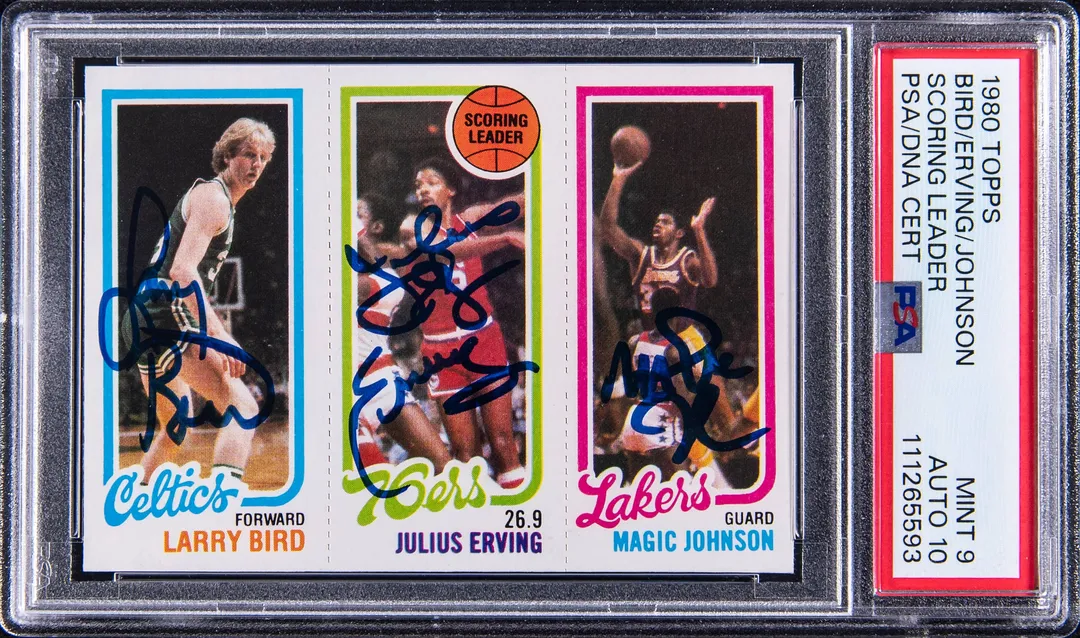
1980-81 Topps Bird/Magic Rookie Sells for $104,920
Goldin sold a PSA 9, PSA/DNA 10 multi-signed 1980-81 Topps Bird/Erving/Magic rookie card for $104,920 on Feb 8, 2026. Here’s the market context.
Sold Card
1980-81 Topps Scoring Leader Larry Bird/Julius Erving/Magic Johnson Multi-Signed Rookie Card - PSA MINT 9, PSA/DNA GEM MT 10
Sale Price
Platform
Goldin1980-81 Topps Scoring Leader Larry Bird/Julius Erving/Magic Johnson Multi-Signed Rookie Card - PSA MINT 9, PSA/DNA GEM MT 10 Sells for $104,920
On February 8, 2026, Goldin closed a notable sale for one of the hobby’s most recognizable vintage basketball cards: a 1980-81 Topps Scoring Leader Larry Bird/Julius Erving/Magic Johnson rookie card, multi-signed, graded PSA MINT 9 with a PSA/DNA GEM MT 10 autograph grade. The final price was $104,920.
For collectors who follow high-end basketball, this card combines three pillars of hobby demand: a key rookie, a historically important set, and premium autograph authentication.
The Card: What Exactly Sold?
Let’s break down the card and why it matters:
- Year & Set: 1980-81 Topps Basketball
- Card Type: Scoring Leader three-panel card
- Players:
- Larry Bird (Boston Celtics) – true Topps rookie panel
- Julius Erving (Philadelphia 76ers)
- Magic Johnson (Los Angeles Lakers) – true Topps rookie panel
- Card Status: Considered the flagship rookie card for both Larry Bird and Magic Johnson.
- Autographs: Multi-signed by Larry Bird, Julius Erving, and Magic Johnson
- Grading:
- Card grade: PSA MINT 9 (one step below a PSA 10 GEM MT)
- Autograph grade: PSA/DNA GEM MT 10 (top autograph grade, indicating a clean, bold signature presentation)
Unlike modern cards that are designed as autograph issues from the factory, this 1980-81 Topps is a standard base card that was later signed by all three legends. That makes it a crossover piece: a true vintage rookie card paired with modern-style authenticated, graded ink.
Why the 1980-81 Topps Bird/Erving/Magic Card Is So Important
The 1980-81 Topps Bird/Erving/Magic is one of the cornerstone basketball cards of the vintage and early modern era:
Dual flagship rookies: It’s the main recognized Topps rookie for both Larry Bird and Magic Johnson. Having two all-time greats share a rookie card is already unusual; pairing them with Julius Erving adds another Hall of Famer to the mix.
Three-panel design: The set is known for its three-player perforated format. Collectors could separate the panels along perforation lines, which means fully intact, well-centered examples became increasingly scarce over time.
Condition sensitivity: The vertical perforations, off-centering, and print issues make high-grade copies tough. PSA 9 and PSA 10 examples of this card—especially with strong centering—are heavily chased.
Era context: 1980-81 falls into what many consider the transition from true vintage into the early modern period for basketball. Production was lower than the mass "junk wax" era that followed later in the decade, and the NBA’s popularity was still building around Bird and Magic’s rivalry.
Adding on-card signatures of all three players essentially creates a premium, one-of-a-kind item even within the already-important base issue.
Market Context: How Does $104,920 Fit In?
When collectors talk about “comps,” they mean comparable recent sales used as reference points for value. For this card, there are three main categories that tend to be tracked:
- Unsigned 1980-81 Topps Bird/Erving/Magic in high grades
- Multi-signed copies without a high card grade
- Multi-signed copies with both strong card and autograph grades (like this one)
Unsigned High-Grade Copies
Unsigned PSA 9 and PSA 10 examples have long been considered bellwethers for vintage basketball.
- PSA 9 (unsigned): Historically has sold in the tens of thousands of dollars range, with realized prices fluctuating based on centering and broader market conditions.
- PSA 10 (unsigned): When they do appear, they have commanded six-figure prices in strong markets.
The key point is that this card is already an established blue-chip piece even in unsigned form.
Multi-Signed Versions
Multi-signed Bird/Erving/Magic copies are far less common than unsigned ones, and the population of:
- Clean, bold signatures from all three players
- On an intact, well-centered example
- With a high technical grade (PSA 9) and a top-tier autograph grade (PSA/DNA GEM MT 10)
is extremely limited.
Auction histories show that high-end dual- and triple-signed copies can sell for a meaningful premium over unsigned counterparts, but exact pricing often depends on:
- Signature placement (avoiding faces, strong contrast against the background)
- Ink quality (no fading, streaking, or bubbling)
- Whether the card grade and auto grade are aligned at the top of the scale
Within that context, $104,920 for a PSA 9 card grade plus PSA/DNA 10 auto sits in the territory collectors expect for a premium, investment-level example—particularly in an environment where top vintage basketball remains a focal point for many advanced collections.
This result does not appear as an outlier in the sense of being wildly detached from prior six-figure outcomes for elite examples of this card, especially PSA 10 unsigned copies or very strong signed ones. Instead, it fits in as another data point confirming the Bird/Erving/Magic’s status as a long-term, high-confidence key issue.
Grading, Autographs, and Scarcity
For newer collectors, here is why the specific grade combination on this card is important:
- PSA MINT 9 (card): Indicates sharp corners, clean edges, strong gloss, and only minor, mostly invisible flaws to the naked eye. For a perforated, early-1980s basketball card, that’s a high bar.
- PSA/DNA GEM MT 10 (autographs): PSA/DNA is the autograph authentication arm of PSA. A GEM MT 10 auto grade means the signatures are not only authentic, but also exceptionally strong in eye appeal—typically bold, well-centered, and free of smudging or significant fading.
The combination matters because:
- Many multi-signed vintage rookies have great ink but weaker card surfaces or centering.
- Others are strong card examples with one or more signatures that are light, streaky, or poorly placed.
Cards that check both boxes—high technical grade and top autograph grade—tend to be the ones that set the ceiling in auction results.
Why Collectors Care About This Sale
From a collector’s standpoint, this Goldin sale on February 8, 2026 is meaningful for several reasons:
Confirms demand for true iconic vintage rookies: Even as attention shifts to modern and ultra-modern cards, the market continues to validate cornerstone vintage/early modern issues.
Shows appetite for authenticated, high-end autos on vintage cards: Rather than relying only on pack-pulled modern autographs, many collectors are gravitating toward classic rookie cards signed later in the player’s career, especially when backed by top PSA/DNA grades.
Highlights the importance of grade + eye appeal together: At this level, buyers care about centering, perforations, surface, and how the signatures present against the artwork. The premium realized price reflects that the card likely scores well on those fronts.
Strengthens the Bird/Magic narrative: As hobby history continues to elevate the Bird vs. Magic rivalry and its role in building the modern NBA, this shared rookie card remains one of the clearest physical artifacts of that story.
How This Fits Into the Broader Basketball Card Market
The broader basketball market has evolved into several parallel lanes:
- Vintage and early modern hall-of-famer rookies (like this 1980-81 Topps card)
- 1990s inserts and parallels
- Modern and ultra-modern numbered parallels, patch autos, and case hits
This Goldin sale underlines that the first category—the foundational rookies of all-time greats—still commands consistent attention. While pricing can move up and down over time, this part of the market tends to be less driven by short-term hype and more by long-term hobby consensus about player greatness and card importance.
For small sellers and newer collectors, this sale is also a reminder:
- Classic, historically significant cards in strong condition often hold broad liquidity.
- Third-party grading and autograph authentication are central to how the high end of the hobby functions.
Key Takeaways for Collectors
- Card: 1980-81 Topps Scoring Leader Larry Bird/Julius Erving/Magic Johnson, multi-signed, flagship rookie for Bird and Magic.
- Grades: PSA MINT 9 card; PSA/DNA GEM MT 10 autographs.
- Sale: Closed at $104,920 at Goldin on February 8, 2026 (UTC).
- Market context: In line with prior six-figure outcomes for the very best examples of this iconic card; reflects sustained demand for top-tier vintage basketball.
As always, prices can move over time, and no single sale tells the full story. But for anyone tracking the trajectory of truly foundational basketball cards, this Goldin result is another clear marker of where the Bird/Erving/Magic rookie currently stands in the hobby’s hierarchy.
At figoca, we follow these kinds of sales closely so collectors—whether just coming back to the hobby or building an advanced PC—can understand how key cards behave in the real auction market over time.