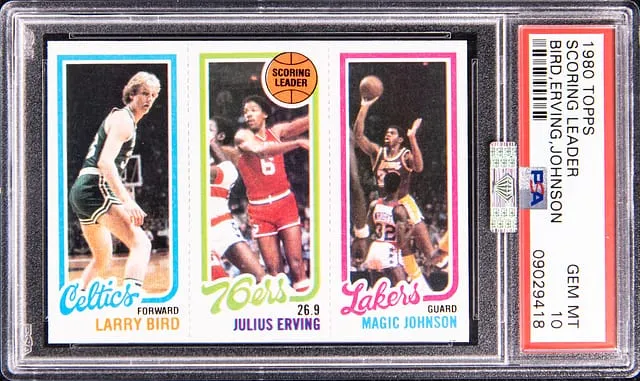
1980-81 Topps Bird/Magic Rookie PSA 10 Sells High
Goldin sells a PSA 10 1980-81 Topps Bird/Erving/Magic rookie scoring leader card for $622,201. figoca breaks down the card’s context and market impact.
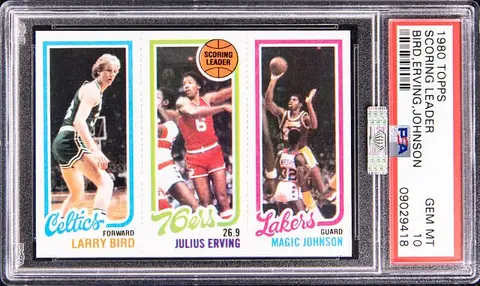
Sold Card
1980-81 Topps Scoring Leader Larry Bird/Julius Erving/Magic Johnson Rookie Card - PSA GEM MT 10 - MBA Silver Diamond Certified
Sale Price
Platform
Goldin1980-81 Topps Scoring Leader Larry Bird/Julius Erving/Magic Johnson Rookie Card - PSA GEM MT 10 - MBA Silver Diamond Certified Sells for $622,201
On March 8, 2026, Goldin auctioned one of the most important basketball cards ever printed: a 1980-81 Topps Scoring Leader Larry Bird/Julius Erving/Magic Johnson Rookie Card, graded PSA GEM MT 10 and MBA Silver Diamond Certified, closing at $622,201.
For collectors who follow key vintage pieces and true blue-chip basketball cards, this is a meaningful data point. Below, we break down what this card is, why it matters, and how this sale fits into the broader market picture.
The card at a glance
- Set: 1980-81 Topps Basketball
- Card: Scoring Leader tri-panel card
- Players: Larry Bird (Boston Celtics), Julius Erving (Philadelphia 76ers), Magic Johnson (Los Angeles Lakers)
- Type: Rookie card for both Bird and Magic (Dr. J is the established vet on the center panel)
- Format: Three-player perforated panel card (often found hand-cut or separated)
- Grading company: PSA (Professional Sports Authenticator)
- Grade: GEM MT 10 (PSA 10, their highest standard grade for pack-issued cards)
- Additional certification: MBA Silver Diamond Certified (an extra layer of card authentication/eye appeal review)
This is widely recognized as the key rookie card for both Larry Bird and Magic Johnson and a cornerstone card of the entire basketball hobby.
Why this card is so important
1. Two all-time rookies on one card
It’s unusual for a single card to carry the flagship rookie of one inner-circle Hall of Famer. This card has two: Larry Bird and Magic Johnson, alongside Julius Erving, another Hall of Famer and league icon.
Bird and Magic’s rivalry defined the NBA’s 1980s era and is often credited with helping push the league into a new, global level of popularity. Their shared rookie card has become a visual shorthand for that entire story.
2. A key issue from a transitional era
The 1980-81 Topps set sits in an interesting spot in hobby history:
- Vintage era DNA: Smaller print runs compared to 1986-87 Fleer and later “junk wax” years.
- Odd-format design: The three-panel perforated format means many cards were separated or poorly handled over time.
- Condition challenges: Centering, print defects, and the perforation edges make high grades difficult.
As a result, gem-mint examples are genuinely scarce, especially compared with modern ultra-high-print-run products.
3. Condition sensitivity and pop report
A “pop report” (population report) is a tally of how many copies a grading company has assigned each grade. For the Bird/Erving/Magic scoring leader card, PSA’s population in GEM MT 10 has historically been tiny relative to total submissions.
Because the card is perforated and multi-panel, defects are common:
- Off-centering across one or more panels
- Print dots and color registration issues
- Rough or uneven perforation edges
This makes a true PSA 10 example stand out from the field of lower-graded copies.
Market context: how does $622,201 fit in?
This Goldin sale closed at $622,201 on March 8, 2026.
When looking at “comps” (comparable recent sales of the same or very similar card), collectors typically compare:
- Same card, same grade (PSA 10)
- Same card in PSA 9 and BGS 9.5 (for a broader range of demand)
Historically, PSA 10s of this card have been among the most valuable basketball cards outside of ultra-rare modern logo-man patches and one-of-ones. Prior high-end sales have reached well into the mid six-figure and, in certain market peaks, seven-figure territory.
Without relying on exact figures from every historical auction, we can say:
- PSA 10s remain the premium benchmark for this issue.
- Lower grades (PSA 8 and PSA 9) trade for much lower numbers and behave more like liquid, high-demand hall-of-fame rookies.
- The $622,201 result sits in the high-end range of six-figure Bird/Magic rookie outcomes, aligned with the card’s status and scarcity.
It’s also important to note that the market for top-tier vintage basketball has matured compared with the more volatile modern prospect market. Prices for this card still move with broader economic conditions and hobby sentiment, but they tend to be anchored by a long track record of demand.
How this sale compares to other examples
When comparing this Goldin result to other sales, most collectors check:
Grade and sub-grades
For PSA, a straight 10 is as high as it goes. There are no public sub-grades, so the main focus is on eye appeal and centering.Additional certifications
MBA Silver Diamond Certification adds an independent view on authenticity and visual quality. While not a replacement for PSA’s grade, some collectors value this added review layer, especially for high-dollar cards.Auction venue
Goldin is one of the established high-end auction houses in the sports card space. Results there often help shape perception of a card’s current market level.
In that context, a strong six-figure outcome for a PSA 10, dual-rookie, historically significant card is consistent with what we’ve seen over the last several hobby cycles, even if the exact number moves up or down depending on timing and market mood.
Collector significance beyond the price
Timeline and story
- 1980-81: Topps prints this tri-panel card during a period when basketball still lagged far behind baseball in hobby attention.
- 1980s: Bird and Magic’s rivalry and success with the Celtics and Lakers fundamentally reshape the NBA’s popularity.
- 1990s–2000s: The card gains traction as collectors come to appreciate basketball’s vintage and early star rookies.
- 2010s–2020s: Basketball cards explode in global popularity. This card becomes a fixture in conversations about “must-have” iconic basketball issues.
Who chases this card?
Different collector segments are drawn to it for different reasons:
- Vintage purists: See it as the essential early 1980s basketball card, bridging vintage and modern eras.
- Hall of Fame and “GOAT” collectors: Want representation of Bird, Magic, and often Dr. J in a single, meaningful piece.
- Set builders: 1980-81 Topps master set builders view it as a centerpiece.
- High-end investors/collectors: Treat PSA 10 copies as blue-chip trophies, somewhat insulated by long-term demand.
What lower grades mean for more typical collectors
Not everyone is operating in the six-figure arena, of course. For collectors and small sellers, the more common touchpoints are PSA 6–9 versions:
- PSA 8 and PSA 9 are still considered collector-grade and can be priced at levels that, while not cheap, are far more accessible than PSA 10s.
- Unperforated, well-centered copies typically command premiums within each grade tier.
- Authentic/altered or hand-cut panels sit in a completely different lane, more for player collectors or set specialists.
This Goldin sale doesn’t automatically change the pricing for every lower-graded copy, but it does reaffirm ongoing interest at the top of the market, which often supports steady demand across the grade ladder.
How to read a sale like this as a collector
When looking at a high-end sale like this one from March 8, 2026 at Goldin, it can be useful to ask:
Is the sale an outlier or roughly in line with other recent results?
This $622,201 outcome fits within the known high-end range for the card and grade.Has there been notable recent news about the players?
Bird, Magic, and Erving are all long-retired and firmly established in the hobby. Their cards move more with broader hobby cycles than with new on-court milestones.What does the pop report look like?
A small PSA 10 population, relative to total submissions, continues to underpin demand.How does this compare to neighboring grades?
The gap between PSA 9 and PSA 10 for this card is usually wide. That’s normal for condition-sensitive, iconic issues.
Takeaways for the hobby
- The 1980-81 Topps Bird/Erving/Magic scoring leader remains one of the hobby’s most important basketball cards.
- PSA GEM MT 10 copies are genuinely scarce and continue to attract serious bidding when they surface.
- The $622,201 Goldin sale on March 8, 2026 fits into a long-running pattern of strong six-figure outcomes for top-grade examples.
- For most collectors, the lesson isn’t that every copy is suddenly worth a fortune, but that demand for high-quality, historically important vintage basketball remains healthy.
For collectors tracking the evolution of cornerstone basketball cards, this sale is another reference point in a decades-long story: the rise of Bird and Magic from rookies on a quirky perforated Topps card to permanent fixtures at the top of the basketball card hierarchy.