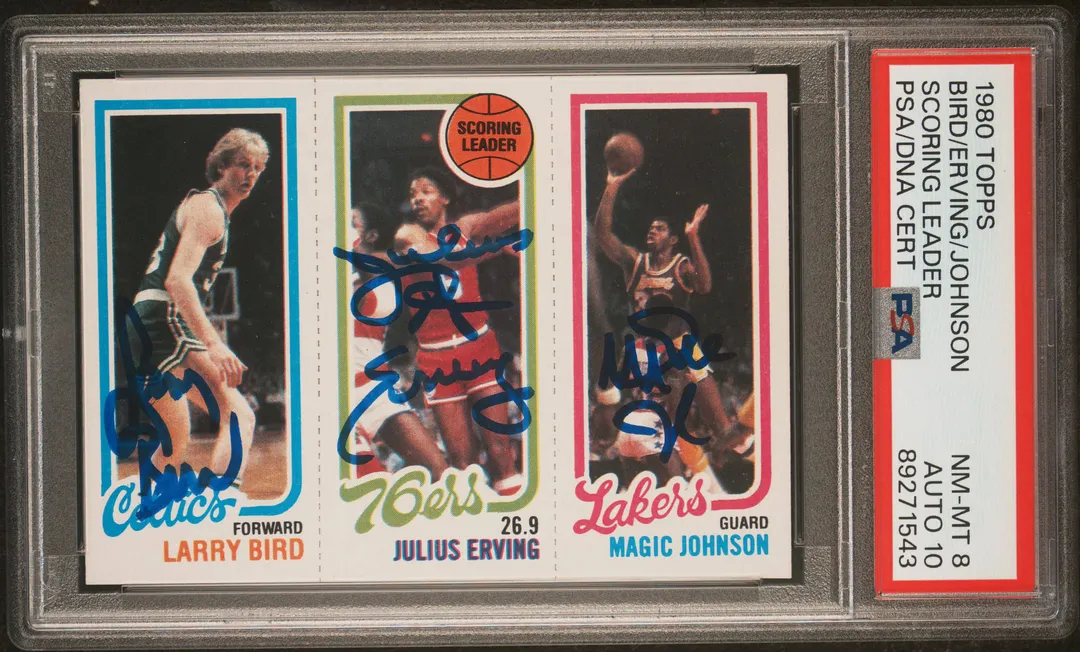
1980-81 Topps Bird/Erving/Magic Auto Rookie Sold
Goldin sold a PSA 8, PSA/DNA 10 multi-signed 1980-81 Topps Bird/Erving/Magic rookie for $22,570. See what this means for basketball card collectors.
Sold Card
1980-81 Topps Scoring Leader Larry Bird/Julius Erving/Magic Johnson Multi-Signed Rookie Card - PSA NM-MT 8, PSA/DNA GEM MT 10
Sale Price
Platform
Goldin1980-81 Topps Scoring Leader Larry Bird/Julius Erving/Magic Johnson Multi-Signed Rookie Card - PSA NM-MT 8, PSA/DNA GEM MT 10 Sells for $22,570 at Goldin
On February 8, 2026, Goldin closed the sale of a hobby landmark: a 1980-81 Topps Scoring Leader Larry Bird/Julius Erving/Magic Johnson rookie card, signed by all three legends, graded PSA NM-MT 8 with a PSA/DNA GEM MT 10 autograph grade. The card realized $22,570.
For a single piece of cardboard, this one carries a lot of basketball history. Here’s a closer look at what sold, why it matters, and how this price fits into the current market.
What exactly is this card?
- Year / Set: 1980-81 Topps Basketball
- Card: Scoring Leader / Tri-panel featuring:
- Larry Bird (Boston Celtics) – RC panel
- Julius Erving (Philadelphia 76ers)
- Magic Johnson (Los Angeles Lakers) – RC panel
- Type: Rookie card for Bird and Magic; iconic Topps tri-panel format
- Autographs: Multi-signed by Larry Bird, Julius Erving, and Magic Johnson
- Card Grade: PSA NM-MT 8 (Near Mint–Mint 8)
- Autograph Grade: PSA/DNA GEM MT 10 (essentially a perfect autograph quality grade)
The base, unsigned 1980-81 Topps Bird/Erving/Magic is one of the cornerstone basketball cards of the early 1980s. It’s the only mainstream rookie card for both Larry Bird and Magic Johnson, and it also includes Julius Erving, who was already a superstar by the time this card was printed.
This particular copy is made even more special by being multi-signed by all three players and authenticated/graded by PSA/DNA, which evaluates the autographs separately from the card’s condition.
Why collectors care about this card
A triple-icon rookie configuration
The 1980-81 Topps tri-panel design is unlike most modern rookie cards. Each card is printed as three mini-panels on one standard card, often perforated (or at least laid out in a way that invites being hand-cut apart). Many copies were separated over time, which makes intact, well-centered examples more desirable.
On this card you get:
- Bird’s first mainstream Topps rookie panel
- Magic’s first mainstream Topps rookie panel
- Dr. J, one of the most important bridge figures from ABA to NBA
For collectors, this single piece captures a passing-of-the-torch moment: Erving as the established superstar, flanked by two rookies who would define the 1980s NBA.
Condition and autograph combination
For vintage and early modern basketball (roughly pre-1986 Fleer), finding clean copies is tough. Centering, print defects, and handling wear are common issues.
- PSA 8 is a strong grade for this card. It’s not ultra-elite like PSA 10, but in the context of a 1980 issue, an 8 is firmly in the high-end collector range.
- The PSA/DNA GEM MT 10 autograph grade signals that the signatures from Bird, Erving, and Magic are bold, well-placed, and of top quality.
Collectors often think in terms of “card grade + auto grade” as a combined profile. A nice balance—strong card, top-tier autograph—tends to draw steady demand.
Era and set context
1980-81 Topps sits in an interesting spot:
- It’s pre-Jordan, but not quite as old as the true vintage era of the 1960s and early 1970s.
- Print runs were higher than the 1960s but far lower than the 1990s “junk wax” era (a term used for periods of mass overproduction).
- Many cards in this set were mishandled, folded, or separated into singles, which means fully intact high-grade copies are not as easy as the raw supply might suggest.
All of that gives the Bird/Erving/Magic rookie a long-standing reputation as a set-defining card.
Market context: how does $22,570 compare?
When evaluating a sale like this, collectors often look at “comps”—short for comparables—which are recent sale prices for the same or similar items.
Because auction results for multi-signed, dual-graded Bird/Erving/Magic rookies are relatively thin, the market is not as deep or as frequently traded as, say, a base PSA 8 or PSA 9 example. However, some general patterns are clear when comparing known ranges for related cards:
- Unsigned PSA 8 copies of the Bird/Erving/Magic rookie have tended to sell in the low-to-mid four-figure range, depending on centering and eye appeal.
- Higher-grade unsigned copies (PSA 9 and PSA 10) have historically pushed well into five- and, in the case of PSA 10, six-figure territory at notable peak points.
- Signed or multi-signed versions introduce an additional premium, particularly when you have all three players on-card and a strong autograph grade. It’s not just the signatures themselves; it’s the difficulty of getting all three legends on a single, already-important rookie card and then having it authenticated and encapsulated.
Within that context, $22,570 for a PSA 8 with a PSA/DNA 10 triple autograph lands in a range that reflects:
- A clear premium over typical unsigned PSA 8 copies
- A meaningful, but not speculative, uplift for the combination of condition and autograph grade
The market for this exact configuration is relatively thinly traded, so there isn’t a perfectly neat “price chart.” Instead, this sale provides a fresh reference point for collectors tracking multi-signed versions of this card.
Why this sale matters for the hobby
1. Demand for autographed key rookies
Over the last several years, collectors have paid more attention to autographed versions of iconic rookie cards, especially when:
- The autographs are on-card (signed directly on the card rather than a sticker)
- The signatures are authenticated and graded by a major third-party service
This Goldin result reinforces that trend. While modern products now routinely include pack-issued autographs, true on-card signatures on original vintage or early modern rookie issues remain much scarcer and often require considerable effort to secure.
2. Three Hall of Famers, one slab
Bird, Magic, and Erving each have strong individual followings. There are:
- Player collectors who chase everything Bird
- Lakers and Celtics team collectors
- Dr. J and ABA-era specialists
A multi-signed rookie that crosses fan bases like this tends to have a wider audience than a typical single-player card. That broader collector base can support stable interest over time.
3. Ongoing respect for pre-Jordan basketball
Even in a hobby where Michael Jordan’s 1986 Fleer rookie often dominates the conversation, this sale underlines that pre-Jordan legends continue to attract serious attention.
The Bird/Erving/Magic rookie, especially in premium configurations like this, is one of the clearest examples that the early 1980s are still viewed as a foundational era for modern basketball collecting.
For collectors and small sellers: what to take away
This Goldin sale from February 8, 2026, doesn’t rewrite the entire price structure for the 1980-81 Topps set, but it does offer some useful signals:
- Key rookies with strong autograph authentication can command a meaningful premium. Even when the card grade isn’t a 9 or 10, a GEM MT 10 multi-signature can move the card into a higher bracket.
- Condition still matters. A PSA 8 isn’t perfect, but it’s comfortably high-end for this issue. Cards with weaker centering, extensive print flaws, or lower grades generally track at more modest price points, even when signed.
- Supply of true multi-signed examples is thin. Not every signed Bird/Erving/Magic rookie is triple-signed, not every triple-signed copy is authenticated, and not every authenticated copy carries a top autograph grade. That layered scarcity helps support prices when high-quality examples reach auction.
For newcomers or returning collectors:
- If you’re looking at this card purely as a piece of NBA history, unsigned lower-grade copies are far more accessible and still give you the iconic image.
- If you’re drawn to autographs, pay close attention to who signed, where on the card, and whether the signatures are authenticated by a major company like PSA or Beckett.
None of this is a prediction about where values will go next, but Goldin’s $22,570 sale gives the hobby another documented data point for one of basketball’s most recognizable rookie cards in a premium signed configuration.
Final thoughts
The 1980-81 Topps Bird/Erving/Magic rookie has long been a checklist anchor for vintage and early modern basketball collectors. This PSA 8 copy, elevated by triple Hall of Fame signatures and a PSA/DNA GEM MT 10 autograph grade, shows how the market continues to reward historically important cards when eye appeal, condition, and authentication line up.
For collectors tracking key basketball rookies, this February 8, 2026 Goldin result is worth bookmarking as part of the evolving price picture for multi-signed, Hall of Fame–level cardboard.