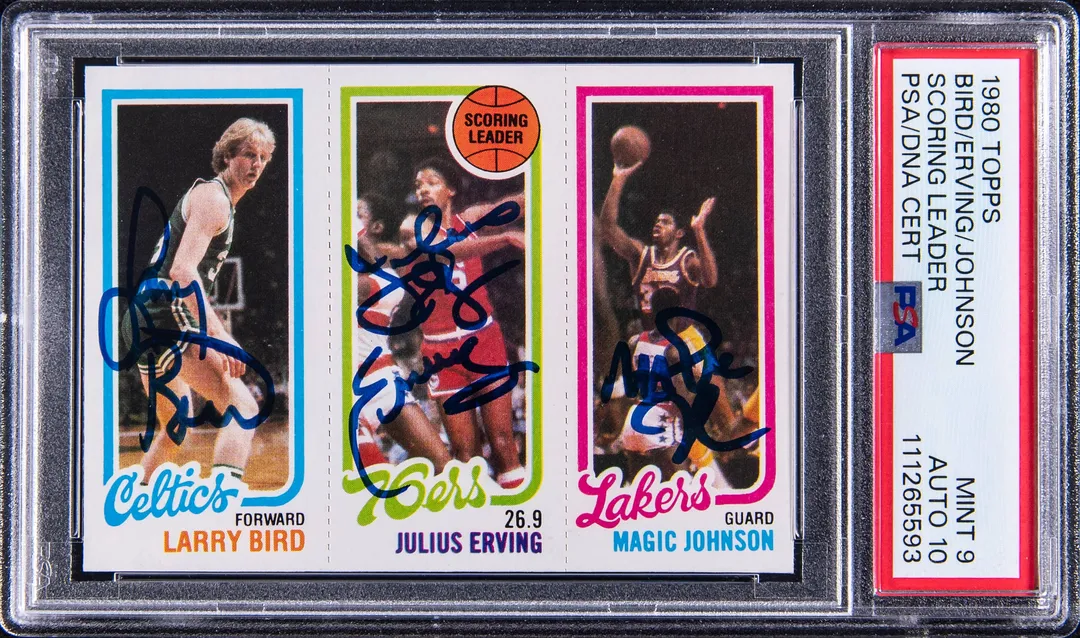
1980-81 Topps Bird/Erving/Magic Auto PSA 9 Sale
Goldin sold a PSA 9, PSA/DNA 10 triple-signed 1980-81 Topps Bird/Erving/Magic rookie for $104,920. See what this means for collectors and the market.
Sold Card
1980-81 Topps Scoring Leader Larry Bird/Julius Erving/Magic Johnson Multi-Signed Rookie Card - PSA MINT 9, PSA/DNA GEM MT 10
Sale Price
Platform
Goldin1980-81 Topps is already one of the most important basketball sets ever produced, but one card towers over the rest: the Scoring Leader rookie that triples up Larry Bird, Julius Erving, and Magic Johnson on a single panel.
When that card is not only in high grade but also signed by all three Hall of Famers, it moves from “key rookie” territory into true centerpiece status.
On February 8, 2026, Goldin sold a 1980-81 Topps Scoring Leader Larry Bird/Julius Erving/Magic Johnson Multi-Signed Rookie Card, graded PSA MINT 9 with a PSA/DNA GEM MT 10 autograph, for $104,920.
Below, we’ll break down what this card is, why collectors care, and how this sale fits into the broader market for this iconic triple rookie.
The card at a glance
- Card: 1980-81 Topps Scoring Leader
- Players: Larry Bird (Boston Celtics), Julius Erving (Philadelphia 76ers), Magic Johnson (Los Angeles Lakers)
- Year/Set: 1980-81 Topps Basketball
- Type: Rookie card for Larry Bird and Magic Johnson
- Format: Triple-panel card (three players on one card)
- Attributes: Multi-signed by Bird, Erving, and Johnson
- Card condition: PSA MINT 9
- Autograph grade: PSA/DNA GEM MT 10
- Sale price: $104,920 (Goldin, February 8, 2026)
This is the famous tri-panel Bird/Erving/Magic card from 1980-81 Topps, recognized as the flagship rookie for both Bird and Magic. It’s printed as a three-player “scoring leader” style card, and many surviving examples were either miscut, poorly centered, or later separated into single panels.
The copy sold by Goldin stands out further by being:
- Professionally graded PSA 9 (MINT) – a very strong grade for this issue.
- Authenticated and graded PSA/DNA 10 for the autograph – indicating the autographs are not only authentic but of top quality in terms of strength and presentation.
- Multi-signed on-card by all three legends, which is significantly scarcer than unsigned or single-signed examples.
Why this card matters to collectors
A shared rookie for two all-time greats
For many basketball collectors, the hobby starts with a short list of core rookie cards: Jordan’s 1986-87 Fleer, Chamberlain’s 1961 Fleer, Abdul-Jabbar’s 1969 Topps, and the 1980-81 Topps Bird/Erving/Magic triple rookie.
Two of the three players on this card – Bird and Magic – are making their cardboard rookie debut in this set and on this specific card. Julius Erving’s earlier ABA and NBA cards were already established by then, but his presence in the center panel adds another Hall of Fame anchor to an already stacked card.
A defining card from a transitional era
1980-81 Topps sits in a transitional window between what many call vintage (roughly pre-late-1970s) and the early modern era of cards. Production was higher than the earliest basketball releases but nowhere near the mass-production levels of the late 1980s and 1990s “junk wax” period.
The tri-panel format was unusual and has had a long-term impact on condition scarcity:
- Perforations and cuts: Some collectors – especially kids at the time – separated the three panels. Surviving intact examples in high grade are much less common.
- Centering and print defects: Off-centering, print issues, and rough edges are common on this issue, which caps the PSA population in the higher grades.
Because of this, clean, well-centered copies in PSA 9 or PSA 10 carry a strong premium, and any additional premium features (on-card autographs, inscription, etc.) stack on top of that foundation.
Why a multi-signed copy is special
Autographed copies of this card introduce a second layer of scarcity beyond the raw card itself.
- Not pack-issued: These are not factory-signed or pack-inserted autographs. They were signed later, usually at private signings or shows, and then submitted to PSA/DNA for authentication and grading.
- Logistical rarity: Getting all three legends – Bird, Erving, and Magic – to sign the same card is not straightforward, especially on a high-grade example that a collector is often reluctant to risk handling.
- Condition plus signature: A PSA 9 card with a PSA/DNA 10 auto means both the cardboard and the ink are graded near the top of the scale.
For many advanced basketball collectors, this puts the card into “grail” territory: an iconic rookie card, multi-signed by all featured Hall of Famers, with both card and autograph in elite condition.
Market context: how $104,920 fits in
In hobby conversations, you’ll often hear collectors talk about “comps”, short for comparable sales. These are recent, confirmed sales for the same card (or very close variants) used as rough reference points for price expectations.
For this card, there are a few different lanes of comps that matter:
- Unsigned copies by grade
- Single-signed or dual-signed versions
- High-end multi-signed copies in strong grades
Unsigned 1980-81 Topps Bird/Erving/Magic prices
Unsigned copies form the base of the market. While exact numbers move over time, the general pattern has been:
- PSA 8: Solid mid-tier option for collectors who want the card but don’t need top-grade. Prices tend to track overall market health but sit far below 9s and 10s.
- PSA 9: Premium tier for most collectors, usually trading at several multiples of PSA 8 copies.
- PSA 10: True high-end, with a very limited population. When they come to auction, they often command six-figure results, especially in stronger market windows.
Against that backdrop, a PSA 9 copy with no autograph provides a starting point. A premium is then assigned for the autograph, multi-signature factor, and the PSA/DNA 10 auto grade.
Autographed and multi-signed versions
Sales data for triple-signed versions in strong card grades is more sparse than for unsigned copies, simply because far fewer exist and they reach public auction less frequently.
When they do appear, a few consistent themes show up:
- Card grade matters a lot. Multi-signed copies on a PSA 7 or PSA 8 base card attract strong interest, but there’s a notable step up when the underlying card is PSA 9 or better.
- Autograph presentation matters. Clean, bold signatures that earn PSA/DNA 10 are more desirable than faded or streaky autos.
- All three signatures add a significant multiplier over single- or dual-signed versions, especially when aligned nicely on the card’s design.
The Goldin sale price of $104,920 places this copy squarely in what can be considered the upper tier for 1980-81 Topps Bird/Erving/Magic cards that are not PSA 10 unsigned population pieces. It reflects:
- The combination of PSA 9 card grade
- A PSA/DNA 10 autograph grade
- The rarity and desirability of having all three legends on one piece of cardboard, all signed
In other words, the result aligns with how the market has historically treated premium, multi-signed examples of this card: notably above unsigned PSA 9s, and in the neighborhood of other six-figure outcomes achieved by top-tier examples.
Because auction outcomes can move with broader hobby trends, timing, and bidder competition, this price should be viewed as a recent data point rather than a fixed benchmark. But it does underscore ongoing demand at the high end for this specific card in exceptional form.
Set and grading scarcity
A “pop report”, or population report, is a grading company’s public tally of how many copies of a given card it has graded at each grade level.
For the 1980-81 Topps Bird/Erving/Magic card, PSA’s population report has consistently shown:
- A decent overall number of graded copies, reflecting its popularity and the age of the card.
- A much thinner population in PSA 9 and especially in PSA 10.
When you then layer on:
- Multi-signature requirements
- High autograph grade standards
- The reluctance of some collectors to have already-graded, high-end copies signed (because of handling risk)
…the pool of comparable PSA 9 / PSA/DNA 10 triple-signed examples becomes very limited.
This scarcity at the intersection of card grade, autograph quality, and signatures present is a key driver behind the $104,920 realized price.
Why this sale matters for different types of collectors
For newcomers and returning collectors
If you’re just getting back into the hobby, this sale is a good reminder of a few principles:
- Iconic rookies tend to hold collector interest over long periods. The Bird/Erving/Magic is a classic example – it has been a “must-know” card for decades.
- Condition and authenticity matter. Professional grading (PSA, BGS, SGC) and autograph authentication (PSA/DNA, Beckett, etc.) provide a common language for comparing cards.
- Not every card reaches six figures. This result reflects a very specific combination: an iconic card, legendary players, high condition, and triple signatures.
You don’t need to chase PSA 9s or $100,000 cards to participate. Lower-grade copies and unsigned examples still provide a way to collect the same key image and players at more accessible price points.
For active hobbyists
If you’re already active in the market, this sale:
- Reinforces the premium attached to multi-signed, properly authenticated blue-chip rookies.
- Highlights the importance of presentation – a PSA/DNA 10 auto grade can meaningfully separate one signed copy from another.
- Offers a fresh, public comp from a major auction house (Goldin) that can be referenced when evaluating similar pieces.
It’s also a reminder to look beyond just card grade. On issues with meaningful autograph activity, the card grade + autograph grade combination tells the full story.
For small sellers and dealers
From a small seller’s perspective, the key takeaways aren’t about chasing six-figure results but about process:
- When handling signed vintage or early-modern pieces, consider third-party authentication if the card and signature combination is notable.
- Understand that market depth declines as you move into more niche, high-end combinations (triple-signed, high-grade, etc.), but competition among dedicated buyers can be intense.
- Use this kind of result as a context point, not a direct pricing template. Each card’s grade, eye appeal, and signature characteristics matter.
Closing thoughts
The February 8, 2026 Goldin sale of a 1980-81 Topps Scoring Leader Larry Bird/Julius Erving/Magic Johnson Multi-Signed Rookie Card, graded PSA MINT 9 with a PSA/DNA GEM MT 10 autograph, at $104,920 underscores the long-term significance of this card in the basketball hobby.
It combines:
- One of the most recognizable rookie cards ever made
- Three Hall of Famers who defined an era
- High-end technical grades for both card and ink
For collectors at every level, this sale is a useful reference point – not because everyone is chasing six-figure cards, but because it illustrates how history, condition, and authentication work together to shape the upper end of the market for a true hobby icon.
If you’re tracking iconic basketball rookies and want to better understand how condition, signatures, and grading intersect, the 1980-81 Topps Bird/Erving/Magic remains one of the clearest case studies in the modern hobby.