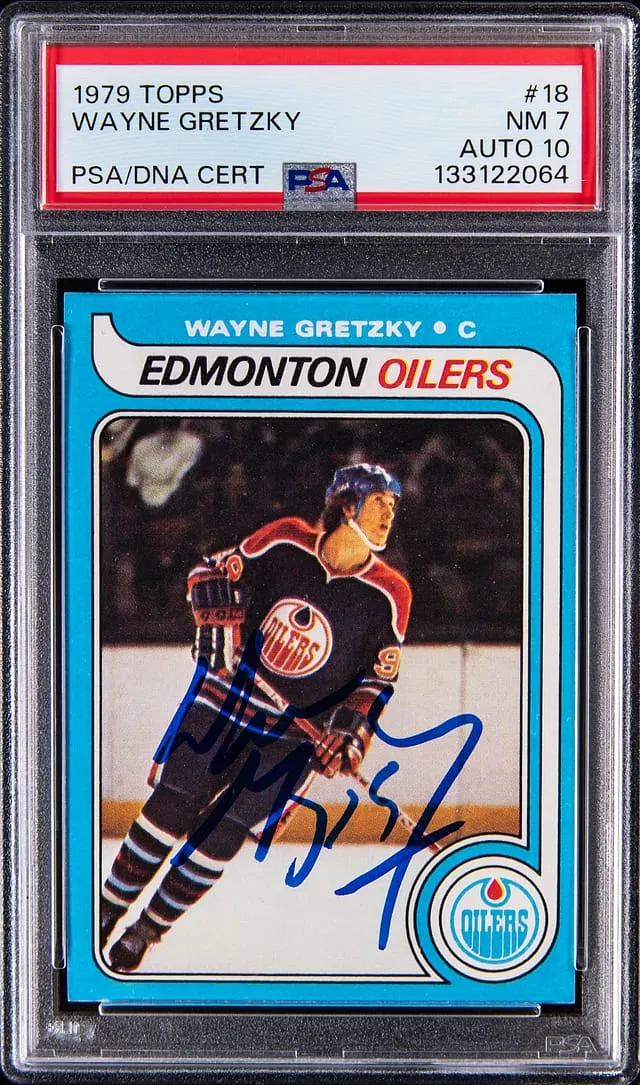
1979-80 Topps Wayne Gretzky Auto Rookie Sells for $31K
Goldin sold a 1979-80 Topps #18 Wayne Gretzky signed rookie (PSA 7, PSA/DNA 10) for $31,720. A key data point for vintage Gretzky collectors.
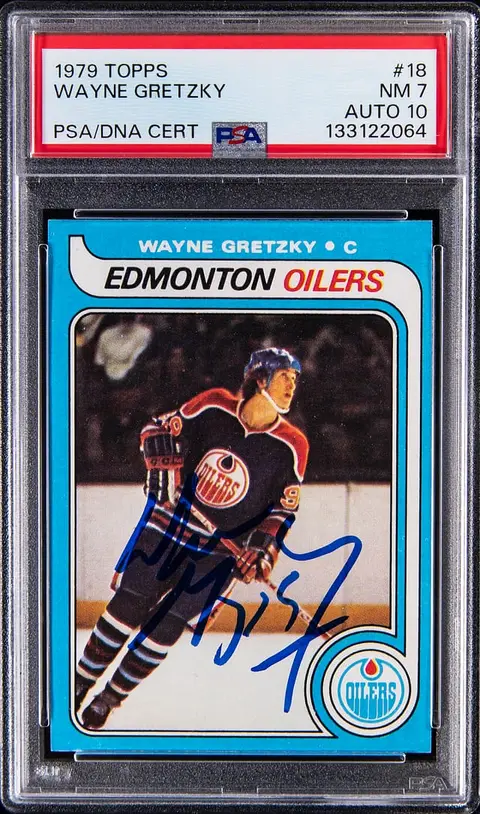
Sold Card
1979-80 Topps #18 Wayne Gretzky Signed Rookie Card - PSA NM 7, PSA/DNA GEM MT 10
Sale Price
Platform
GoldinA blue-ink signature across a clean early Topps design, a young Edmonton Oilers center, and two elite grades from PSA and PSA/DNA came together on May 22, 2026, when Goldin sold a 1979-80 Topps #18 Wayne Gretzky Signed Rookie Card (PSA NM 7, PSA/DNA GEM MT 10) for $31,720.
For collectors who focus on Gretzky, on-card autographs, or vintage hockey in general, this result adds another data point to an already well-studied card and player.
The card at a glance
- Player: Wayne Gretzky
- Team: Edmonton Oilers
- Year / Set: 1979-80 Topps Hockey
- Card number: #18
- Type: Rookie card (Topps version)
- Attributes: On-card autograph, authenticated and graded PSA/DNA GEM MT 10
- Card grade: PSA NM 7 (Near Mint)
- Auction house: Goldin
- Sale date: May 22, 2026 (UTC)
- Sale price: $31,720
The 1979-80 Topps Gretzky is one of two major North American flagship rookies for “The Great One.” The other is his 1979-80 O-Pee-Chee (OPC) #18. Topps was produced for the U.S. market and typically shows better print quality, while OPC was produced for Canada and is generally seen as the more desirable and historically important version—especially in high grade.
This particular copy adds something the standard rookie does not have out of the pack: an on-card autograph. The auto has been authenticated and graded GEM MT 10 by PSA/DNA, which is the highest grade PSA assigns to autographs.
Why this rookie matters
Flagship rookie of the greatest modern hockey player
Gretzky’s 1979-80 Topps and OPC rookies are widely considered essential pieces in the hockey card hobby. For many collectors, owning at least one example—at almost any grade—is a long-term goal.
A few reasons this card holds lasting appeal:
- Historic player: Gretzky is still the NHL’s all-time leading scorer and a four-time Stanley Cup champion. His records and reputation give his rookie cards a level of stability and long-term interest that few modern players can match.
- Era and production: The late 1970s sit in a transitional zone: not as scarce as the 1950s and 1960s, but well before the mass overproduction of the 1990s “junk wax” era. High-grade examples are tough because of print quality, centering, rough cuts, and handling over four-plus decades.
- Topps vs. OPC: Many collectors prioritize the OPC version, but the Topps rookie is still a core key for vintage hockey runs and for collectors who want a Gretzky rookie at a more accessible price level than comparable OPC grades.
Adding a verified, high-grade on-card autograph turns a foundational rookie into more of a niche, premium item. It sits at the intersection of vintage base rookies and the autograph-focused segment of the hobby that’s more common in modern and ultra-modern sets.
Grading: PSA NM 7 with PSA/DNA GEM MT 10 auto
This card was:
- Graded by PSA: NM 7 (Near Mint) for the card itself.
- Auto graded by PSA/DNA: GEM MT 10 for the signature.
A quick breakdown of what that usually implies:
- PSA 7 (Near Mint): Light wear on corners or edges, potentially minor print or surface flaws, but still a strong, presentable card. For a 1979-80 card, PSA 7 is comfortably in the mid-grade range—better than the bulk of raw copies, but below high-end investment grades (PSA 9–10) that tend to chase record numbers.
- PSA/DNA GEM MT 10 auto: A 10-grade autograph typically indicates a bold, well-placed, and clean signature with no noticeable skips or smudges.
When a card is both graded and autographed, collectors often look at it as a combination of two separate attributes:
- Card grade (eye appeal, centering, corners)
- Autograph grade (placement, ink quality)
A GEM MT 10 auto on a mid-grade vintage rookie can appeal to collectors who care more about the visual presence and the signature itself than about ultra-high card grades.
Market context and recent sales
In hobby conversations, “comps” (comparable sales) are recent prices for the same or similar items. They help collectors and sellers understand current demand, but they’re not guarantees of future value.
For Gretzky’s 1979-80 rookies, the market has developed several layers:
- Unsigned base rookies (Topps and OPC) across grades
- Signed rookies (with third-party authentication)
- Premium slabs with dual grading for card and autograph
Within that structure:
- Topps copies generally trade at a discount to OPC in the same grade.
- Autographed copies form a smaller, more specialized sub-market, where the combination of card grade and auto grade determines the range.
This specific sale at $31,720 for a Topps PSA 7 with a PSA/DNA GEM MT 10 auto sits in a premium segment for signed Gretzky rookies. While exact, recent comps for the precise configuration (Topps, PSA 7, PSA/DNA 10 auto) can be thin, activity in nearby lanes can offer context:
- Unsigned Topps PSA 7: Historically, these sell for much less than same-grade OPC, positioning them as a more budget-friendly way to own a graded Gretzky rookie.
- Unsigned OPC PSA 8–9: Command noticeably higher prices because they combine the more desirable Canadian issue with stronger grades.
- Signed rookies with strong auto grades: Often carry a significant premium over unsigned copies, especially when the autograph grade is GEM MT 10 and the placement is clean.
In that context, this $31,720 result looks like a solid, high-end outcome for a signed Topps Gretzky rookie in a mid-range card grade with a top-tier signature.
Why collectors chase signed vintage Gretzky rookies
Autographed rookies of vintage legends sit in an interesting spot in the hobby. They’re not pack-pulled autograph cards like modern issues; they’re standard base rookies that were signed later, then authenticated.
Collectors who target this lane often value:
- Direct connection to the player: An on-card signature adds a personal, historical layer to a card that was already important.
- Crossover appeal: These cards can attract both vintage set collectors (who know the 1979-80 Topps run) and autograph-focused collectors (who prize high-grade signatures).
- Condition plus ink: A nicely centered, eye-appealing card with a bold signature often stands out even if the numeric card grade isn’t at the very top.
Gretzky himself remains active in the public eye—through media work, appearances, and ongoing cultural relevance—which helps keep steady interest in his key cards. There hasn’t been a single recent event (like a new record or Hall of Fame induction) driving sudden spikes; instead, the market has largely been about long-term recognition of his status in the sport.
How this sale fits into the bigger picture
For collectors tracking long-term trends, a few takeaways from this Goldin sale:
Signed vintage continues to find its lane.
This result reinforces that authenticated, high-grade signatures on iconic rookies command meaningful premiums over unsigned versions, even when the card grade sits in the mid-range.Topps still matters beside OPC.
While OPC dominates Gretzky rookie discussions, the Topps issue clearly has its own established audience, especially at approachable grades and in niche formats like dual-graded autos.Eye appeal and auto quality drive attention.
With a GEM MT 10 autograph, this card shows how ink quality can compete with—if not occasionally overshadow—card grade in certain segments of the vintage market.Data points, not guarantees.
This $31,720 result is a snapshot, not a promise. Future prices can move up or down as supply, demand, and broader hobby conditions change. For most collectors, it’s more useful as a reference point than as a target.
What this means for different types of collectors
New and returning collectors
If you’re just getting into hockey or back into the hobby:
- Gretzky’s 1979-80 rookies are foundational, but they come in many forms and price tiers.
- You don’t need a signed, dual-graded example to enjoy collecting Gretzky—lower grades, reprints, and later cards all exist at more modest price points.
Active hobbyists
If you already follow auction results and pop reports (population reports, which show how many copies exist at each grade at a grading company):
- Watching signed Gretzky rookies across both Topps and OPC can give a clearer view of how much collectors are currently paying for ink versus purely for cardboard.
- Tracking results across grades (PSA 6–8 with GEM MT 10 autos) can help map out how condition premiums scale in this niche.
Small sellers and flippers
If you’re selling into this market:
- Condition, eye appeal, and authentication all matter. Raw signed copies generally sit at a discount until vetted by a third party like PSA/DNA.
- Clear photos of the signature, centering, and surface—plus transparent mention of any flaws—can help your listing stand out and align expectations.
Final thoughts
The 1979-80 Topps #18 Wayne Gretzky Signed Rookie Card that sold at Goldin on May 22, 2026 for $31,720 doesn’t rewrite the record books, but it does reinforce a few steady themes: Gretzky’s flagship rookies remain core to vintage hockey collecting, authenticated on-card signatures add a meaningful layer of demand, and mid-grade vintage with top-tier ink continues to attract serious attention.
For collectors, it’s another useful marker in the ongoing story of one of the hobby’s most important cards—and a reminder of how many different ways there are to collect the game’s greatest player.