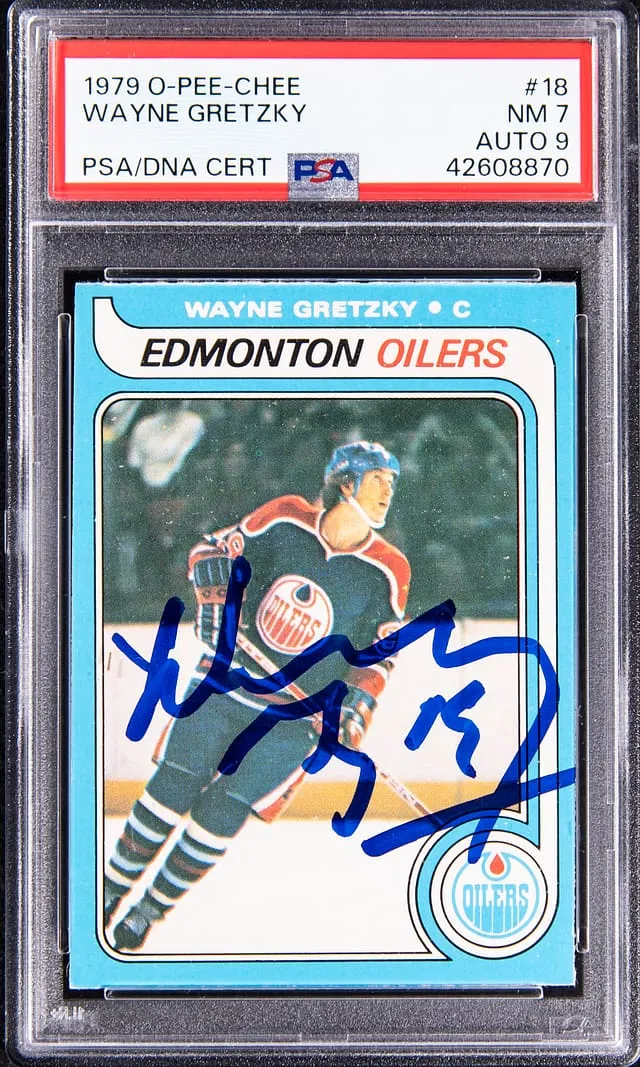
1979-80 OPC Gretzky Signed Rookie PSA 7 Sells
Goldin sold a 1979-80 O-Pee-Chee #18 Wayne Gretzky signed rookie PSA 7, PSA/DNA 9 for $12,810. See what this means for vintage hockey collectors.
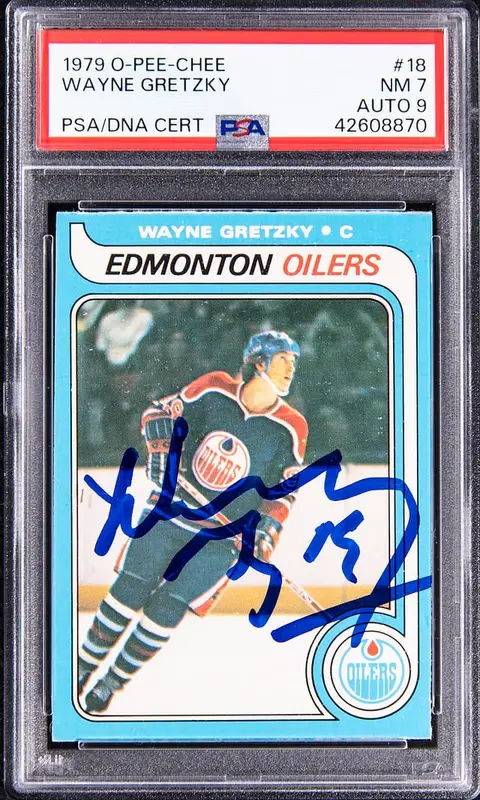
Sold Card
1979-80 O-Pee-Chee #18 Wayne Gretzky Signed Rookie Card - PSA NM 7, PSA/DNA MINT 9
Sale Price
Platform
Goldin1979-80 O-Pee-Chee #18 Wayne Gretzky Signed Rookie Card – PSA NM 7, PSA/DNA MINT 9 Sells for $12,810
On March 15, 2026, Goldin closed a notable vintage hockey sale: a 1979-80 O-Pee-Chee #18 Wayne Gretzky rookie card, graded PSA NM 7 with a PSA/DNA MINT 9 autograph, realized $12,810.
For collectors tracking key Gretzky rookies and the signed vintage market, this is a useful datapoint in a segment that sits between pure high-grade slabs and ultra-premium museum pieces.
The card at a glance
- Player: Wayne Gretzky
- Team: Edmonton Oilers
- Year / Set: 1979-80 O-Pee-Chee Hockey
- Card number: #18
- Key status: True rookie card, the flagship O-Pee-Chee issue
- Autograph: On-card signature, PSA/DNA certified MINT 9
- Card grade: PSA NM 7 (Near Mint)
- Sale price: $12,810
- Auction house: Goldin
- Sale date: March 15, 2026 (UTC)
The 1979-80 O-Pee-Chee Gretzky is widely viewed as the foundational hockey card of the modern era. O-Pee-Chee is the Canadian-printed counterpart to Topps, with rougher card stock and famously inconsistent centering and edges. That production quality makes higher-grade copies significantly harder to find than their technical grade might suggest.
Why this rookie matters to collectors
Flagship rookie of a foundational player
Wayne Gretzky is the central figure in modern hockey collecting: all-time leader in points, assists, and a long list of other categories, plus four Stanley Cups and a global impact on the sport. For many collectors, his O-Pee-Chee #18 is the hockey equivalent of:
- 1952 Topps Mickey Mantle in baseball
- 1986-87 Fleer Michael Jordan in basketball
In hobby terms, this is a flagship rookie – the primary, most recognized rookie card for a player, as opposed to oddball or regional issues.
Vintage era with real condition challenges
This card comes from the late-1970s vintage era, before the 1980s “junk wax” overproduction. O-Pee-Chee’s print quality in 1979-80 introduced multiple condition challenges:
- Off-center cuts
- Rough, often frayed edges
- Print dots and color variations
- Easy chipping along the blue borders
Because of that, even mid-grade examples can present nicely, and truly sharp copies command strong premiums.
Signed vintage as a distinct lane
This copy adds another layer: a PSA/DNA authenticated on-card autograph graded MINT 9.
Autographed vintage rookies sit in their own lane, different from:
- Unsigned base rookies (pure card condition focus)
- Modern on-card autos (built into the product with serial numbering and parallels)
With a signed vintage rookie, collectors often weigh two condition dimensions:
- Card grade (PSA 7): Corners, edges, surface, centering.
- Auto grade (PSA/DNA 9): Ink strength, clarity, placement, and smudging.
This combination – solid mid-grade card with a high-grade signature – tends to target collectors who want both eye appeal and authenticity, without stepping into the price tier of high-grade unsigned copies or ultra-rare premium variants.
Market context and price positioning
When hobbyists talk about comps (short for comparable sales), they mean recent, similar sales used to understand current price ranges. For a signed Gretzky O-Pee-Chee rookie in PSA 7 / PSA/DNA 9, the comp set includes:
- Other PSA 7 signed copies (ideally with similar auto grades)
- Neighboring card grades (PSA 6 / PSA 8) with strong autos
- Unsigned PSA 7s, to gauge the added value of the autograph
Based on public auction records and recent reporting in the hobby:
- Unsigned PSA 7 O-Pee-Chee Gretzky rookies typically trade well above this sale price, reflecting strong demand for clean, unaltered examples.
- Signed copies in similar card grade but with pristine autos (PSA/DNA 10) can push higher, especially when the signature placement and ink color are particularly appealing.
This $12,810 result sits in a middle band of the Gretzky rookie landscape:
- Below what you’d expect for high-grade unsigned showpieces (PSA 8, PSA 9)
- Above raw or lower-grade signed copies that carry more visible wear or weaker ink
For context, headline Gretzky sales – such as PSA 10 O-Pee-Chee or extremely high-grade Topps rookies – have reached well into the six-figure territory at various points in the market cycle. This signed PSA 7 example is not competing with those record levels; instead, it represents a more accessible, but still premium, way to own a key Gretzky piece.
How scarcity and grading play into this card
Population and grading dynamics
Grading companies like PSA maintain a population report (“pop report”), a count of how many copies of a given card they’ve graded at each grade level. While exact numbers change as more cards are submitted, a few themes are consistent for this card:
- There are far fewer PSA 8–10 O-Pee-Chee Gretzky rookies than mid-grades.
- Many existing copies show issues that tend to cap them at PSA 5–7.
- Combining a respectable card grade with a high-grade autograph significantly narrows the pool further.
So while PSA 7 is technically “mid-grade,” in practical collecting terms it’s a sweet spot: good eye appeal, more attainable than upper-echelon copies, and still meaningfully above heavily worn examples.
Signed vs. unsigned in the Gretzky market
Not every collector wants a signed version of a vintage rookie. Some prefer the card in its original, unsigned state. Others actively seek authenticated autos as a way to:
- Reduce concerns about forgery
- Add a personal or visual element to a cornerstone card
- Distinguish their copy from standard population figures
That split preference keeps signed and unsigned markets related but distinct. This sale reinforces that a high-quality autograph, even on a mid-grade card, carries a clear premium over unsigned lower-grade copies, but may still sit under the very top unsigned graded examples.
Why this Goldin sale is worth noting
A few takeaways from this March 15, 2026 Goldin result:
Stable demand for blue-chip hockey icons
Gretzky’s O-Pee-Chee rookie remains one of the hobby’s most recognized blue-chip cards. A $12,810 sale for a PSA 7 / PSA/DNA 9 signed copy confirms that demand is still present for well-graded, authenticated examples.Ongoing interest in high-grade autographs on vintage stock
The MINT 9 auto grade signals a strong, clean signature – something that is not guaranteed on older, in-person-signed cards. The market continues to differentiate between merely authenticated and truly high-grade autographs.A reference point for signed mid-grade Gretzky rookies
For collectors holding similar cards – say a PSA 6 or 7 with PSA/DNA 8–10 ink – this Goldin sale offers a useful reference. It doesn’t set a record, but it helps map the pricing terrain between raw or low-grade signed copies and top-tier showpieces.
What this might mean for different kinds of collectors
This sale can be read differently depending on where you are in the hobby:
New or returning collectors
It illustrates how condition, autograph quality, and authentication interact. A “PSA 7 with PSA/DNA 9 auto” is a very different proposition from an ungraded signed card or a raw copy bought at a show.Active hobbyists
It adds another datapoint to the comp trail for signed Gretzky rookies. If you’re tracking how signed vintage performs versus unsigned equivalents, this is one more sale to plug into your notes.Small sellers
It highlights the importance of clearly labeling both the card grade and auto grade in listings, and of referencing recognized auction results (like this Goldin sale on March 15, 2026) when buyers ask about price context.
Key lessons from this sale
- The 1979-80 O-Pee-Chee #18 Wayne Gretzky remains a cornerstone of vintage hockey collecting.
- Mid-grade, signed, and authenticated copies occupy a healthy, but not speculative, price tier.
- Strong autograph grades (PSA/DNA 9 and 10) matter, especially on a card that many collectors consider a “must-own” piece.
- Auction results like this one at Goldin help refine expectations for similar cards without dictating future outcomes.
For collectors who want a meaningful Gretzky rookie but don’t need the absolute highest technical grade, a PSA 7 with a MINT 9 autograph offers an appealing balance of history, presentation, and documented authenticity. The $12,810 result on March 15, 2026 is a clear snapshot of where that balance is sitting right now in the market.