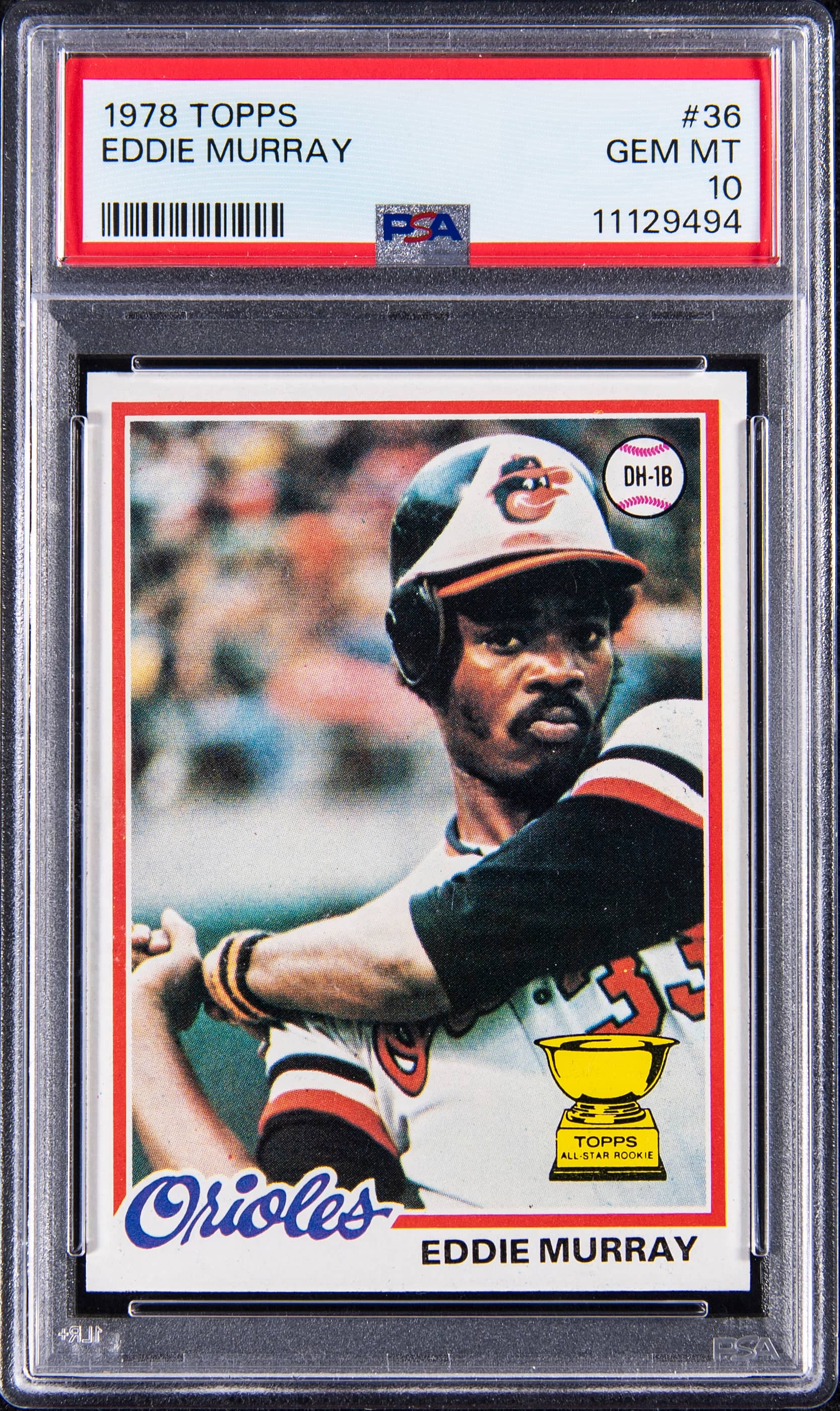
1978 Topps Eddie Murray PSA 10 Rookie Sells for $47k
Goldin sold a 1978 Topps #36 Eddie Murray rookie PSA 10 for $47,580 on Feb 22, 2026. See how this gem fits into the Hall of Famer’s card market.
Sold Card
1978 Topps #36 Eddie Murray Rookie Card - PSA GEM MT 10
Sale Price
Platform
Goldin1978 Topps #36 Eddie Murray Rookie Card – PSA GEM MT 10 Sells for $47,580
On February 22, 2026, Goldin sold a 1978 Topps #36 Eddie Murray Rookie Card graded PSA GEM MT 10 for $47,580. For vintage baseball collectors, this is one of the defining rookie cards of the late 1970s, and gem-mint copies simply do not surface often.
In this breakdown, we’ll look at what exactly sold, how this price fits into recent market data, and why this card matters so much to collectors.
The Card: 1978 Topps #36 Eddie Murray RC, PSA 10
Card details
- Player: Eddie Murray
- Team: Baltimore Orioles
- Year: 1978
- Set: 1978 Topps Baseball
- Card number: #36
- Type: Base rookie card (flagship Topps RC)
- Grading company: PSA (Professional Sports Authenticator)
- Grade: GEM MT 10 (gem mint)
- Attributes: Standard paper stock, no autograph, no patch, no serial numbering
This is Murray’s primary flagship rookie card from his playing era. It’s a clean, straightforward design from Topps’ 1978 set, showing the future Hall of Famer in an Orioles cap with the Orioles name in a colored banner.
While the raw (ungraded) card is readily available, PSA GEM MT 10 copies are a different story. High-grade vintage cards from the 1970s are often limited by centering, print defects, and handling over the years. That combination makes true gem-mint examples extremely difficult to find.
Market Context: How $47,580 Fits In
To understand this sale, it helps to look at “comps” – comparable recent sales of the same card and closely related versions. Comps give collectors a real-world price context instead of relying on asking prices.
For the 1978 Topps Eddie Murray rookie, the hobby generally focuses on three PSA grade tiers:
- PSA 10 (GEM MT) – Top tier, very low population.
- PSA 9 (MINT) – High-end but more attainable.
- PSA 8 (NM-MT) – Solid investment-grade vintage, wider supply.
PSA 10 vs. Lower Grades
While exact numbers can fluctuate with each auction cycle, the pattern in recent years has been consistent:
- PSA 10: Commands a large premium because of population scarcity. It’s the condition-sensitive “ceiling” for this card. Even modest movement in demand can create big swings in price, because so few copies are available at any given time.
- PSA 9: Often trades at a fraction of PSA 10 levels, despite still being a very sharp card. For many collectors, PSA 9 represents the best balance of quality and cost.
- PSA 8 and below: Much more common and significantly more affordable, but they don’t typically move the high-end market like PSA 10s.
In that context, Goldin’s February 22, 2026 result at $47,580 sits firmly in the upper tier of what this card can do. It reflects:
- Ongoing demand for Hall of Fame rookie cards from the 1970s.
- The continued power of true gem-mint grades in shaping top-of-market prices.
- The scarcity gap between PSA 10s and everything else.
Because PSA 10 copies come to auction infrequently, any single sale can reset or reinforce expectations. The Goldin sale is an important datapoint for collectors tracking the top end of the Eddie Murray rookie card market.
Why Collectors Care About Eddie Murray’s Rookie
Hall of Fame Resume
Eddie Murray is widely regarded as one of the most consistent and underrated hitters of his generation. His career résumé includes:
- 3,000+ hits
- 500+ home runs
- 8-time All-Star
- 3-time Gold Glove Award winner
- World Series champion
- National Baseball Hall of Famer (inducted 2003)
That combination of 3,000 hits and 500 home runs is extremely rare. For collectors, that puts him in the top tier of post-war greats whose rookie cards anchor collections focused on Hall of Famers.
Set and Era Significance
The 1978 Topps Baseball set lives in the late-vintage/early-modern transition zone:
- Not quite ultra-scarce vintage, like the 1950s and 1960s.
- Not full “junk wax” either – it predates the massive overproduction of the late 1980s and early 1990s.
That means:
- Raw copies are accessible and not rare.
- High-grade, perfectly centered, defect-free examples are genuinely tough.
For many collectors who grew up in the 1970s and 1980s, 1978 Topps is also a strong nostalgia set. Murray’s rookie is the clear flagship card of the release, much like the key rookie in any modern set.
Condition Sensitivity and Pop Report
A “pop report” (population report) is a grading company’s public tally of how many copies of a card they’ve graded at each grade level.
For the 1978 Topps #36 Eddie Murray:
- The total number of graded copies runs into the thousands.
- The number of PSA 10s is very small relative to that total.
Vintage and late-vintage Topps issues are known for:
- Off-center cuts (left-right and top-bottom).
- Print dots, fisheyes, and color variations.
- Soft corners and edge wear from decades of handling.
All of this contributes to the gap between PSA 10 and everything else. The rarity of true gem-mint copies is a major reason the Goldin sale cleared the $40,000 mark.
Recent Hobby and Player Context
While Eddie Murray is long retired, his status as a Hall of Famer keeps steady hobby interest around his key cards, especially:
- Rookie issues (like this 1978 Topps #36).
- High-grade examples of important 1980s cards.
- Low-population, high-grade vintage and late-vintage issues.
The market in recent years has maintained a strong focus on Hall of Fame position players with milestone careers. Collectors who prefer more stable historical résumés often gravitate to this type of card rather than chasing unproven modern prospects.
What This Sale Suggests for Collectors
A single auction result is not a guarantee of future prices, but it does tell us how at least two motivated parties valued the card at that moment.
The $47,580 Goldin sale on February 22, 2026 highlights a few ongoing themes:
Hall of Fame rookies remain a core hobby pillar.
Murray’s rookie does not rely on current-season hype or news cycles. Its appeal is rooted in a completed, Hall of Fame career.Top-population grades can command strong premiums.
PSA 10s in condition-sensitive, late-vintage sets continue to separate sharply from PSA 9 and below.Auction houses matter for visibility.
A sale through a major platform like Goldin often brings out serious bidders who understand the scarcity and are willing to compete for the few chances to secure a gem.
For newer or returning collectors, one practical takeaway is the importance of understanding grade tiers and population. Two copies of the same 1978 Topps Murray rookie can differ in price by a factor of 10 or more simply based on centering, corners, and surface quality reflected in the grade.
Final Thoughts
The February 22, 2026 sale of a 1978 Topps #36 Eddie Murray Rookie Card – PSA GEM MT 10 for $47,580 at Goldin is a clear marker for how the hobby values top-condition Hall of Fame rookies from the late 1970s.
As more collectors study population data and chase the best-graded examples, it’s likely that rare, true gem copies of key Hall of Fame rookies will continue to be closely watched whenever they come to auction.
For anyone tracking vintage and late-vintage baseball, this sale is an important reference point – not as a prediction, but as a current snapshot of how one of Eddie Murray’s most important cards is being valued today.