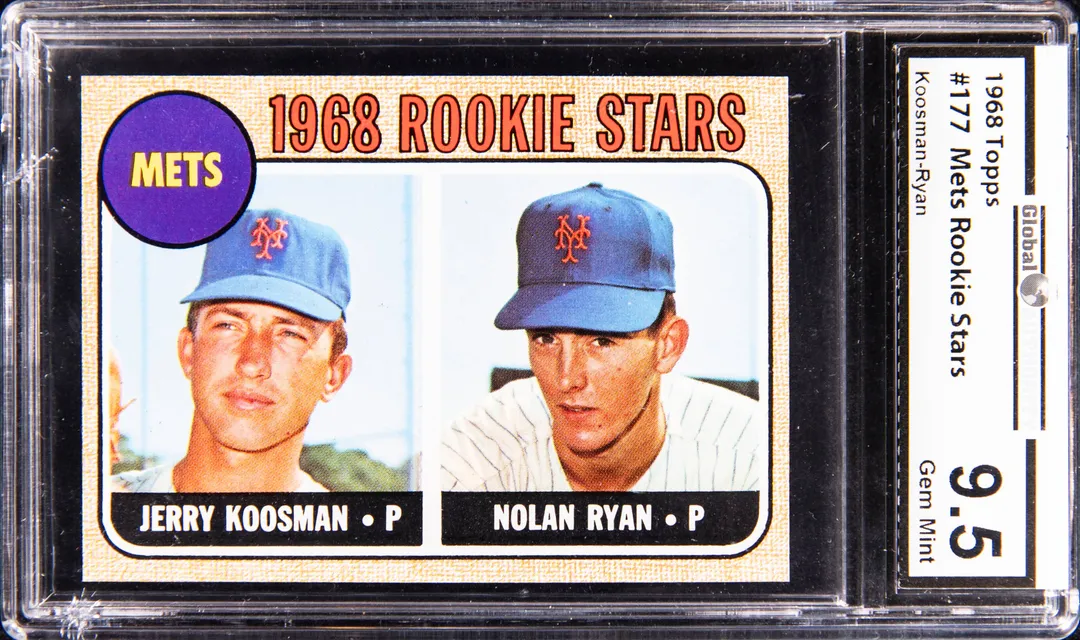
1968 Topps Nolan Ryan Rookie Gem 9.5 Sells at Goldin
A 1968 Topps #177 Nolan Ryan Rookie, Global Authority Gem Mint 9.5, sold for $31,110 at Goldin on Feb 22, 2026. Here’s what it means for collectors.
Sold Card
1968 Topps #177 Nolan Ryan Rookie Card - Global Authority Gem Mint 9.5
Sale Price
Platform
Goldin1968 Topps #177 Nolan Ryan Rookie Card – Global Authority Gem Mint 9.5 Sells for $31,110
On February 22, 2026, Goldin auctioned a key vintage baseball rookie that always gets collectors talking: a 1968 Topps #177 Nolan Ryan Rookie Card, graded Gem Mint 9.5 by Global Authority, closing at $31,110.
For new and returning collectors, this sale offers a useful snapshot of how the hobby currently values one of the most important post-war baseball rookies, especially when it appears in a non-traditional grading holder.
The card at a glance
- Card: 1968 Topps #177 Nolan Ryan / Jerry Koosman
- Player: Nolan Ryan (Hall of Fame pitcher, all-time strikeout leader), featuring a dual-player “Rookie Stars” design with Jerry Koosman
- Team: New York Mets
- Year / Set: 1968 Topps Baseball
- Card number: #177
- Type: True flagship rookie card (Nolan Ryan’s first mainstream Topps issue)
- Grading company: Global Authority (GAI)
- Grade: Gem Mint 9.5
- Attributes: Standard base issue (no serial number, no autograph, no memorabilia)
The 1968 Topps set is firmly in the vintage era—well before mass overproduction—so high-grade examples can be notably tougher than many modern cards, especially for a high-demand rookie like Ryan.
Why Nolan Ryan’s 1968 Topps rookie matters
Nolan Ryan is one of the most collected pitchers in baseball history. Several factors keep his rookie card near the top of many want lists:
- Hall of Fame résumé: All-time MLB leader in strikeouts (5,714) and no-hitters (7), with a 27-year career spanning four decades.
- Cross-era appeal: Ryan connects multiple collecting generations: late-1960s vintage, 1970s classics, and early 1990s nostalgia.
- True flagship rookie: This is his first widely distributed Topps base card, often considered the definitive Ryan card for a collection.
- Dual rookie design: The shared card with Jerry Koosman is iconic in its own right and emblematic of the 1960s “Rookie Stars” look.
Because this is a vintage flagship rookie, collector demand is steady rather than driven by short-term performance or hype cycles.
Grading context: Global Authority vs. PSA/BGS/SGC
One of the most important aspects of this sale is the grading company: Global Authority (often abbreviated GAI). Today’s market generally concentrates premium prices around three major grading companies:
- PSA (Professional Sports Authenticator)
- BGS (Beckett Grading Services)
- **SGC (Sportscard Guaranty)
Cards in holders from smaller or older grading outfits frequently sell at a discount relative to top-tier slabs, even at similar numeric grades. Many experienced buyers treat them as “raw-plus”—better than an ungraded card, but still often evaluated with an eye toward potential crossover (submitting to another grading company).
So when you see “Gem Mint 9.5” from Global Authority, it’s important to:
- Understand that the market usually values it differently than a PSA 9 or PSA 10.
- Recognize that buyers may price in both grading standards and reholder costs if they plan to cross it over.
Where this $31,110 sale sits in the market
The hammer price for this card at Goldin was $31,110.
To understand that number, it helps to look at “comps”—short for comparable sales, meaning recent confirmed sales of the same or very similar cards.
Recent comp context (same card, different grades)
Market data going into 2025–2026 has been broadly consistent on one point: top-tier graded copies of the 1968 Topps Nolan Ryan rookie command strong premiums in high grade. While exact figures move over time, the general structure of the market has looked something like this in recent years:
- PSA 10 (Gem Mint): Extremely rare; past public sales have reached into the seven-figure range when they appear. These are more museum pieces than everyday hobby items.
- PSA 9 (Mint): Often trading deep into the six-figure range at major auction houses when market conditions are healthy.
- PSA 8 (NM-MT): Frequently found in the mid–five-figure range, sometimes more depending on eye appeal and auction setting.
- PSA 7 and below: Offer more accessible entry points for collectors, with strong demand because they still represent a cornerstone rookie.
Against that backdrop:
- A Global Authority Gem Mint 9.5 at $31,110 sits well below the established pricing tiers for PSA 9 and above, and can land in or near the price neighborhood of strong PSA 7–8 copies, depending on the moment in the market.
- This gap is consistent with the broader pattern where non-PSA/BGS/SGC slabs are discounted relative to their numeric grades.
Typical, low, or high?
Relative to major-brand mint or gem-mint examples, this Goldin result is on the lower end of the spectrum. Relative to mid-grade PSA or SGC copies, it’s more in line with expectations, especially after factoring in the grading company.
In other words, the price:
- Is strong for a non-flagship grading holder, reflecting continued respect for the card itself.
- Remains well below elite PSA/BGS benchmarks, underscoring how much the market differentiates between slabs.
Vintage scarcity and grade difficulty
The 1968 Topps Ryan rookie is not a rare card in the absolute sense, but high-grade examples are meaningfully scarce:
- Centering issues, print defects, and corner wear are common.
- The woodgrain-style border of 1968 Topps tends to highlight edge and corner flaws, making pristine copies more difficult to find.
Population reports ("pop reports"—the grading-company tallies of how many cards exist in each grade) for PSA have long shown a steep drop-off between mid-grade and mint/gem-mint levels for this card. While this particular copy is in a Global Authority holder, the broader PSA population structure still frames how collectors think about scarcity in the higher grades.
Why this sale matters for collectors
For collectors and small sellers, this Goldin sale offers a few useful takeaways:
Card quality still drives attention. A Gem-level 1968 Nolan Ryan rookie, even in a secondary grading holder, still commands meaningful money because the underlying card is historically important.
Grading brand matters. The gap between this $31,110 sale and recent PSA 9+ comps reinforces the premium attached to PSA/BGS/SGC for headline vintage rookies.
Vintage demand is steady. Unlike ultra-modern prospect cards, the Ryan rookie’s demand is built on a long Hall of Fame career, not short-term performance or hype. That tends to make the price action feel more stable and data-driven.
Crossover potential is part of the conversation. Some buyers may look at a Global Authority 9.5 and mentally model what it might bring if successfully crossed into a PSA or SGC holder, discounting for risk and cost.
What this means if you collect Nolan Ryan or vintage rookies
If you’re collecting Nolan Ryan or building a focused vintage Hall of Fame rookie run, this sale reinforces a few practical points:
- Define which grading holders you’re comfortable with. If you want the most liquid, market-accepted version, you’ll probably lean toward PSA, BGS, or SGC.
- Eye appeal matters, regardless of label. Centering, registration, and color can create a wide range of desirability even within the same technical grade.
- Be mindful of comps by grading company. When researching recent sales, make sure you compare like with like: PSA to PSA, SGC to SGC, and so on, then adjust if you’re looking at a smaller grading company.
The bottom line
The February 22, 2026 Goldin sale of a 1968 Topps #177 Nolan Ryan Rookie Card – Global Authority Gem Mint 9.5 for $31,110 is another data point in the long story of one of baseball’s cornerstone rookie cards.
It shows how the market:
- Continues to respect vintage Hall of Fame rookies.
- Carefully distinguishes between grading companies.
- Keeps rewarding strong copies of iconic cards, even outside the most preferred holders.
For collectors, it’s a reminder that understanding card history, grading nuances, and recent sales data is just as important as the number on the label.