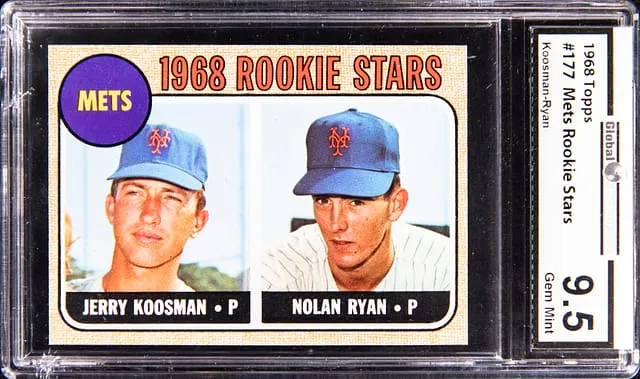
1968 Topps Nolan Ryan Rookie GAI 9.5 Sells for $31K
A 1968 Topps #177 Nolan Ryan rookie, Global Authority Gem Mint 9.5, sold for $31,110 at Goldin on Feb 22, 2026. Here’s what that means for collectors.
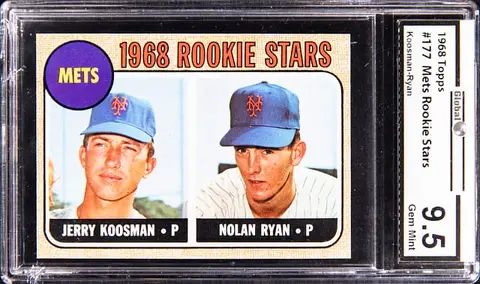
Sold Card
1968 Topps #177 Nolan Ryan Rookie Card - Global Authority Gem Mint 9.5
Sale Price
Platform
Goldin1968 Topps #177 Nolan Ryan Rookie Card – Global Authority Gem Mint 9.5
On February 22, 2026, Goldin closed a notable vintage baseball sale: a 1968 Topps #177 Nolan Ryan Rookie Card graded Gem Mint 9.5 by Global Authority hammered for $31,110. For a key Hall of Fame rookie in a high grade from a smaller grading company, this result offers a useful snapshot of how collectors currently value condition, grading labels, and long-term hobby icons.
Card overview
Let’s break down what sold:
- Player: Nolan Ryan (with Jerry Koosman)
- Team: New York Mets
- Year & set: 1968 Topps Baseball
- Card number: #177
- Card type: True rookie card (first mainstream Topps issue)
- Grading company: Global Authority (GAI)
- Grade: Gem Mint 9.5
- Attributes: Standard paper stock, no autograph, no patch, not serial-numbered
This is the classic “combo rookie” that most collectors recognize as Nolan Ryan’s flagship Topps debut. It sits firmly in the vintage era (typically pre-1980), where print runs were high by modern standards but high-grade survivors are relatively scarce.
Why this card matters to collectors
Nolan Ryan is one of the most established long-term names in the hobby. His market doesn’t rely on short-term performance; it’s built around historical resume and nostalgia.
Key reasons collectors care about this card:
Flagship rookie status
This is the widely accepted Topps rookie card for Ryan. In vintage baseball, the “true rookie” is a central pillar of most player-focused and Hall of Fame collections.Career resume
- All-time MLB leader in strikeouts (5,714)
- Seven no-hitters (an MLB record)
- 27-year career, eight All-Star selections
That kind of longevity and record book presence tends to keep interest stable across decades.
Set significance – 1968 Topps
1968 Topps is known for its burlap-style borders, which make edge and corner wear very visible. Centering can also be inconsistent. Those design and production quirks make high-grade examples noticeably tougher and more desirable.Condition difficulty
On a card with busy borders and typical late‑1960s print quality, achieving a gem-level grade is tough. Even if different grading companies don’t command the same premiums, the core fact remains: visually high-end copies are not common compared with the raw population.
Grading company context: Global Authority vs PSA/SGC/BGS
The copy sold through Goldin is graded Gem Mint 9.5 by Global Authority (GAI). In 2026, most high-end vintage buyers tend to focus on PSA, SGC, and (to a lesser degree) BGS for record-setting results and strong liquidity.
That context helps frame this sale:
- Top prices for this card’s PSA 9 and above often come from major auction houses, and those grades are closely tracked by collectors.
- A GAI Gem Mint 9.5 will usually be compared visually to PSA and SGC examples, with some buyers mentally adjusting for grading company reputation.
- Some advanced collectors may consider cross-grading (submitting a card from one grading company to another) if the card appears strong for the assigned grade.
In other words, this sale price primarily reflects how the market currently values a high-end Ryan rookie in a non-PSA/SGC holder, not an absolute ceiling for the card.
Market context and recent sales
Because vintage comps (short for “comparables,” meaning recent similar sales) can swing with condition and grading label, it’s useful to separate three layers:
- The card itself – 1968 Topps #177 Nolan Ryan Rookie Card
- The condition – very high-end, gem or near-gem
- The grading label – PSA/SGC/BGS versus smaller grading companies
Within that framework:
- PSA 8–9 range: Historically, PSA 8s and 9s for this card have been the primary reference points for serious collectors. Prices can vary widely based on eye appeal (centering, color, print defects) and auction visibility.
- Gem and gem-adjacent territory: True gem copies (PSA 10 or equivalent) are extremely scarce and rarely appear; they tend to set the headline numbers when they do. A 9.5 from a smaller grading company sits below that tier but above the broad mid-grade population.
- Non-PSA slabs: High-grade 1968 Ryan rookies in holders from companies like GAI often trade at a discount to PSA/SGC equivalents, unless they have exceptional visual appeal or a strong chance of crossing over.
At $31,110, this Global Authority Gem Mint 9.5 result:
- Sits well above the pricing range of typical mid‑grade copies.
- Lands below the highest headline sales seen for PSA gem or near‑gem examples.
- Fits the pattern where a strong card in a secondary grading holder finds a solid, but not record‑setting, level at a major auction house.
This makes it a useful reference point for collectors who:
- Own high-grade 1968 Ryan rookies in non‑PSA holders, or
- Are evaluating whether to buy, sell, or cross-grade a similar card.
Vintage scarcity and grade distribution
“Pop report” is hobby shorthand for a grading company’s population report – a count of how many copies they’ve graded at each grade level. While specific live numbers differ by company and change over time as more cards are submitted, the general pattern for this card is consistent:
- Large total population in low to mid grades (reflecting how many were originally printed and handled).
- Steep drop‑off as you approach near-mint, mint, and gem levels.
That slope from plentiful low grades to scarce gem copies is part of what supports strong pricing at the top end. Many collectors are willing to pay a premium for a single example that checks the boxes for centering, corners, color, and general eye appeal.
Factors influencing current interest
Several long-running themes shape demand for cards like this:
Shift toward established legends
In periods where modern prospect or ultra-modern speculation cools, attention often returns to vintage Hall of Famers. Nolan Ryan tends to benefit from those shifts, as his story is already written and his records are deeply embedded in MLB history.Focus on condition and eye appeal
Even within the same numerical grade, buyers are increasingly selective. Auction houses that provide clear, high-resolution images and detailed descriptions help strong copies separate themselves, which can support firmer prices.Grading strategy
As grading fees and turnaround times stabilize, some owners of high-grade vintage from smaller grading companies choose to crack and resubmit to PSA or SGC. Sales like this one help them decide whether that extra step might be worth the risk and cost.
What this sale might mean going forward
This $31,110 sale at Goldin on February 22, 2026, reinforces a few practical takeaways for collectors and small sellers:
- Nolan Ryan’s rookie remains a cornerstone vintage card. Even outside the top-tier grading labels, premium-condition examples continue to attract strong bidding on major platforms.
- Grading label matters, but so does the card. A visually strong copy in a secondary holder can still achieve a meaningful result, especially when presented on a large stage.
- Comps should be chosen carefully. When you look up recent sales, try to compare:
- The same card and year (1968 Topps #177),
- Similar grade levels, and
- Similar grading companies.
That approach will give you a more realistic view of where your card might fit in today’s market. While no past sale guarantees a future outcome, this Goldin result offers one more data point in the evolving picture of Nolan Ryan’s iconic rookie.
For figoca users tracking vintage trends, keeping an eye on how cards like this perform across different grading companies helps build a more nuanced understanding of the market beyond the headline PSA record numbers.