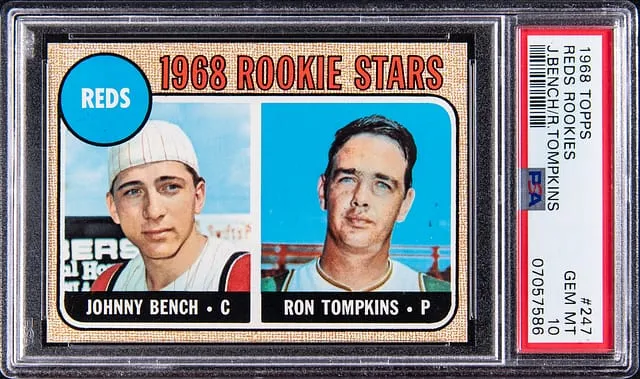
1968 Topps Johnny Bench PSA 10 Rookie Sells for $74K
Goldin sold a 1968 Topps #247 Johnny Bench rookie PSA 10 for $74,425 on Feb 22, 2026. See what this means for vintage baseball card collectors.
Sold Card
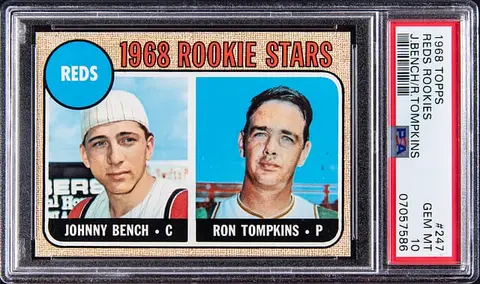
1968 Topps #247 Johnny Bench Rookie Card - PSA GEM MT 10
Sale Price
Platform
Goldin1968 Topps #247 Johnny Bench Rookie Card – PSA GEM MT 10 Sells for $74,425
On February 22, 2026, Goldin auctioned a true blue-chip vintage piece: a 1968 Topps #247 Johnny Bench / Ron Tompkins rookie card, graded PSA GEM MT 10, closing at $74,425.
For long-time collectors, this card needs no introduction. For newer or returning hobbyists, it’s worth slowing down and looking at why this specific copy matters – not just as a big sale, but as a data point in the long story of vintage baseball.
Card Overview
- Card: 1968 Topps #247 Johnny Bench / Ron Tompkins
- Year / Set: 1968 Topps Baseball
- Player: Johnny Bench, Cincinnati Reds
- Card number: #247
- Type: Rookie card (first mainstream Topps issue)
- Format: Dual-player “Rookie Stars” design
- Grading company: PSA (Professional Sports Authenticator)
- Grade: GEM MT 10 (Gem Mint)
- Attributes: No autograph, no patch, no serial numbering – this is a standard flagship base rookie in a top-tier grade.
The 1968 Topps design is immediately recognizable: burlap-style borders, simple photography, and team-colored nameplates. Bench shares this rookie card with pitcher Ron Tompkins, as was common for Topps rookie stars at the time.
Why Johnny Bench’s Rookie Matters
Johnny Bench is widely viewed as one of the greatest catchers in baseball history. For many vintage-focused collectors, his 1968 Topps #247 is the defining cardboard of his career.
Key points that drive collector interest:
- All-time great at a premium position: Bench anchored the Cincinnati Reds’ “Big Red Machine,” winning multiple Gold Gloves and MVP awards and helping lead the team to World Series titles.
- Hall of Fame status: Inducted into the Baseball Hall of Fame in 1989, which cements long-term collector demand.
- Flagship rookie: When collectors say “flagship rookie,” they mean the main, widely recognized base rookie card from the major manufacturer of the era. For Bench, that’s this 1968 Topps #247.
- Vintage era: Late-1960s Topps is considered vintage. Cards were printed in large quantities for kids, handled heavily, and not preserved with grading in mind.
Because of all this, a high-end Bench rookie – especially at the very top of the grading scale – is a cornerstone card in any serious Hall of Fame or vintage run.
Grading, Condition, and Scarcity in PSA 10
PSA’s 1–10 scale tops out at PSA 10 GEM MT, which indicates sharp corners, near-perfect centering, clean edges, and an overall “as issued” appearance.
For a 1968 Topps card, reaching GEM MT 10 is especially difficult:
- Burlap borders highlight every little nick or touch of wear.
- Centering issues were common on 1960s printing runs.
- Handling and storage in the late 1960s were casual; few cards were saved in pristine condition.
Most Bench rookies seen today, even when nicely preserved, fall somewhere in the mid-grade to high-grade range (PSA 4–8). PSA 9s (Mint) are significantly tougher. PSA 10s (Gem Mint) are at the absolute top, with population reports (the grading company’s count of how many copies exist in each grade) typically showing only a very small handful in that grade.
Because population reports can change as new cards are submitted, it’s good practice to check PSA’s database directly for the latest numbers. But regardless of the exact count on any given day, a PSA 10 1968 Topps Bench rookie is understood in the hobby to be extremely scarce.
Market Context and Recent Sales
This Goldin result at $74,425 sits in a specific context within the broader market for this card and for vintage HOF rookies in general.
When collectors talk about “comps” (comparables), they mean recent, publicly recorded sales of the same card or very similar versions. These comps help provide price context, not guarantees.
For the 1968 Topps #247 Bench rookie, the market has historically looked something like this:
- Mid grades (PSA 4–6): Typically in the low hundreds to low four figures, depending on eye appeal and market conditions.
- High grades (PSA 7–8): Often in the mid hundreds to a few thousand dollars.
- Premium grades (PSA 9): Significantly higher, commonly in the few-thousand to five-figure range in stronger market periods.
- Top of the scale (PSA 10): This is where the biggest separation occurs. PSA 10 copies have historically sold at substantial premiums over PSA 9s because of their scarcity and “registry appeal.”
In past strong vintage cycles, high-end copies of iconic Hall of Fame rookies – including Johnny Bench – have posted record results at major auction houses. Some of those record prices were set in particularly aggressive market phases, and later sales have sometimes come in above, near, or below those peaks depending on overall demand.
Within that backdrop, a $74,425 hammer for a PSA 10 Bench rookie at a major venue like Goldin is consistent with the idea that:
- Collectors and investors still place a meaningful premium on the very top grade.
- The card continues to occupy an “upper-tier vintage” slot, but one that is now trading in a more measured, data-aware environment compared with the sharp run-ups of a few years ago.
Instead of thinking of this sale as an outlier or a guarantee of future prices, it makes more sense to view it as one important data point in an ongoing price range for an ultra-high-grade key vintage rookie.
Why This Sale Matters to Collectors
For active hobbyists, this Goldin result is notable for several reasons:
Reinforces the tiering within grades
The gap between PSA 9 and PSA 10 remains large for true vintage icons. This sale underscores how substantial that premium can be when population is low and demand is steady.Shows continued respect for vintage Hall of Fame rookies
Even as modern and ultra-modern cards (with autographs, patches, and serial numbering) attract attention, simple vintage base rookies of inner-circle Hall of Famers keep drawing strong bids.Offers a reference point for lower grades
You don’t need a PSA 10 to appreciate this card. Many collectors build their sets or Hall of Fame runs in the PSA 3–7 range. Seeing a PSA 10 transact at this level helps frame how condition-sensitive the card is and why eye appeal matters at every grade.Highlights the role of major auction houses
High-end copies of key vintage cards often surface at established auction houses like Goldin. These venues tend to set the most visible benchmarks that smaller sellers and buyers later reference.
Market Influences: Player and Hobby Factors
There hasn’t been a sudden, single event recently that would fully explain a one-off spike in Bench rookie prices. Instead, the drivers here are steady and long-term:
- Legacy: Bench’s status as one of the top catchers ever is secure and well understood.
- Content and nostalgia: Regular features, documentaries, and Hall of Fame content keep his era in front of newer fans.
- Hobby focus on condition: Registry competition (collectors building top-ranked graded sets) and increased attention to centering and eye appeal have driven premiums on best-of-the-best copies.
All of this tends to support consistent demand for his flagship rookie without needing a short-term news catalyst.
What This Means for Different Types of Collectors
New and Returning Collectors
If you’re just getting back into the hobby, a $74,425 sale might feel distant. The key takeaway isn’t the exact number, but the structure behind it:
- Vintage Hall of Fame rookies are a long-standing focus.
- Condition and grading dramatically change price ranges.
- Major auction results often sit at the upper end of what the market will bear for the very best examples.
You can still participate with more modest goals: raw or mid-grade copies of the same card let you own a piece of the same history at a fraction of the price.
Active Hobbyists and Small Sellers
For people already buying, selling, or consigning:
- Use sales like this primarily as context, not targets. A PSA 10 result shouldn’t be applied directly to raw or lower-grade copies.
- When evaluating your own Bench rookies, condition details (centering, print quality, corners) matter more than ever. Small flaws have big effects as you move up the grading ladder.
- Keep an eye on multiple venues – auction houses, larger marketplaces, and fixed-price platforms – to get a fuller picture of comps over time.
Figoca Takeaways
From a figoca perspective, this Goldin sale of a 1968 Topps #247 Johnny Bench Rookie Card – PSA GEM MT 10 on February 22, 2026 fits neatly into a broader theme:
- Iconic vintage rookies with low top-grade populations continue to command premium prices.
- Market participants are more data-aware, focusing on pop reports, past auction histories, and realistic comp ranges.
- For collectors across all budget levels, sales like this are useful as reference points, not benchmarks to chase.
Whether you’re tracking high-end auctions or just deciding what to grade next, keeping an eye on these key results helps you better understand how condition, scarcity, and player legacy interact in today’s trading card market.