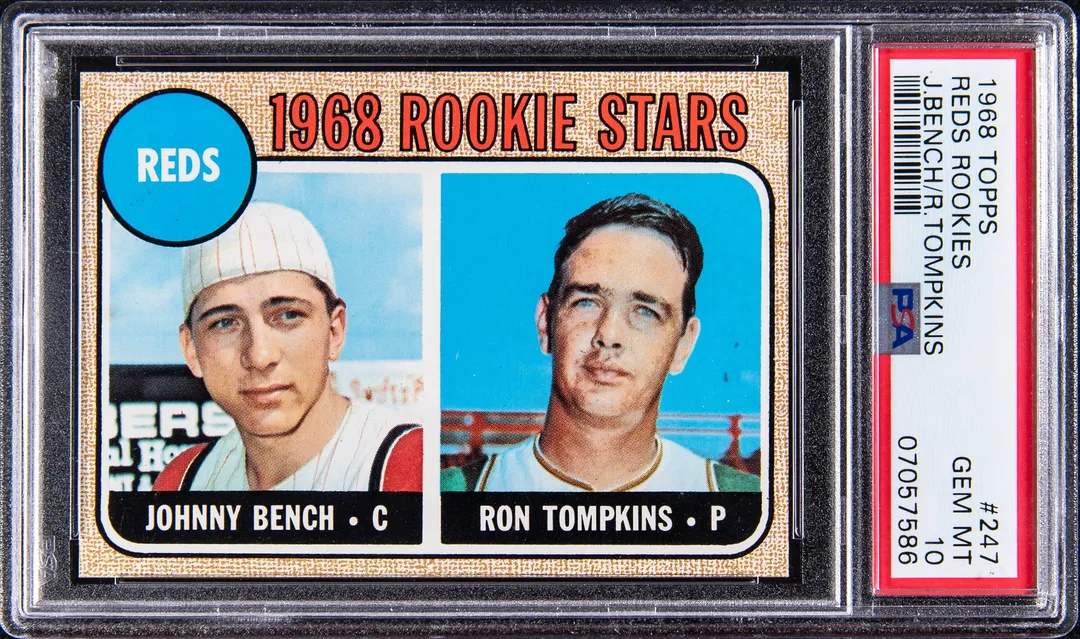
1968 Topps Johnny Bench PSA 10 Rookie Sells for $744K
Goldin sold a 1968 Topps #247 Johnny Bench Rookie PSA 10 for $744,250. See why this vintage Hall of Fame card commands such a premium.
Sold Card
1968 Topps #247 Johnny Bench Rookie Card - PSA GEM MT 10
Sale Price
Platform
Goldin1968 Topps #247 Johnny Bench Rookie Card in a PSA GEM MT 10 holder has long been one of those “white whale” vintage pieces that many collectors talk about but few ever see. On February 22, 2026, Goldin sold a copy for $744,250, a result that deserves a closer look for anyone tracking the high end of the vintage baseball market.
In this breakdown, we’ll walk through what the card is, why it matters so much to collectors, how this PSA 10 sale compares to other recent results, and what it might mean for the broader hobby.
The Card at a Glance
- Player: Johnny Bench
- Team: Cincinnati Reds
- Year: 1968
- Set: 1968 Topps Baseball
- Card number: #247
- Card type: Rookie card (shared “Rookie Stars” format)
- Grading company: PSA (Professional Sports Authenticator)
- Grade: GEM MT 10 (Gem Mint)
- Attributes: Standard base rookie card, no autograph or patch, iconic vintage issue
For many collectors, this is the Johnny Bench card: his primary flagship rookie in Topps’ core baseball release. The 1968 Topps design—often called the “burlap” set because of its textured border—has become one of the most recognizable vintage templates, and the Bench rookie is one of the key cards in the entire checklist.
Why the 1968 Topps Johnny Bench Rookie Matters
A cornerstone of Hall of Fame catching
Johnny Bench is widely considered one of the greatest catchers in baseball history. As the anchor of the Cincinnati Reds’ “Big Red Machine” dynasty, he collected:
- 2 National League MVP awards
- 10 Gold Gloves
- 14 All-Star selections
- Multiple World Series titles
Collectors often gravitate toward a player’s flagship rookie card, meaning their first main card in a core annual set like Topps. For Bench, that flagship rookie is card #247 from 1968 Topps.
Iconic vintage era
1960s Topps baseball sits firmly in what collectors call the vintage era. Vintage sets typically have:
- Tougher centering and print quality
- More surface and print issues straight from the pack
- Lower survival rates in high grade because most cards were actually handled and played with
The 1968 set is notorious for centering problems and chipping along the darker “burlap” borders. That means that while raw (ungraded) copies of this card are not rare, truly high-grade examples are extremely difficult to find.
Understanding the PSA 10 Grade and Scarcity
PSA’s grading scale runs from 1 to 10, with PSA 10 GEM MT (Gem Mint) being the highest grade. A PSA 10 indicates a card that is, in PSA’s view, essentially perfect in terms of corners, edges, surface, centering, and overall presentation.
For a 1960s Topps card, a PSA 10 is especially significant:
- Older printing methods produced more defects.
- Storage and handling from that era were rarely “collector-grade.”
- The “burlap” border shows even small touches of wear.
Population reports (often shortened to “pop report”) are the grading company’s public counts of how many copies of a card have earned each grade. For the 1968 Topps Johnny Bench rookie, long-running pop reports have shown a large total number graded, but an extremely small fraction earning a PSA 10. Bench’s rookie is generally regarded as a very low-population card at the GEM MT 10 level.
That imbalance—many cards graded, very few 10s—creates a substantial separation between PSA 10 pricing and all other grades.
Recent Market Context and Comps
In the hobby, “comps” (comparable sales) are past sales of the same card or very similar versions that help frame what a current result means.
For the 1968 Topps #247 Johnny Bench rookie:
- Mid-grade copies (PSA 5–7) have typically traded in the low hundreds to low thousands of dollars, depending on eye appeal and exact grade.
- High-grade copies (PSA 8–9) have been much stronger, especially PSA 9s, which have historically pushed into five-figure territory when centered and visually sharp.
At the very top:
- Past PSA 9 sales have often set the pace for most collectors, functioning as a benchmark for “premium but not unreachable” vintage condition.
- PSA 10 examples of this card, however, almost never come up for sale and have historically realized prices that are orders of magnitude above even strong PSA 9s.
The February 22, 2026 Goldin sale of a PSA GEM MT 10 copy for $744,250 sits in that context as a true outlier: not because the card is unknown, but because PSA 10 opportunities are so rare that each auction can reset expectations for what the very top of the market is willing to pay.
Given the scarcity of recent PSA 10 comps for this exact card, it’s more accurate to view this result as part of a very short, selective history of record-level sales rather than as an everyday price guide number.
How This $744,250 Result Fits the Market
A few points stand out when you compare this sale to the broader Bench rookie market and the vintage landscape:
Extremely strong grade premium
The gap between PSA 9 and PSA 10 for key vintage rookies has been wide for years. For Bench, a $744,250 PSA 10 result dramatically underscores that top-pop, historically important Hall of Fame rookies continue to occupy their own tier.Limited true comps at this level
Because so few PSA 10 copies exist, and even fewer come to auction, most collectors and small sellers will never transact at this tier. Still, the number provides a useful ceiling when thinking about relative values of PSA 8s and 9s.Alignment with other vintage Hall of Fame rookies
High-end vintage has seen strong interest in cornerstone Hall of Fame rookies: players like Mickey Mantle, Willie Mays, Hank Aaron, Roberto Clemente, and others. Bench’s rookie is not on the same level as the most iconic 1950s issues in terms of market size, but this sale confirms that his very best examples share the same logic: rare, top-graded copies of historically significant players command outsized premiums.No short-term news driver needed
Bench is long retired and firmly established in the Hall of Fame. This isn’t a modern “hype cycle” card driven by a playoff run, award, or prospect buzz. Instead, the value is anchored in long-term historical significance and extreme condition rarity.
What Collectors Can Take Away
Whether you are a newcomer, a returning collector, or an active hobbyist, there are a few practical lessons from this sale.
1. Condition matters more as you go back in time
As sets get older, high-grade copies become much more scarce. For a 1960s issue like this Bench rookie, jumping from PSA 8 to PSA 9 to PSA 10 isn’t just a small upgrade—it’s a leap into a much thinner supply pool.
Even if you are not chasing PSA 10s, understanding how the population is distributed across grades helps you:
- Set realistic expectations for what condition you can find.
- Understand why price jumps between adjacent grades can be steep.
2. Pop report context is key
A raw number like “only a handful of PSA 10s exist” matters, but it matters more when you know how many total copies have been graded. A small population at the top combined with a large total graded population usually indicates:
- The card is widely collected and submitted.
- The grading standard is tough enough that top grades are genuinely rare.
That dynamic is very much in play with the 1968 Topps Johnny Bench rookie.
3. Flagship vintage rookies have durable collector interest
Even as modern and ultra-modern cards (with serial numbering, patches, and autographs) have surged and cooled at different times, flagship vintage rookie cards of established Hall of Famers have generally maintained deep collector bases.
The Bench rookie is a good example of that pattern:
- No autograph.
- No patch.
- No serial number.
- Just the key early-career image from an important Topps set.
This type of card tends to remain a priority for team collectors, Hall of Fame collectors, set builders, and player specialists.
What This Means for Small Sellers and Everyday Collectors
Most collectors will encounter this card in raw, mid-grade, or maybe PSA 6–8 condition, rather than in PSA 10. Still, the record-type result at the top can inform decisions at lower levels.
For small sellers:
- Strong headline results can attract more attention to the card in all grades.
- It can be worth taking a fresh look at raw copies you own to see if a grading submission now makes sense based on condition and updated comps.
- Keep expectations grounded: PSA 10 pricing does not automatically translate to comparable percentage gains at every grade.
For everyday collectors:
- The sale is a reminder that even iconic cards can be approachable in more modest grades.
- Centering and overall eye appeal still matter a lot, even within the same numeric grade.
- You can often find a balance between price and presentation by comparing several graded copies side by side.
Final Thoughts
The February 22, 2026 Goldin sale of the 1968 Topps #247 Johnny Bench Rookie Card – PSA GEM MT 10 at $744,250 highlights how far the very top of the vintage market can stretch when a historically important player, a key flagship rookie, and an ultra-rare grade all collide.
For the broader hobby, it reinforces a few themes:
- Vintage remains a core pillar of the market.
- Flagship Hall of Fame rookies continue to attract deep interest.
- True condition scarcity, backed by pop report data, can generate prices that stand apart from more common grades.
Whether you’re chasing a well-loved raw copy or a sharp PSA 8, understanding why this PSA 10 example commanded such a premium can help you navigate your own Johnny Bench pickups with clearer eyes and better context.