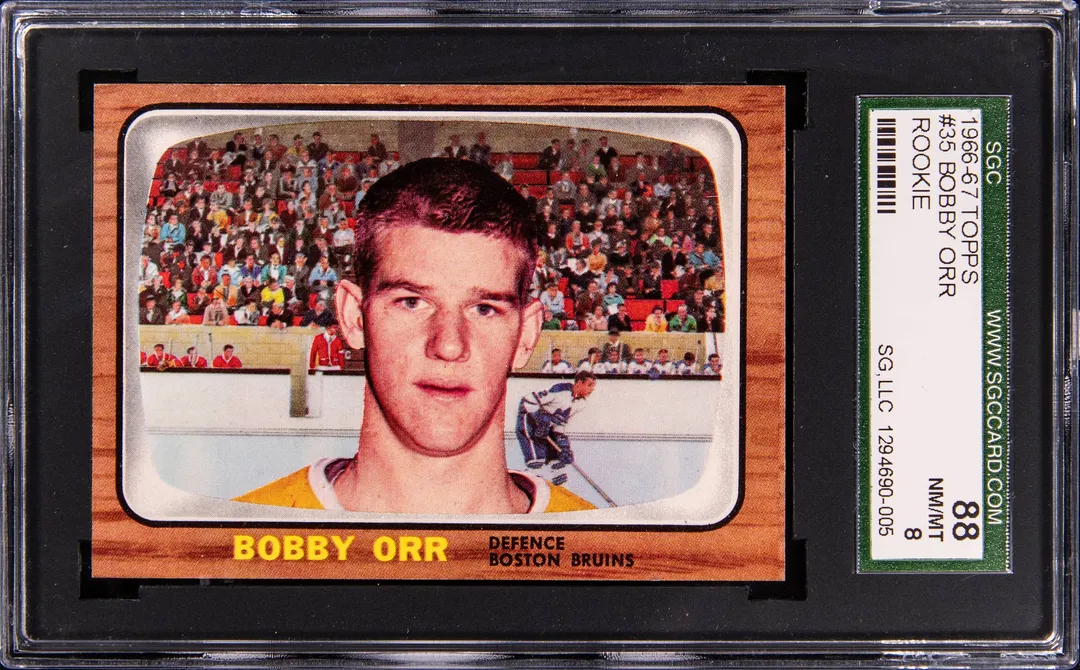
1966-67 Topps Bobby Orr RC SGC 8 sells for $29,890
Goldin sold a 1966-67 Topps #35 Bobby Orr rookie card graded SGC NM-MT 8 for $29,890 on Feb 22, 2026. See context, comps, and what it means.
Sold Card
1966-67 Topps #35 Bobby Orr Rookie Card - SGC NM-MT 8
Sale Price
Platform
Goldin1966-67 Topps #35 Bobby Orr Rookie Card (SGC NM-MT 8) Sells for $29,890 at Goldin
The 1966-67 Topps #35 Bobby Orr is one of the foundational vintage hockey cards, and a cornerstone of many serious collections. When an example in a strong grade surfaces at auction, it tends to attract attention well beyond just Bruins fans.
On February 22, 2026 (UTC), Goldin sold a 1966-67 Topps #35 Bobby Orr rookie card graded SGC NM-MT 8 for $29,890. For a hobby that increasingly tracks every major sale, this is a useful data point for understanding where one of hockey’s most important rookie cards is currently trading.
Card overview: why this Orr matters
Card details
- Player: Bobby Orr
- Team: Boston Bruins
- Year: 1966-67
- Set: 1966-67 Topps Hockey
- Card number: #35
- Type: True rookie card (widely recognized flagship rookie)
- Grading company: SGC (Sportscard Guaranty Corporation)
- Grade: NM-MT 8 (Near Mint–Mint)
- Attributes: Standard base rookie, no autograph or memorabilia; important as a key vintage issue rather than for modern-style inserts
Bobby Orr’s 1966-67 Topps #35 is generally viewed as the mainstream rookie card for one of the most influential defensemen in NHL history. This is a classic vintage issue: standard card size, simple design, no serial numbering, and all of the usual condition challenges that come with 1960s printing and distribution.
The 1966-67 Topps hockey set itself is significant. It is a mid-1960s Topps release that captures a transitional era in the NHL, and it includes the early cardboard appearance of a player who would redefine what an offensive defenseman could be. That combination—important era, key set, all-time player—helps explain why collectors consistently target this card in all major grading company holders.
Grading context: SGC NM-MT 8
In modern hobby language, NM-MT 8 means the card is in Near Mint–Mint condition:
- Strong overall eye appeal
- Relatively clean surfaces
- Minor touches to corners or edges
- Centering that is solid but not necessarily perfect
SGC has long been respected in vintage circles, especially for pre-war and early post-war issues. For 1960s hockey, SGC is typically considered part of the main grading ecosystem alongside PSA and, to a lesser extent, BGS. For this Orr rookie, PSA historically has the largest population, but SGC examples have developed a consistent following among collectors who prefer their holders and vintage-focused grading standards.
While exact population report numbers can fluctuate as more cards are submitted, the broader pattern is clear:
- High-grade vintage Orr rookies (in the 8–9 range) are significantly scarcer than mid-grade copies.
- True mint-level examples (9 and above) command a substantial premium and rarely surface.
- SGC 8 sits at the upper tier of what most collectors would consider an accessible, high-end copy.
Recent sales and price context
When collectors talk about “comps”, they mean comparable recent sales that help frame what a card has actually sold for in the open market. For a key vintage card like the 1966-67 Topps #35 Bobby Orr, comps typically include:
- The same card in the same grade and grading company (ideal)
- The same card in the same grade but different grading company (PSA/SGC/BGS)
- The same card in adjacent grades (for example, 7.5 or 8.5) to understand the price curve
Across major marketplaces and auction houses in recent years, this card has shown a few consistent patterns:
- PSA 8 examples of the Orr rookie generally sell for a noticeable premium over SGC 8, reflecting PSA’s larger resale market and registry competition.
- SGC 8 sales typically slot in below PSA 8 but above strong 7 or 7.5 copies, mirroring grading-cross-over expectations and collector preferences.
- High-end sales (PSA 9 and similarly top-tier examples) have historically set much higher benchmarks, underscoring the steep price escalation as condition improves at the very top.
Against that backdrop, the $29,890 result at Goldin on February 22, 2026 looks consistent with where a strong SGC NM-MT 8 Orr rookie can sit in the current market. Vintage hockey has seen periods of increased attention, especially around the hobby-wide run-up in the early to mid-2020s, followed by some normalization. Within that broader cycle, the Orr rookie has generally remained one of the more stable long-term pieces, especially in higher grades.
For collectors trying to contextualize this specific sale:
- It reinforces the idea that clean, graded vintage Hall of Fame rookies continue to command meaningful premiums relative to lower grades.
- It shows that SGC-graded copies can achieve strong results when offered through a major auction house with established bidding audiences.
- It provides another documented data point for anyone tracking mid- to high-grade Orr rookie pricing over time.
Exact past sale prices will vary based on timing, overall market conditions, and card-by-card factors such as centering and visual appeal. However, the Goldin result fits into the ongoing trend of solid demand for iconic vintage hockey rookies.
Collector significance: why Orr’s rookie is a long-term target
Several factors help explain why the 1966-67 Topps #35 Bobby Orr rookie continues to be a centerpiece for many collections:
All-time player status
Bobby Orr is widely regarded as one of the greatest defensemen in NHL history. His impact on how the position is played—pushing offense from the blue line and driving play end-to-end—gives his rookie card relevance that goes beyond any single team or era.Flagship vintage rookie
This Topps #35 issue is the main, widely recognized rookie card for Orr. In hobby terms, it functions as his flagship rookie—the go-to card when collectors think “Bobby Orr RC.” That clarity matters, especially for newer collectors who want one card that represents the player.Era and printing realities
As a 1960s card, it predates modern production standards. Common issues include off-centering, print defects, and handling wear. Many surviving copies were heavily handled or stored casually. That history is part of what makes higher-grade examples meaningful: they are reminders of how few cards survived in top condition.Set importance
The 1966-67 Topps release has a modest checklist but carries outsized importance because of Orr. For many collectors, building or upgrading this set naturally revolves around the Orr rookie as the central piece.Ongoing hobby interest in vintage hockey
Over the last decade, collectors have shown steady interest in established Hall of Famers across all sports. In hockey, that has meant sustained attention for names like Gretzky, Orr, and Lemieux. While market cycles can move prices up or down in the short term, interest in the core vintage icons has remained comparatively resilient.
As of the February 22, 2026 sale, there is no single news event (such as a recent milestone on the ice) driving attention to Orr. Instead, the support for his rookie card continues to come from his long-established status in the hobby.
What this sale tells collectors and small sellers
For newcomers, returning collectors, and small sellers, this Goldin auction offers a few takeaways:
Documented benchmark
The $29,890 price serves as a concrete reference point for an SGC NM-MT 8 copy of this card in early 2026. Anyone buying, selling, or trading can log this as part of their comp research.Grading choice and value
The strong result confirms that SGC-graded vintage can perform well at major auction houses, particularly for historically important cards. When considering grading, this is one more example that serious buyers will engage with high-grade SGC vintage.Condition still drives outcomes
Even within the same numerical grade, centering, print quality, and overall eye appeal can influence final hammer prices. While the headline here is “SGC 8,” the specific look of the card often matters to bidders willing to stretch.No guarantees implied
Like every comp, this is a single data point. It should be considered alongside other recent sales, changing market conditions, and individual card attributes rather than treated as a guaranteed value.
How to use this comp in your own research
If you’re trying to make sense of Bobby Orr rookie prices or considering a purchase or sale, here are a few practical steps:
Line up multiple comps
Don’t rely on a single auction result. Compare this $29,890 Goldin sale to:- Recent SGC 8 sales on other auction platforms
- PSA 8 and SGC 7.5 / 8.5 sales to understand the grade curve
- Any documented private or fixed-price marketplace sales in similar condition
Compare eye appeal
When possible, look at front and back scans. Ask how the centering, corners, edges, and color of your card compare to the Goldin example. Some collectors are willing to pay a premium within the same grade for better centering or stronger visual appeal.Note timing and venue
Major auction houses like Goldin can draw more bidders than smaller sites. Differences in audience, promotion, and timing can all affect final prices, which is why it is helpful to track results across multiple venues, not just one.Track trends over time
Instead of focusing only on today’s price, consider how Orr rookie sales have moved over the last several years. This can help you understand whether the current level is part of a rising trend, a pullback, or a relatively stable band.
Final thoughts
The sale of the 1966-67 Topps #35 Bobby Orr rookie card in SGC NM-MT 8 for $29,890 at Goldin on February 22, 2026, is another measured reminder of where one of hockey’s cornerstone vintage rookies stands today. For collectors building long-term vintage hockey collections, it reinforces the enduring appeal of well-preserved key cards. For small sellers and hobbyists, it provides a clear, time-stamped data point to factor into future research.
As with any card, especially at this level, it’s worth spending time with the data: review multiple comps, look closely at condition, and think about where a specific copy fits within the broader landscape of Bobby Orr rookies. This Goldin result is one more piece of that bigger picture.