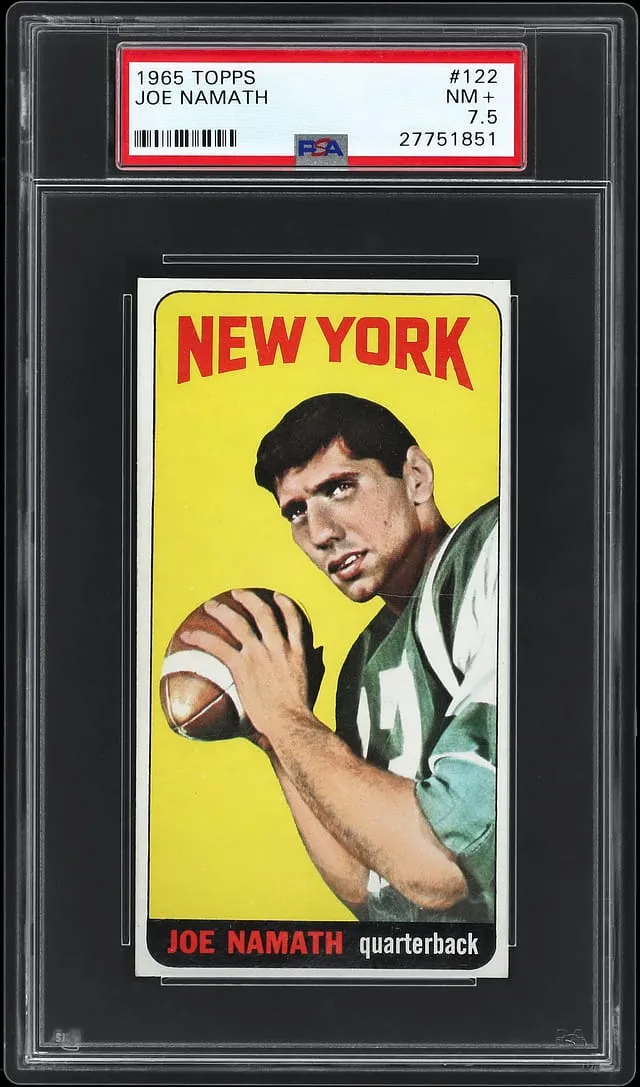
1965 Topps Joe Namath Rookie PSA 7.5 sells for $12k
Goldin sold a 1965 Topps #122 Joe Namath Rookie PSA 7.5 for $12,509 on Feb 22, 2026. See what this means for vintage football collectors.
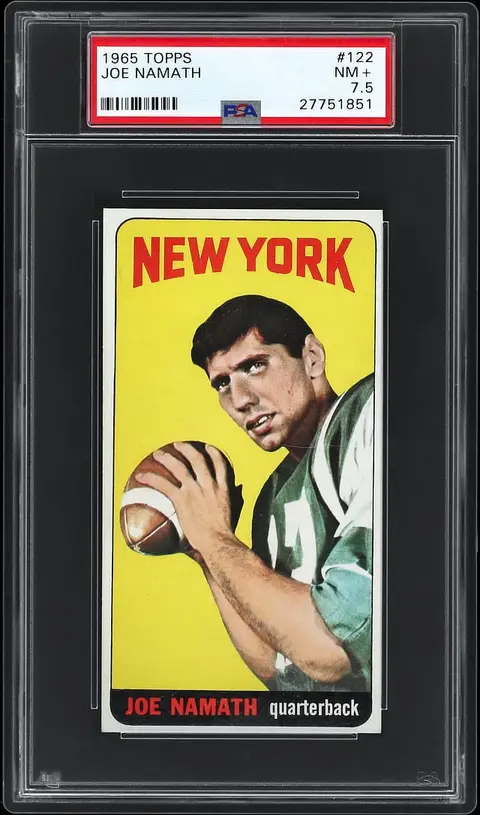
Sold Card
1965 Topps #122 Joe Namath Rookie Card - PSA NM+ 7.5
Sale Price
Platform
Goldin1965 Topps #122 Joe Namath Rookie Card (PSA NM+ 7.5) just changed hands at Goldin on February 22, 2026 for $12,509. For vintage football collectors, this is one of the defining rookie cards of the entire 1960s, and every notable sale helps clarify where the market really stands.
The card at a glance
- Player: Joe Namath
- Team: New York Jets (New York Titans on earlier material; Jets by 1965 Topps)
- Year / Set: 1965 Topps Football
- Card number: #122
- Issue type: True rookie card, key vintage Hall of Famer
- Grading company: PSA (Professional Sports Authenticator)
- Grade: NM+ 7.5
The 1965 Topps football release is famous for its tall-boy design: oversized, vertical cards that stand out immediately next to standard modern issues. Namath’s #122 rookie is the clear anchor of the set and a top-tier Hall of Fame rookie in all of vintage football.
Why the 1965 Topps Namath matters so much
For newer collectors: a “rookie card” is generally the player’s first widely distributed base card from a major manufacturer in a standard set. Namath’s 1965 Topps rookie checks every box: flagship Topps release, mainstream distribution for the era, and a clear Hall of Fame career behind it.
A few reasons this particular card has become so important:
- Cultural impact – Namath wasn’t just a great quarterback; he was a cultural figure. His guarantee and win in Super Bowl III are still among the most replayed moments in NFL history.
- Era scarcity – While 1960s Topps football was mass-produced relative to its time, surviving high-grade examples of tall boys are genuinely tough. The larger format made them more likely to be damaged, miscut, or stored poorly.
- Set hierarchy – Within vintage football, this is one of the key non-rookie-Quarterback cards: it sits alongside the likes of Jim Brown, Johnny Unitas, Bart Starr, and others as a target for people building Hall of Fame runs.
Because of the combination of player, design, and era scarcity, the 1965 Topps Namath rookie is often one of the first big vintage cards collectors learn about when they move beyond modern issues.
Understanding PSA NM+ 7.5
PSA uses a numeric scale from 1 to 10, with 10 being gem mint. A PSA 7.5 is labeled NM+ (Near Mint Plus), falling between a straight 7 (Near Mint) and 8 (Near Mint–Mint). In practice, that often means:
- Strong surface and edges with only minor wear
- Centering that is decent but not necessarily sharp enough for an 8
- Eye appeal that can feel closer to an 8 than a 7, depending on the copy
For 1965 tall boys, getting into the 7–8 range already puts a card into a relatively small segment of the total surviving population. High-grade tall boys are frequently held long term by set builders and vintage-focused collectors.
When collectors talk about a “pop report,” they mean the population report: the grading company’s data on how many copies of a card exist in each grade. While exact numbers change over time as more cards are submitted, the broad pattern on this card has been consistent for years: there are many low-to-mid grade Namath rookies, but the number of 7s and 8s is meaningfully smaller, and the jump into true high-end 9s is extremely rare.
Market context for this $12,509 sale
This Goldin result at $12,509 (before any buyer’s premium details beyond the hammer price given here) sits in the mid–high range for strong mid-grade Namath rookies.
To give a sense of context, recent hobby data across major marketplaces and auction houses has generally shown:
- PSA 6 range – Often significantly below the five-figure mark, with condition issues more apparent to the naked eye.
- PSA 7 range – Commonly sitting below the final price we’re looking at here, though strong-centered or high eye-appeal 7s can push higher.
- PSA 8 range – Typically above this sale, often a noticeable step up in price versus 7s and 7.5s because of the population gap and stronger eye appeal.
In that light, this $12,509 result for a PSA 7.5 looks like a healthy, but not extreme, number: it reflects sustained demand for solid vintage examples of iconic rookies, without suggesting a runaway record or an outlier bidding war.
For long-time hobbyists, it fits a broader pattern we’ve seen the last few years: meaningful but more measured pricing for blue-chip vintage football compared to the more volatile peaks in ultra-modern cards.
How it compares to notable past sales
Historically, the very top of the market for Joe Namath rookies has centered on PSA 9s and other super high-end copies, which can reach well into six-figure territory when the right card meets the right bidder group. Those results are rare because the cards themselves are rare in that grade.
By contrast, the mid-graded tier (5–7.5) tends to show a steadier volume of sales. These are the grades where many collectors aim when they want an authentic, presentable copy of an iconic rookie without paying the premium for near-mint-mint plus and above.
Within that band, PSA 7.5s can act as a bridge grade: they attract
- Collectors who want something meaningfully nicer than an average 6 or 7
- Buyers priced out of 8s and above who still value eye appeal
This $12,509 sale feels aligned with that role: strong enough to signal real demand, but still in a range that matches recent market behavior for similar examples.
Why this result matters to collectors
For anyone tracking vintage football, this Goldin sale on February 22, 2026 provides a useful reference point:
- Confirmation of demand – It reinforces that key Hall of Fame rookies from the 1960s, especially in problem-free mid-to-high grades, remain a priority for collectors.
- Grade-to-price curve clarity – When you compare this PSA 7.5 sale to recent 6, 7, and 8 sales, you can see how the market currently prices the jump from solid mid-grade to high-grade eye appeal.
- Set health check – The 1965 Topps set continues to command attention well beyond Namath. Strong prices for its anchor card usually correlate with ongoing interest in building the full run.
For small sellers and casual investors, it’s helpful to think of this sale as one data point in a trend rather than a standalone signal. When hobbyists talk about “comps,” they mean comparable sales—recent transactions of the same card and grade that help set expectations. This Goldin auction now joins that comp list for PSA 7.5 Namath rookies.
Takeaways for different types of collectors
If you’re new to vintage football:
- The 1965 Topps Namath rookie is one of the clearest examples of a historically important, widely recognized vintage card.
- Watching how PSA 4–7 copies move over time is a practical way to learn how condition, centering, and eye appeal influence price.
If you’re a returning collector from the 1980s–1990s:
- The tall-boy format and the Namath name may be familiar, but the current grading-driven structure of the market may feel new.
- Use sales like this one to understand where graded vintage sits relative to raw copies you might still have.
If you’re an active hobbyist or small seller:
- This $12,509 sale suggests steady liquidity at the mid-high grade level for key vintage rookies.
- When listing a similar card, photos that highlight centering, corners, and color saturation become especially important, since eye appeal can push one 7.5 notably higher than another.
Final thoughts
The February 22, 2026 Goldin auction of a 1965 Topps #122 Joe Namath Rookie Card in PSA NM+ 7.5 at $12,509 underlines why this card has remained a central piece of vintage football collecting.
It’s not just a nostalgic tall-boy from the 1960s. It’s a flagship Hall of Fame rookie that continues to serve as a benchmark for how the hobby values history, condition, and iconic players over time.
As always, it’s best to treat results like this as informational rather than predictive. Market conditions change, and no single sale tells the whole story. But for collectors tracking the health of vintage football, this Namath result is a useful, grounded reference point for where a strong mid-high grade copy sits in early 2026.