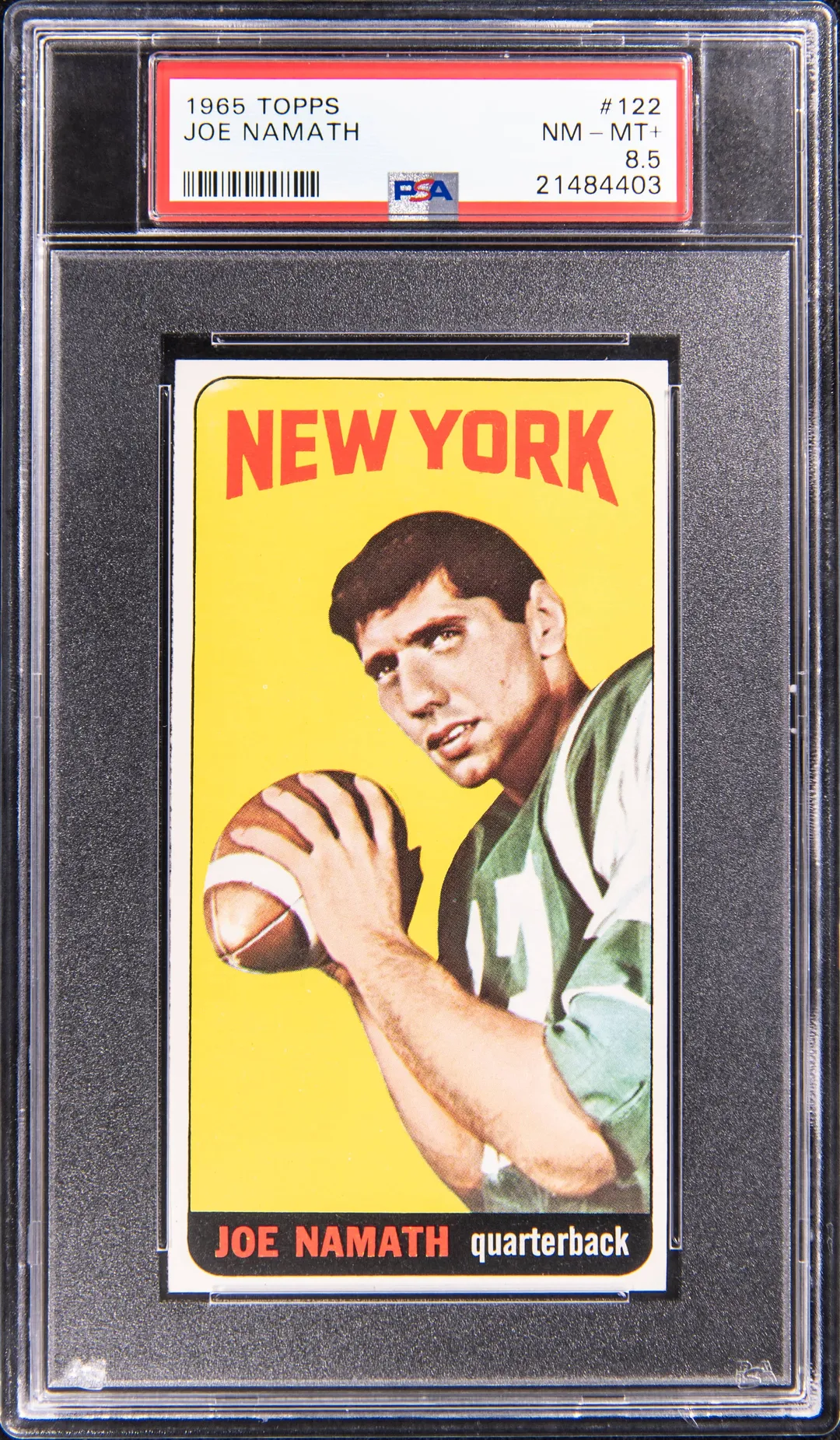
1965 Topps Joe Namath PSA 8.5 Rookie Sells for $173K
Goldin sold a PSA 8.5 1965 Topps Joe Namath rookie for $173,240. See why this low-pop, high-grade vintage football card matters to collectors.
Sold Card
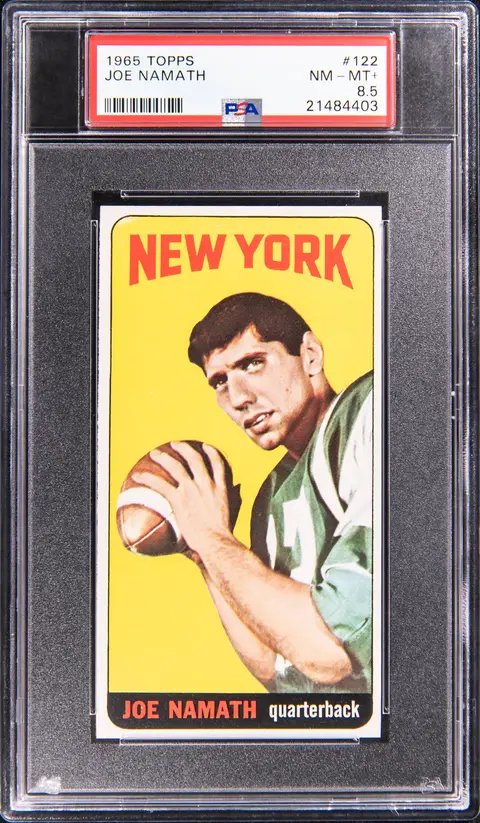
1965 Topps #122 Joe Namath Rookie Card PSA NM-MT+ 8.5 – POP 3; Only 5 Higher PSA Copies
Sale Price
Platform
GoldinA PSA 8.5 Joe Namath Rookie Just Cleared $173,240: What It Tells Us About Vintage Football
On February 22, 2026, Goldin sold a 1965 Topps #122 Joe Namath rookie card graded PSA NM-MT+ 8.5 for $173,240. For a vintage football card, especially one from the mid‑1960s, that’s a meaningful result—and it sits right in the middle of a very thin, very competitive part of the population report.
In this breakdown, we’ll look at what this specific card is, why it matters so much to collectors, and how this sale fits into the broader market for high‑grade Namath rookies.
Card basics: what exactly sold?
• Player: Joe Namath
• Team: New York Jets (AFL)
• Year: 1965
• Set: 1965 Topps Football (often nicknamed the “tall boy” set)
• Card number: #122
• Key status: Rookie card and the clear flagship Namath issue
• Era: Vintage (pre‑1980)
• Grading company: PSA (Professional Sports Authenticator)
• Grade: NM-MT+ 8.5
• Population: PSA pop 3 in 8.5, with only 5 higher‑graded copies
The 1965 Topps design is unusually tall compared with standard modern cards, which makes it more prone to edge and corner wear over time. Namath’s card is also known for centering issues and print imperfections. Those condition challenges are a big reason that high PSA grades are scarce.
This particular copy has no autograph, memorabilia patch, or serial numbering. Its value is driven primarily by three things:
- It is Joe Namath’s flagship rookie card.
- It is from a historically important and condition‑sensitive vintage set.
- It sits at the very top of the graded condition ladder (PSA 8.5, with very few PSA 9s and any PSA 10 essentially treated as a museum‑level piece).
Why the Namath rookie matters so much
Joe Namath occupies a unique spot in football history. He was not just a statistical quarterback; he was a cultural figure whose guarantee and victory in Super Bowl III helped legitimize the AFL and shape the modern NFL.
Collectors tend to value this card for a few overlapping reasons:
• Historical significance: Namath’s Super Bowl III guarantee and upset win over the Colts is one of the most replayed storylines in football history. His rookie card is a direct connection to that era.
• AFL and Jets heritage: For collectors focused on the early AFL and the New York Jets, this is the cornerstone card.
• Set importance: The 1965 Topps football set is one of the most distinctive vintage sets because of its oversized “tall boy” format, bright colors, and relatively low survival in top condition.
• Condition sensitivity: Taller cards are more easily dinged, creased, or miscut. Centering and print issues are common. That makes strong 8s, 8.5s, and 9s genuinely tough.
Because of these factors, the Namath rookie has long been viewed as one of the key vintage football cards, mentioned in the same breath as other blue‑chip football rookies when collectors discuss “must‑have” Hall of Fame issues.
Grading, scarcity, and the PSA pop report
A pop report (population report) is the grading company’s tally of how many copies of a card they have graded at each grade level. For high‑grade vintage, the pop report is often where the story really starts.
For the 1965 Topps #122 Joe Namath rookie in PSA holders, the landscape looks roughly like this at the top end:
• PSA 8.5: Pop 3 (including this card)
• Higher than 8.5: Only 5 total PSA copies
That makes PSA 8.5 essentially a gateway to the card’s true upper tier. There are more total PSA 8s, but once you cross into 8.5 and above, the supply becomes very tight.
Two points follow from that:
- Thin supply means each sale matters. With only three copies in PSA 8.5, any public auction result becomes an important data point for collectors and consignors.
- Price jumps between grades can be large. In vintage, the move from 8 to 8.5—or especially from 8.5 to 9—often isn’t about a small bump in condition; it’s about entering a much scarcer tier where some collectors are chasing registry rankings or simply the best examples they can realistically acquire.
Price context: how does $173,240 compare?
The Goldin sale on February 22, 2026 closed at $173,240. To understand what that means, it’s useful to look at “comps” (comparable recent sales) for the same card in similar grades.
While exact figures move over time and across platforms, the general recent pattern for this card has been:
• PSA 7 and below: These serve as more accessible entry points, often traded more frequently and at much lower prices than the 8–9 range.
• PSA 8: Historically strong, but with higher population. These tend to set the baseline for the card’s high‑grade market.
• PSA 8.5: Pop 3, so sales are infrequent. When they do appear, they typically clear well above PSA 8 pricing due to scarcity and registry demand.
• PSA 9 and above: Very rare. Past public results for PSA 9s have commanded substantial premiums over 8.5, and any PSA 10 sale is treated as a headline event for the entire vintage football market.
Within that structure, a $173,240 result for a PSA 8.5 aligns with the idea that this is a truly scarce, upper‑tier vintage football rookie. It sits in a range that:
• Is clearly separated from more common mid‑grade copies.
• Recognizes the card’s importance relative to other 1960s football issues.
• Reflects the ongoing premium that collectors place on population‑constrained, registry‑relevant grades.
Because PSA 8.5 sales are so infrequent, this Goldin auction effectively refreshes the market’s view of what an 8.5 Namath rookie can bring in a competitive setting. Collectors can treat it as a contemporary benchmark, while also remembering that future prices—higher or lower—will depend on broader market conditions, individual card eye appeal, and timing.
Vintage football and the broader market
The Namath rookie doesn’t exist in a vacuum. It sits at the crossroads of several hobby trends:
- Growing interest in vintage football: While vintage baseball has long dominated, high‑end football has been catching up, with more collectors treating key Hall of Fame rookies as centerpieces.
- Condition scarcity: Many 1960s football cards were handled heavily, rubber‑banded, or stored poorly. Clean, well‑centered examples in high‑end PSA holders remain relatively scarce compared with modern print runs.
- Focus on iconic, established names: In a market where modern speculative cards can be volatile, some collectors gravitate toward established legends and historically significant moments like Super Bowl III.
Namath, as a Hall of Famer and cultural figure, fits neatly into that third category. His career and media presence keep him top‑of‑mind for many collectors of classic football.
What this sale may signal for collectors
This Goldin sale on February 22, 2026, doesn’t rewrite the book on Namath rookies, but it reinforces several points that active collectors and small sellers might find useful:
• True high‑grade vintage remains thinly supplied. A pop 3 grade with only five higher PSA copies is not something you see often, especially for a major Hall of Fame rookie.
• Registry and eye appeal matter. When only a handful of cards exist at a given grade, the chase for the best‑looking examples can be intense, and that often shows up in the final hammer price.
• Vintage blue chips continue to function as reference points. Sales like this provide anchor numbers that buyers and sellers can look to when negotiating on adjacent grades (for example, comparing PSA 7, 8, 8.5, and 9 copies).
For newer collectors, it’s a reminder that vintage isn’t just about owning any copy of a famous card. Condition, grading company, and population can dramatically change how the market views a card—even when the front picture and player are the same.
Takeaways for different types of hobbyists
If you’re a newcomer:
The 1965 Topps Joe Namath rookie is a textbook case of how history, aesthetics, and scarcity combine. You don’t have to chase a PSA 8.5 to appreciate it; mid‑grade copies can still offer the same iconic image and story at a fraction of the price.
If you’re a returning collector:
This sale underscores how much the hobby’s infrastructure—grading, pop reports, and auction visibility—has transformed since the 1980s and 1990s. Cards that once felt like simple keepsakes now live in a layered market where data and condition drive outcomes.
If you’re an active hobbyist or small seller:
Watching results like this can help you benchmark your own vintage football inventory. You can use high‑end outcomes as reference points, not as promises, but as context—especially when evaluating raw copies that might be candidates for grading.
Final thoughts
The $173,240 sale of a 1965 Topps #122 Joe Namath rookie card in PSA NM-MT+ 8.5 at Goldin on February 22, 2026 is another chapter in the ongoing story of vintage football.
It highlights how a single card—when it represents a defining career, a visually distinctive set, and a razor‑thin slice of the population report—can command serious attention in the hobby.
For collectors, the lesson is straightforward: understanding the history, the set, and the grading landscape is just as important as knowing the player’s stats. When all three line up, you get cards like this Namath rookie at the center of the conversation.