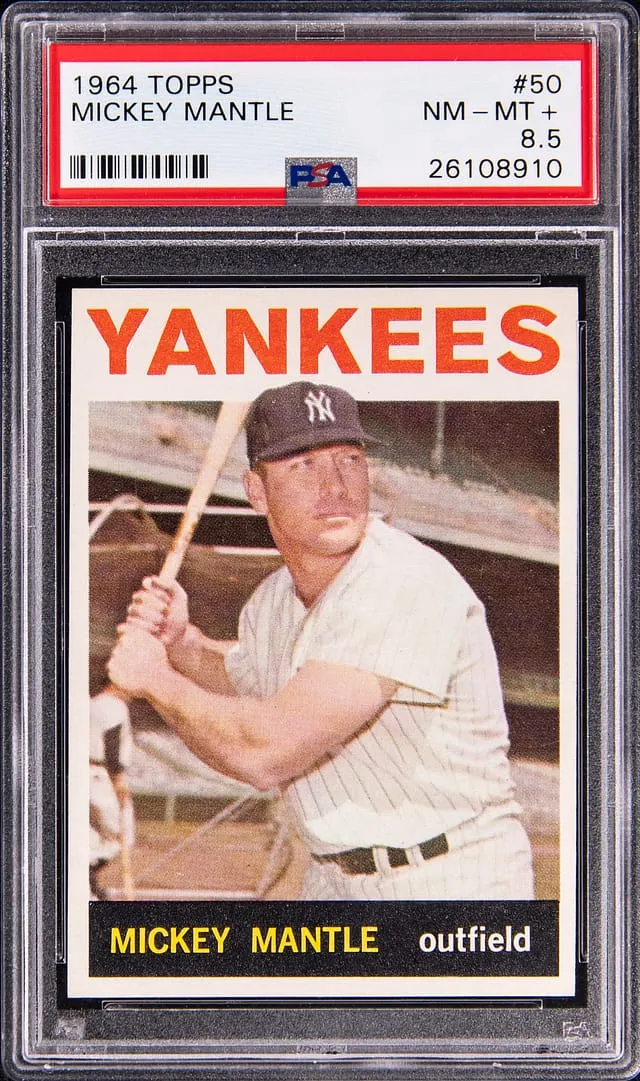
1964 Topps Mickey Mantle PSA 8.5 sells for $15.6K
Goldin sold a 1964 Topps #50 Mickey Mantle PSA 8.5 for $15,561 on March 15, 2026. See how this result fits recent comps and vintage Mantle demand.
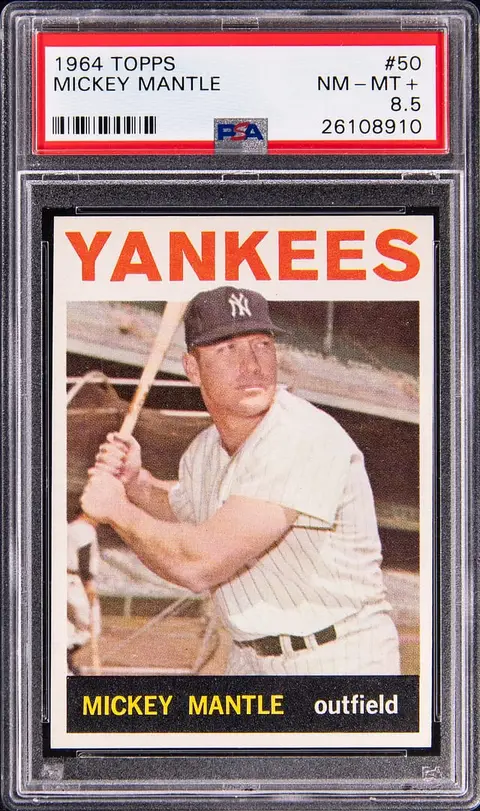
Sold Card
1964 Topps #50 Mickey Mantle - PSA NM-MT+ 8.5
Sale Price
Platform
Goldin1964 Topps #50 Mickey Mantle in a PSA 8.5 doesn’t hit the market every day, and when it does, collectors tend to pay attention. On March 15, 2026, Goldin sold a copy of this card for $15,561, a result that sits right in the heart of current market expectations for this grade.
In this breakdown, we’ll look at what this card is, why it matters, and how this sale fits into the broader Mantle and vintage market.
Card overview: 1964 Topps #50 Mickey Mantle, PSA NM-MT+ 8.5
- Player: Mickey Mantle
- Team: New York Yankees
- Year / Set: 1964 Topps Baseball
- Card number: #50
- Parallel/variant: Standard base issue (no parallel)
- Rookie?: Not a rookie (Mantle’s key rookie is 1951 Bowman; 1952 Topps is his iconic flagship Topps card)
- Era: Vintage
- Grading company: PSA (Professional Sports Authenticator)
- Grade: NM-MT+ 8.5
- Attributes: No autograph or relic; value is driven by vintage appeal, eye appeal, and grade scarcity rather than serial numbering or inserts.
Within Mantle’s run of 1950s–1960s Topps issues, the 1964 card occupies an important middle-vintage lane: it’s not as scarce or historically loaded as his early-1950s cards, but it’s far from an easy high-grade find.
Why the 1964 Topps Mantle matters to collectors
A key Mantle in a classic mid-60s design
1964 Topps features a clean, straightforward design with bold team name at the top and a bright, uncluttered portrait of Mantle. While the 1952 Topps and 1956 Topps designs usually get the spotlight, many set builders and Mantle specialists see 1964 as one of the more approachable, visually friendly vintage Mantle issues.
For collectors:
- Set builders chasing a high-grade 1964 Topps run usually treat Mantle as one of the main stumbling blocks due to demand and condition sensitivity.
- Player collectors of Mantle often target each Topps base card from 1952–1969, and the 1964 is a necessary checkpoint in that run.
- Vintage-focused investors and long-term holders tend to look for older, blue-chip names in strong grades. A PSA 8.5 sits in a sweet spot between cost and quality—significantly cleaner than most mid-grade copies without the cost of truly top-pop.
Condition and PSA 8.5 as a “tweener” grade
PSA’s 8.5 NM-MT+ grade is issued when a card is better than a typical PSA 8 (Near Mint-Mint) but doesn’t quite reach PSA 9 (Mint) standards. That half-step matters in vintage:
- Eye appeal: Many 8.5s present closer to 9s than to 8s, with sharper corners, better centering, or stronger gloss.
- Price positioning: 8.5s often trade at a noticeable premium over 8s, but still at a discount to 9s, which can create an attractive risk/reward profile for condition-focused collectors.
For a 60+ year old Mantle, something that looks this clean, with sharp color and strong centering, is not easy to replace.
Market context: how $15,561 fits into recent sales
This Goldin sale closed at $15,561 on March 15, 2026. To understand that number, it helps to look at the broader Mantle and 1964 Topps market.
Price context vs. nearby grades
Because exact, up-to-the-day realized prices move around and can vary slightly by auction house, it’s useful to think in ranges and relationships between grades, rather than single fixed numbers.
Across recent public sales (auction houses and major marketplaces):
- PSA 7–8 range: These typically change hands in the low-to-mid four figures, with eye appeal and centering driving premiums within the grade.
- PSA 8.5: The $15,561 Goldin result sits in the higher part of the 8.5 band historically but still within a realistic range given Mantle’s sustained demand. Strong-centered, bright copies often command the top of this band.
- PSA 9: There are fewer PSA 9s, and they tend to sell for a multiple of PSA 8.5 pricing, reflecting scarcity and registry demand.
A few things to keep in mind when reading comps (short for “comparables,” or similar recent sales used as a reference):
- Not all 8.5s are equal. Centering, print cleanliness, and registration (how sharply the image is printed) can make two cards in the same grade sell quite differently.
- Auction timing matters. Off-season vs. in-season, hobby sentiment, and broader economic conditions can push realized prices around even when population data is stable.
- Auction house reach. Well-marketed sales at large houses like Goldin often draw deep bidder pools, which can nudge results toward the top of the expected range.
Given those factors, this $15,561 result is best viewed as a strong but reasonable outcome for a high-end example, rather than an outlier or obvious bargain.
Population and scarcity in high grade
In vintage, population reports—often shortened to “pop report”—are a central part of value. A pop report is simply the grading company’s census of how many copies exist in each grade.
While exact numbers change as more cards are submitted, the general pattern for 1964 Topps Mantle at PSA has been:
- A large number of total graded copies, reflecting Mantle’s popularity and the age of the card.
- A steep drop-off as you move into PSA 8.5 and above, with PSA 9 and any PSA 10s being true outliers.
For collectors building graded sets or player runs, that means:
- PSA 8 is relatively attainable, though still not cheap.
- PSA 8.5 requires patience and a willingness to pay a strong price when a centered, bright copy appears.
- PSA 9 and above typically sit in collections or long-term vault holdings and surface less frequently.
This scarcity in higher grade, combined with Mantle’s status, is a key reason an otherwise “non-rookie” mid-60s card can justify a five-figure price.
Mantle, the hobby, and steady demand
Even decades after his last game, Mantle sits in the top tier of hobby demand alongside names like Babe Ruth, Jackie Robinson, and Hank Aaron. For many collectors, especially those returning to the hobby after years away, Mantle is the player they instinctively search for first.
Factors that keep Mantle prices resilient over time:
- Cross-generational recognition: Mantle is well known even to casual baseball fans, which matters for long-term demand.
- Consistent hobby narrative: There’s little speculation with Mantle. His career is finished, his place in history is defined, and the hobby’s view of his importance has been stable for decades.
- Iconic run of Topps issues: From 1952 through the late 1960s, Mantle appears on many of the most recognizable vintage designs. Collectors often try to assemble a complete run, ensuring steady demand for each year.
That context helps explain why a 1964 Topps Mantle in PSA 8.5 can command more than many modern autograph or patch cards despite having no serial number, no auto, and no relic: the card is plugged directly into a long, well-established line of demand.
How collectors might interpret this Goldin result
Without turning this into financial advice, here’s how different types of collectors might read the $15,561 sale price:
- Set builders: This result reinforces that high-grade Mantle anchors the 1964 set. Anyone targeting 8.5s or better for key stars will need to budget accordingly, especially for Mantle.
- Mantle specialists: The sale underlines the ongoing premium for clean, high-grade mid-60s Mantle. It may encourage holders of similarly strong copies to consider consigning, knowing there is active demand.
- Vintage-focused collectors moving up in grade: For those who own a PSA 7 or 8 and are debating a jump to 8.5, this result provides a reference point for the price gap between mid and upper-mid grade.
Rather than signaling a sudden shift, this sale at Goldin on March 15, 2026 looks more like a confirmation of where the market is comfortable valuing a strong PSA 8.5 example right now.
Key takeaways
- The 1964 Topps #50 Mickey Mantle is a core vintage card for set builders and Mantle collectors, even though it is not a rookie.
- A PSA 8.5 NM-MT+ example represents a high-end, condition-sensitive version that is noticeably scarcer than lower grades.
- The $15,561 sale at Goldin on March 15, 2026 fits within the upper end of recent expectations for this grade, supported by Mantle’s established status and the difficulty of finding top-tier copies.
- For collectors watching vintage Mantle, this result reinforces the steady, data-backed demand for clean examples rather than signaling any abrupt market swing.
For figoca users tracking vintage trends, this sale is a useful benchmark: a real-world data point that shows how the market currently values a well-presented, high-grade Mantle from the heart of his Topps run.