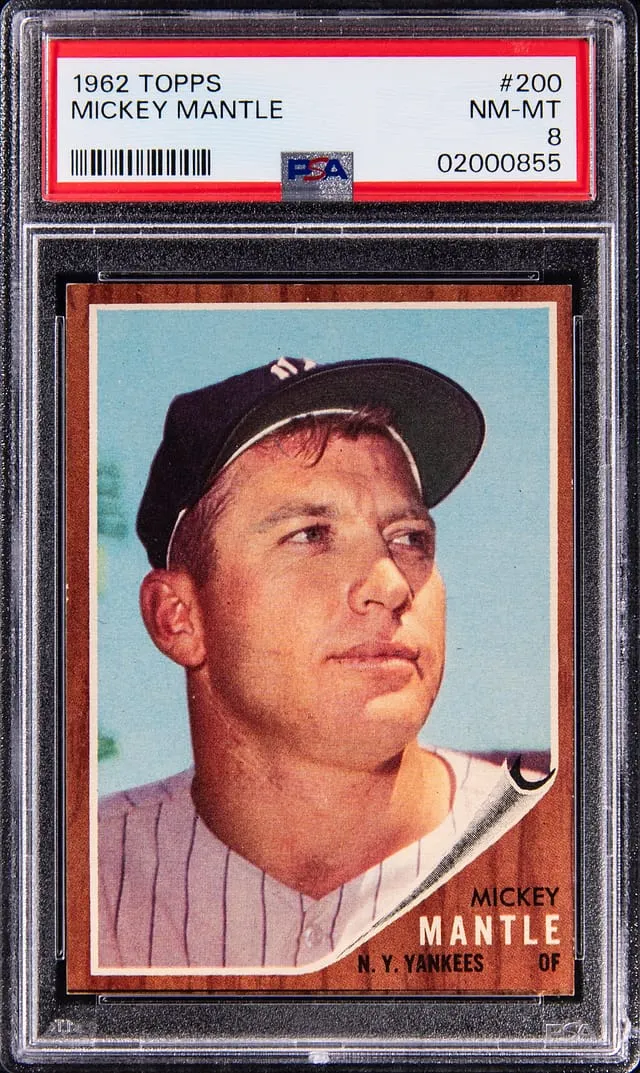
1962 Topps Mickey Mantle PSA 8 sells for $13.5K
Goldin sold a 1962 Topps #200 Mickey Mantle PSA 8 for $13,481. See what this vintage Mantle result means for collectors and the market.
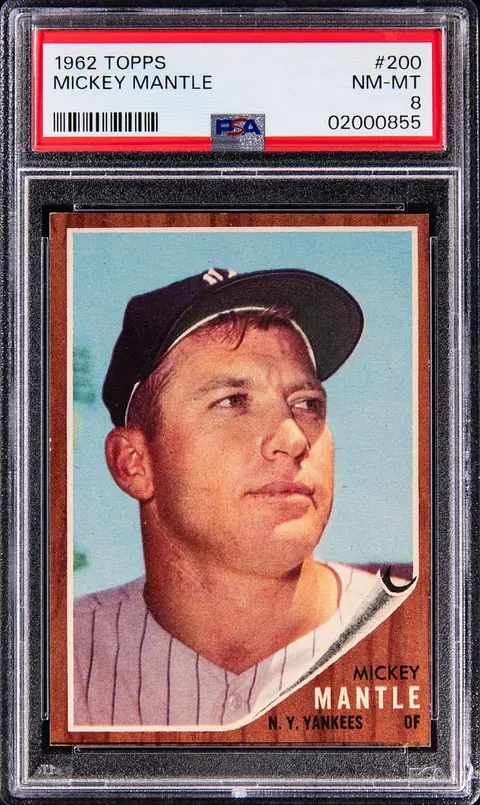
Sold Card
1962 Topps #200 Mickey Mantle - PSA NM-MT 8
Sale Price
Platform
Goldin1962 Topps #200 Mickey Mantle in a PSA 8 holder quietly reminds collectors why vintage icons still anchor the baseball card market.
On March 15, 2026, Goldin sold a 1962 Topps #200 Mickey Mantle graded PSA NM-MT 8 for $13,481. For a non-rookie, non-autographed card from the early 1960s, that’s meaningful money—and a useful data point for anyone tracking Mantle, vintage Hall of Famers, or blue‑chip cards in general.
The card at a glance
- Player: Mickey Mantle (New York Yankees)
- Year / Set: 1962 Topps Baseball
- Card number: #200
- Rookie?: Not a rookie card (Mantle’s key rookies are 1951 Bowman and 1952 Topps), but a major key issue in his run.
- Era: Vintage
- Grading company: PSA (Professional Sports Authenticator)
- Grade: NM-MT 8 (Near Mint–Mint)
This is Mantle’s flagship Topps card for the 1962 season. The set is instantly recognizable for its woodgrain borders—an aesthetic that makes the cards charming but also very condition‑sensitive. Those dark, faux‑wood edges show white chipping and corner wear fast, so high‑grade copies are tougher than the simple print run might suggest.
Why the 1962 Topps Mantle matters to collectors
Even though it isn’t a rookie, the 1962 Topps #200 is considered one of Mantle’s important playing‑days cards for a few reasons:
Woodgrain borders and condition difficulty
The 1962 Topps design is famous—and infamous. Just like 1955 and 1987 Topps, the faux‑wood look is beloved, but it punishes flaws. Any edge or corner wear jumps out against the woodgrain. That makes high‑grade examples notably harder to find than many white‑border vintage issues.Mantle’s peak popularity era
By 1962, Mantle was already a multi‑time MVP and World Series star. Cards from his prime Yankees years sit in the sweet spot for many collectors: the player is fully established, the photography is classic, and the print runs are still firmly vintage.Set importance
1962 Topps is a cornerstone vintage set. It has stars, Hall of Famers, and a design that stands out even to people who don’t collect heavily. Within that set, Mantle at #200 is one of the headliners alongside names like Willie Mays and Roberto Clemente.
Because of those factors, the #200 Mantle often serves as a benchmark card when collectors talk about the health of the Mantle market beyond his rookies.
Understanding a PSA 8 in this context
PSA’s NM‑MT 8 grade means the card is sharp, clean, and well‑centered by vintage standards, with only minor flaws. For 1962 Topps, that’s more meaningful than the label might sound at first glance.
- The woodgrain makes small chips and dings very visible.
- Finding well‑centered copies without obvious border chipping is a challenge.
In many vintage sets, PSA 8 is the entry point into what some collectors think of as the "investment‑grade" range (without making any promises about returns). Above that, PSA 9s and 10s are often extremely scarce and see very steep price jumps.
Population reports (often shortened to "pop report") from PSA give a count of how many copies exist in each grade. While exact figures can change as new cards are submitted, the general pattern for this card has been:
- A solid number of total graded copies.
- A relatively small but healthy population in PSA 8.
- Very limited numbers in PSA 9 and almost no truly high‑end PSA 10s.
That typical vintage curve helps explain why an 8 commands a strong premium over mid‑grade copies, yet still sits far below the thin air of top‑pop examples.
Market context for this $13,481 sale
Goldin’s March 15, 2026 result at $13,481 places this copy firmly in the high‑end but not record‑breaking range for the card.
When you look at comps—short for comparable recent sales—of the same card and closely related versions (different grades of the same card), a few themes generally emerge:
- PSA 8s of the 1962 Topps #200 Mantle tend to cluster in a defined band, with some variation based on eye appeal (centering, color, print quality). The Goldin sale lands toward the strong side of that established band rather than being an outlier.
- PSA 7s often trail well behind 8s, showing the usual vintage "step up" in price for this grade. The jump from 7 to 8 is often larger than from 6 to 7.
- PSA 9s sit in a different tier altogether, sometimes at several multiples of a PSA 8, reflecting true scarcity in top grade.
This Goldin sale does not appear to be a new all‑time high for the card, but it reinforces that well‑centered, attractive PSA 8s still command meaningful attention and solid prices.
What could be driving interest right now
Several steady forces continue to support cards like this:
Mantle as a long‑term hobby cornerstone
Mickey Mantle sits in the same tier as Ruth, Mays, and a handful of others as a perennial focus of vintage baseball collecting. His rookies might get the headlines, but his key playing‑days Topps issues—especially from condition‑sensitive sets—remain highly collected.Renewed attention on vintage stability
As modern and ultra‑modern cards go through cycles of hype, release calendars, and prospect swings, some collectors and small sellers look to vintage as a steadier lane: lower print runs, no serial‑number arms race, and decades of established demand.Set and design collectors
There’s a segment of the hobby that builds full 1962 Topps sets in graded form or chases the run of Mantle’s Topps base cards year by year. For those collectors, a PSA 8 Mantle is often a long‑term target.Auction‑house visibility
A major platform like Goldin naturally puts a spotlight on a card. Strong photography, lot descriptions, and bidding visibility can all contribute to a solid final price for a visually appealing example.
How this sale fits into broader Mantle trends
When you zoom out beyond this specific card, a few patterns often show up across Mantle’s market:
- Rookie and early‑50s issues (1951 Bowman, 1952 Topps, early Bowman/Topps) operate on their own, much higher price scale.
- Late‑50s to early‑60s Topps Mantles—including 1956, 1957, 1961, 1962—tend to track the overall Mantle market while remaining more accessible than the true grails.
- Condition sensitivity plays a large role. Cards from chippy or off‑center‑prone sets often show a sharper price ladder between grades.
Within that structure, the 1962 #200 in PSA 8 acts as a mid‑to‑high tier anchor: not inexpensive, but still within reach for serious collectors who are priced out of the legendary rookies.
Takeaways for collectors and small sellers
If you’re new to vintage, returning to the hobby, or trying to curate a focused Mantle collection, this Goldin result offers a few useful lessons:
Condition matters beyond the number.
Two PSA 8s can bring different prices depending on centering, color, and how the woodgrain borders present. Eye appeal can be a big factor in vintage auctions.Know the set’s difficulty.
Understanding why a set is hard in high grade—like chippy borders or print defects—helps explain why the price curve looks the way it does from PSA 5 up through PSA 9.Track comps over time, not just one sale.
This $13,481 result is a helpful data point, but a full picture comes from looking at several recent sales of the same grade, plus adjacent grades.Think in collecting goals, not just prices.
For many Mantle collectors, the goal is a run of key Topps years in consistent grades. For others, it’s a single high‑quality example from a favorite design. Where a PSA 8 from 1962 fits your plans matters as much as the latest hammer price.
Final thoughts
The March 15, 2026 sale of a 1962 Topps #200 Mickey Mantle PSA NM‑MT 8 at Goldin at $13,481 doesn’t rewrite hobby record books—but it underlines something important: well‑preserved, visually strong vintage of true legends continues to be taken seriously by the market.
For figoca collectors, this card is a clear marker of how the hobby still values condition, set history, and player legacy in a world full of modern parallels and short prints. Whether you’re building a Mantle run, a 1962 Topps set, or just studying the market, this sale belongs on your radar as a current benchmark for one of Mantle’s most recognizable non‑rookie cards.