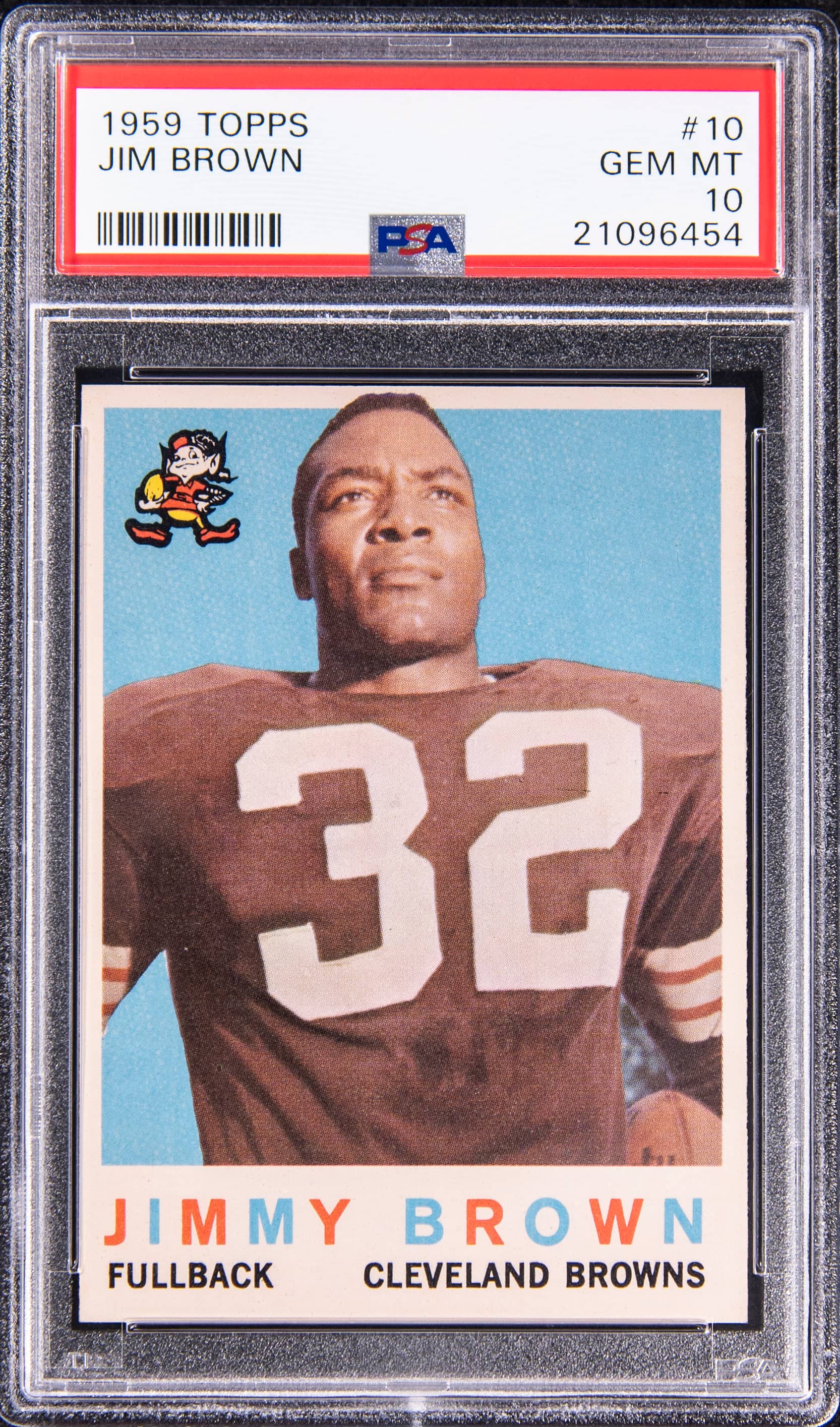
1959 Topps Jim Brown PSA 10 Sells for $112,240
Goldin sold a 1959 Topps #10 Jim Brown PSA 10 (Pop 3) for $112,240 on Jan 4, 2026. Learn why this rare vintage football card matters to collectors.
Sold Card
1959 Topps #10 Jim Brown - PSA GEM MT 10 - Pop 3
Sale Price
Platform
Goldin1959 Topps #10 Jim Brown in a PSA 10 GEM MT holder is about as close as football collectors get to a true vintage unicorn. On January 4, 2026, Goldin sold one of these elusive copies for $112,240, underscoring just how thin the supply is at the very top of the condition ladder.
The card: 1959 Topps #10 Jim Brown, PSA GEM MT 10, Pop 3
This card is Jim Brown’s second-year Topps issue, not his rookie. His true rookie is the 1958 Topps #62, widely considered one of the cornerstone vintage football cards.
Even so, the 1959 Topps #10 is a key early-career card from a Hall of Fame running back many still consider the greatest to ever play the position. The card features:
- Player: Jim Brown, Cleveland Browns (Hall of Famer)
- Year / Set: 1959 Topps Football
- Card number: #10
- Type: Early-career flagship base card (not a parallel, not a serial‑numbered insert)
- Era: Vintage (1950s)
- Grading company: PSA (Professional Sports Authenticator)
- Grade: GEM MT 10 (Gem Mint)
- Population: 3 in this grade ("Pop 3" on the PSA population report)
A “pop report” (population report) is the grading company’s count of how many copies of a specific card exist in each grade. For this Jim Brown, there are only three that have ever reached PSA’s highest grade, which is a big part of why this result stands out.
Why this card matters to collectors
Jim Brown’s place in football history
Jim Brown’s playing career was relatively short by modern standards, but remarkably dominant:
- Led the NFL in rushing in 8 of his 9 seasons
- Three-time NFL MVP
- 1964 NFL champion
- Widely mentioned in “greatest of all time” conversations at running back
For vintage football collectors, Jim Brown cards sit alongside names like Unitas, Unitas, Starr, and later Montana, Rice, and Payton. His 1958 rookie is the headliner, but his early Topps issues, including 1959, are central to any serious run of vintage football Hall of Famers.
The 1959 Topps Football set
The 1959 Topps set is part of the early modern era of football cards. Key characteristics:
- Colorful backgrounds and simple portrait photography typical of late-1950s Topps design
- A relatively modest print run compared with modern cards, but not impossibly rare in low or mid grade
- Condition sensitivity: centering, print quality, and edge wear are common issues
While raw and low-grade copies of many 1959 Topps cards are accessible, truly pristine, pack-fresh examples are rare. That’s especially true for stars like Jim Brown that were heavily handled by kids at the time.
Condition scarcity: why PSA 10 matters
A PSA 10 GEM MT grade is reserved for cards that appear virtually flawless: sharp corners, strong color, clean surfaces, and very good centering. On a modern card pulled from a pack this year, that standard is demanding but achievable in volume. On a 1950s football card, it’s a different story.
Key points about this card’s condition profile:
- Pop 3 in PSA 10: Only three copies have ever graded GEM MT 10.
- Very low high-grade supply: Even PSA 9 (Mint) copies are limited, and there is an obvious price separation between PSA 8, PSA 9, and PSA 10 for a vintage Hall of Famer.
- Survivorship: Many 1959 Brown cards were handled, rubber-banded, or stored casually, so surviving examples often show wear, poor centering, or print issues.
In practice, that means the PSA 10 exists in almost a different market segment than mid-grade examples. Collectors and high-end investors focused on condition rarity treat it more like a unique trophy piece than a commodity.
Market context and price positioning
This sale closed at $112,240 at Goldin on January 4, 2026.
When looking at “comps” (recent comparable sales used for price context), it helps to separate three tiers:
- This exact card and grade: 1959 Topps #10 Jim Brown, PSA 10
- Same card in lower grades: PSA 9, PSA 8, and below
- Rookie and related key cards: 1958 Topps #62 Jim Brown in high grade
1. PSA 10 copies (Pop 3)
Because there are only three PSA 10s and they surface rarely, the public price history is thin and sporadic. When cards trade infrequently and privately, exact numbers are hard to track. What is clear from the limited auction data over recent years:
- PSA 10 copies have consistently realized a significant multiple over PSA 9 prices.
- Each public sale tends to reset expectations because the market has so few reference points.
Given the scarcity and the era, a six-figure result fits with how the hobby has been valuing top-of-the-pop vintage football Hall of Famers in recent years.
2. PSA 9 and PSA 8 copies
While exact recent sale figures vary by auction house and consignment, the pattern is consistent across vintage football:
- PSA 9 (Mint): Commands a premium over PSA 8 but sits well below the 10. There is typically a noticeable supply of PSA 9s compared with PSA 10s, so the 9s trade more often and provide the clearest public pricing baseline.
- PSA 8 (Near Mint–Mint): Often the “sweet spot” for collectors who want strong eye appeal without paying the steep premiums for 9s and 10s.
Relative to those tiers, this $112,240 result reflects the extra scarcity of the PSA 10 and the added demand from high-end set builders and Hall of Fame specialists.
3. Relationship to the 1958 Topps Jim Brown rookie
The 1958 Topps #62 rookie is the main reference point for Jim Brown’s card market. High-grade examples of that card—especially PSA 9 and above—have a long track record of strong auction results.
The 1959 issue typically trades at a discount to the rookie, as is common for second-year cards. However, the extreme pop scarcity in PSA 10 narrows that gap somewhat because the 1959 in GEM MT may be harder to find than some high-grade 1958 copies.
So while this sale does not directly set a rookie-card benchmark, it contributes to the broader picture of how the market values top-condition vintage Jim Brown cards.
What this sale signals for the vintage football market
A single sale doesn’t define an entire segment, but a $100,000+ result for a non‑rookie vintage football card in a pop‑3 top grade does tell us a few things:
- Condition rarity continues to matter. Collectors and high-end buyers are still willing to pay steep premiums for the very best examples, even of early non-rookie issues.
- Vintage football remains a focused but steady niche. Football doesn’t always command the same headlines as vintage baseball, but blue-chip names like Jim Brown hold a defined place in advanced collections.
- Top-of-the-pop cards act like trophies. With only three PSA 10s in existence, each auction gives registry competitors and advanced collectors one of the only chances to acquire a “top of the mountain” copy.
For newer collectors, it’s worth remembering that this result doesn’t mean every 1959 Jim Brown—or every Jim Brown card—carries six-figure potential. Condition, grade, and population drive much of the gap between a nicely centered mid-grade copy and a GEM MT outlier like this one.
Takeaways for collectors and small sellers
If you’re collecting or selling vintage football, here are some practical angles to consider as you look at this Goldin sale from January 4, 2026:
- Learn the pop reports. For key vintage cards, checking the population by grade helps you understand why certain grades behave like entirely separate markets.
- Separate rookie and non‑rookie value. The 1958 rookie will almost always be the flagship card, but this 1959 example shows how important early‑career issues can be when condition lines up.
- Grade sensitivity is real. On cards like this, small differences in centering or corner wear can mean big differences once you cross the line from PSA 8 to 9 to 10.
- Use comps thoughtfully. When there are very few public sales in a specific grade, it can be more useful to look at relative positioning (for example, 10 vs. 9 vs. 8) than to rely on a single headline number.
Final thoughts
The $112,240 sale of the 1959 Topps #10 Jim Brown in PSA GEM MT 10 at Goldin on January 4, 2026, reinforces how tightly held and highly valued top-grade vintage football cards have become.
For long-time Jim Brown collectors, it’s another data point in a story that stretches back decades. For newer hobbyists, it’s a clear illustration of how a non-rookie, widely known card can still reach rare‑air pricing when it sits at the absolute top of the condition pyramid.
As always, it’s one sale—not a guarantee of future prices—but it’s a meaningful benchmark for anyone tracking the upper end of the vintage football market.