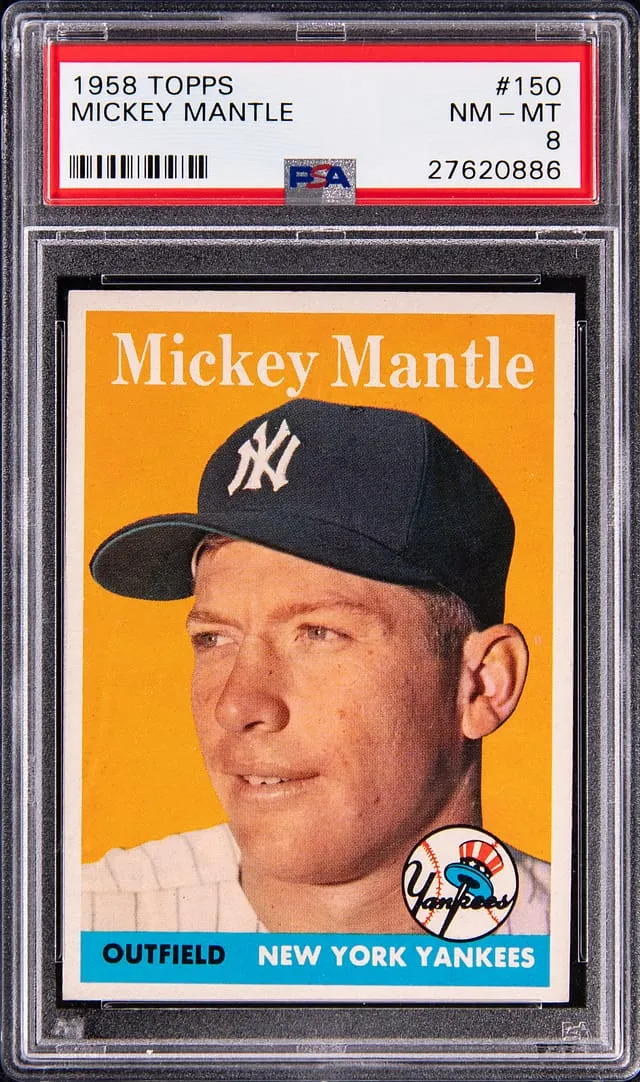
1958 Topps Mickey Mantle PSA 8 sells for $14,707
A 1958 Topps #150 Mickey Mantle PSA NM-MT 8 sold for $14,707 at Goldin on March 15, 2026. See how this result fits the vintage Mantle market.
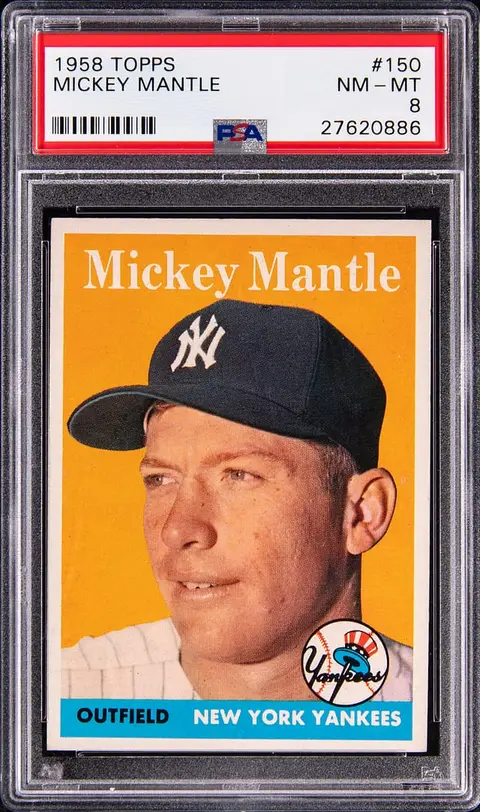
Sold Card
1958 Topps #150 Mickey Mantle - PSA NM-MT 8
Sale Price
Platform
Goldin1958 Topps #150 Mickey Mantle in PSA 8: Why This $14,707 Sale Matters
When a vintage Mickey Mantle changes hands in a strong grade, the hobby tends to pay attention. That was the case on March 15, 2026, when a 1958 Topps #150 Mickey Mantle graded PSA NM-MT 8 sold at Goldin for $14,707.
For newer collectors, that might sound like a lot for a non-rookie. For vintage-focused hobbyists, it sits right in the sweet spot of an iconic player, a popular set, and a grade where true scarcity starts to show up.
In this breakdown, we’ll look at what this specific card is, how this price fits into recent sales, and why the 1958 Mantle continues to be a key target for collectors.
- The card at a glance
• Player: Mickey Mantle
• Team: New York Yankees
• Year: 1958
• Set: 1958 Topps Baseball
• Card number: #150
• Status: Not a rookie card (Mantle’s mainstream rookie is 1952 Topps), but a major “playing-days” issue
• Era: Vintage (pre-1970)
• Grading company: PSA (Professional Sports Authenticator)
• Grade: NM-MT 8 (Near Mint–Mint)
• Special attributes: Standard base card – no autograph, no patch, no serial numbering
The 1958 Topps Mantle is one of the most recognizable post-war baseball cards. While it doesn’t carry the mystique or price tier of his 1952 Topps card, it remains a cornerstone for Mantle and Yankee collectors because it sits squarely in his prime years and in a colorful, widely collected set.
- Why the 1958 Topps set matters
The 1958 Topps design is relatively simple—bright solid-color backgrounds, large portraits, and clean name/team text. That simplicity is part of its appeal today.
Key reasons collectors chase this set:
• Strong checklist: Alongside Mantle, the set features stars like Hank Aaron, Roberto Clemente, Willie Mays, and a popular Mantle–Aaron combo card.
• Color-driven eye appeal: The saturated backgrounds show wear and print defects easily, making strong copies stand out.
• Classic vintage feel: The set is firmly in the vintage era, which usually means lower original print quality and more condition issues compared with modern cards.
Because of how these cards were printed and handled, finding a well-centered, sharp-cornered copy of any star, let alone Mantle, becomes progressively harder at higher grades.
- Understanding a PSA NM-MT 8 for vintage Mantle
PSA’s NM-MT 8 grade signals a high-end example: sharp corners, strong gloss, and only minor print or centering issues. On a 1958 Mantle, that’s not common.
Two key ideas help frame this:
• Pop report: A population report (or “pop report”) is a grading company’s count of how many copies of a specific card exist in each grade. For vintage Mantles, pops tend to be heaviest in mid-grade (PSA 3–6), then drop as you move toward PSA 8, 9, and 10.
• Condition sensitivity: The 1958 Topps stock and print process often produced off-center images, print snow, and color variations—issues that cap the grade well below 8 on many surviving copies.
While exact numbers can shift as more cards are submitted, the broad pattern is consistent: PSA 8 is a premium, condition-sensitive tier for this card, especially compared to the much more common lower grades.
- Market context: how $14,707 fits in
The Goldin sale closed on March 15, 2026, at $14,707. To understand that number, it helps to look at “comps.” In hobby shorthand, “comps” (comparable sales) are recent, verified sales of the same card and grade that help anchor price expectations.
For the 1958 Topps #150 Mantle in PSA 8, recent public auction and major marketplace results leading into 2026 have generally clustered in the low- to mid–five-figure range, with some fluctuation based on:
• Centering and eye appeal: Well-centered 8s with strong color often command a premium over technically similar but visually weaker copies.
• Auction venue and timing: Dedicated vintage-focused auctions can sometimes pull stronger participation than general card marketplaces, especially for Mantle.
• Overall hobby conditions: Broader swings in collector sentiment and liquidity can nudge prices up or down over a given quarter.
Within that context, a $14,707 hammer for a PSA 8 lands in a reasonable band for a solid example headed into 2026—neither an outlier record nor a bargain-basement result, but a healthy, market-reflective sale for a premium grade.
- How this compares to other grades
To get a deeper feel for where a PSA 8 sits, it helps to look at the general shape of the price curve across grades:
• Lower grades (PSA 2–4): Still very collectible, with much lower entry points. These are often the way new vintage collectors secure a Mantle without climbing into five figures.
• Mid grades (PSA 5–6): A balance of eye appeal and relative affordability. Prices here have historically moved in response to Mantle demand more broadly, but without the sharp premiums seen at the top.
• Upper mid / high grades (PSA 7–8): Where condition rarity starts to show. Price jumps between 6 and 7, and 7 and 8, tend to be meaningful.
• Gem tiers (PSA 9–10): Extremely scarce, with prices that can be multiples of an 8 for visually exceptional copies.
While exact numbers will shift with each auction cycle, the pattern is consistent: as grade improves, population drops and each step up the ladder carries a disproportionately higher price.
In that structure, the $14,707 Goldin result underscores PSA 8 as a serious collector’s lane: high-grade enough to be genuinely scarce, but still more accessible than the very top of the scale.
- Why collectors care about this card
A few factors explain the long-term interest in this particular Mantle:
• Mantle as a flagship legend: Mantle’s 1950s Topps run is a core part of post-war baseball card history. Even beyond the fabled 1952, his mid- to late-1950s cards serve as touchstones for the era.
• Prime playing years: The 1958 card captures Mantle while he’s still a central figure on a powerhouse Yankees squad, not at the beginning or the tail end of his career.
• Set-building: Many vintage collectors still build full or partial 1958 Topps runs. Mantle is one of the key “set anchor” cards, often the most expensive piece of a build.
• Visual identity: The bright, minimalist design and bold portrait give this card a distinctive look that contrasts nicely with earlier 1950s designs.
For returning collectors who remember seeing well-loved Mantles in childhood shoeboxes, a sharp PSA 8 version represents the high-end expression of that same card—nostalgia upgraded to museum quality.
- Recent hobby trends around Mantle and vintage
Although day-to-day prices fluctuate, a few broader themes frame this sale:
• Sustained respect for vintage: Across cycles where modern and ultra-modern cards (recent issues, low-serial parallels, autos) see more volatile swings, vintage icons like Mantle tend to behave in a steadier, more historically anchored way.
• Focus on quality: Collectors are increasingly attentive to centering, color, and overall “eye appeal” even within the same numeric grade. Premium-looking 8s can separate themselves from the pack.
• Mantle as a benchmark: Record-setting results for 1952 Topps Mantle in high grade and high-end Mantle memorabilia have reinforced the player’s role as a reference point for price discussions across the vintage category.
The $14,707 sale doesn’t rewrite the Mantle market, but it does contribute another data point that supports a steady demand curve for strong copies of his key 1950s issues.
- What this means for different types of collectors
For newcomers:
• The 1958 Mantle is a way to engage with a true legend without chasing six- or seven-figure grails like the best 1952s. In lower grades, the card remains relatively approachable.
• Watching PSA 8 results like this at Goldin and other major houses can help you understand how condition and eye appeal translate into price gaps.
For returning collectors:
• Comparing this $14,707 result with your own memories of what Mantles used to cost can be eye-opening. It’s a reminder to re-evaluate any vintage you still have in storage; grading can significantly clarify where your cards fit in the modern market.
• If you’re building or upgrading a 1950s Mantle run, recent PSA 8 sales provide a reference band for what “strong but not top-of-the-pyramid” copies are bringing today.
For small sellers and hobbyists:
• This kind of sale underscores that well-graded, visually strong vintage still attracts consistent bidding.
• If you’re considering submitting raw 1950s Mantles, it’s important to pre-screen for centering, corners, and surface before expecting PSA 8 outcomes—the difference between a 5 and an 8 is meaningful both in scarcity and value.
- Takeaways from the Goldin sale
• Card: 1958 Topps #150 Mickey Mantle – PSA NM-MT 8
• Auction house: Goldin
• Sale date (UTC): March 15, 2026
• Realized price: $14,707
In the broader Mantle landscape, this is a solid, market-consistent sale for a high-grade example of a key playing-days card. It adds one more data point confirming that demand for quality vintage Mantle remains real and measurable, especially when the card presents well and is offered through a major auction platform.
For figoca users tracking vintage trends, this 1958 Topps Mantle in PSA 8 is a clear reminder that there is still a deep collector base for classic cardboard—particularly when history, condition, and a trusted auction house all line up on the same night.