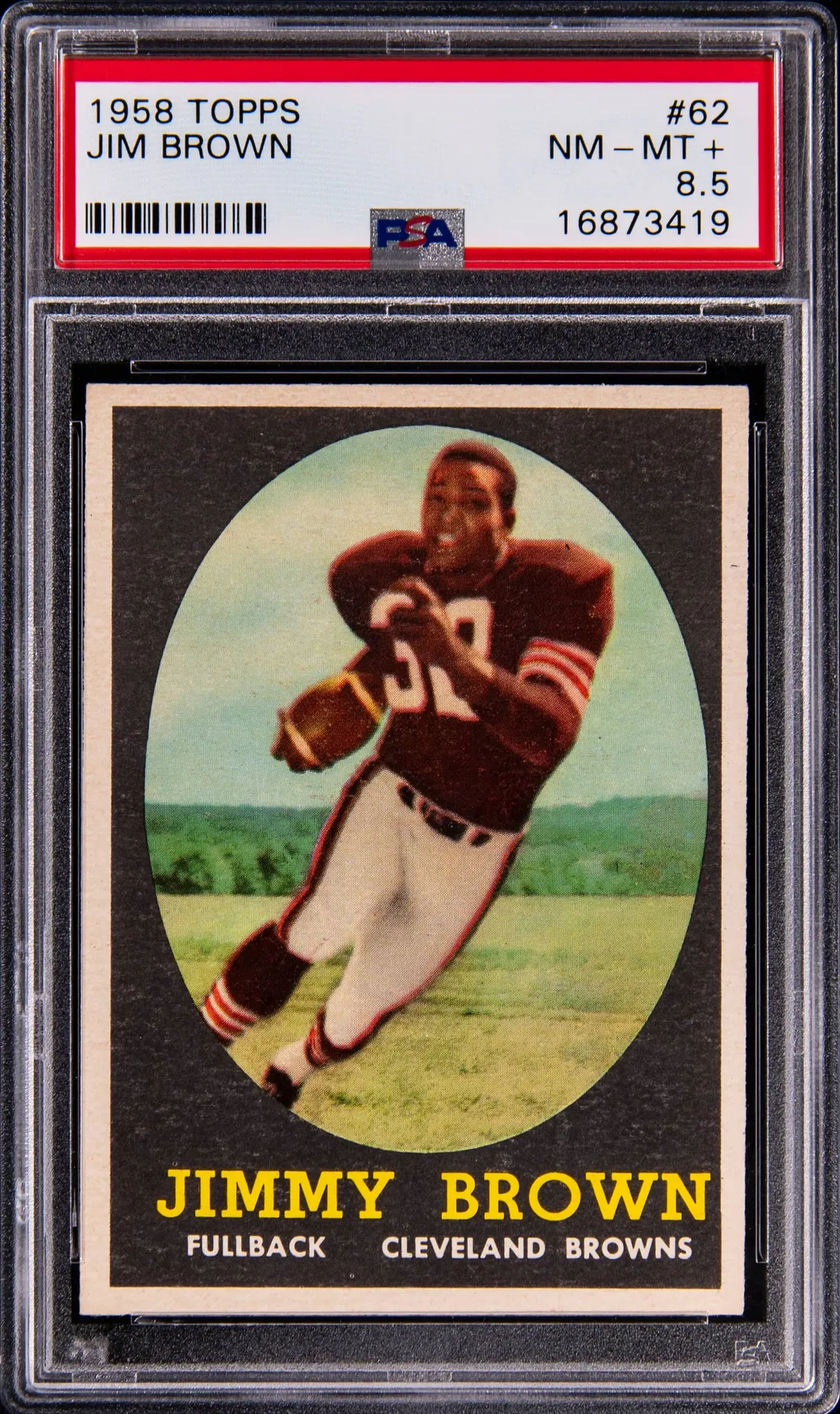
1958 Topps Jim Brown Rookie PSA 8.5 Sells for $219K
Goldin sold a 1958 Topps #62 Jim Brown rookie PSA 8.5 for $219,600 on Feb 22, 2026. See how this vintage football grail fits recent market trends.
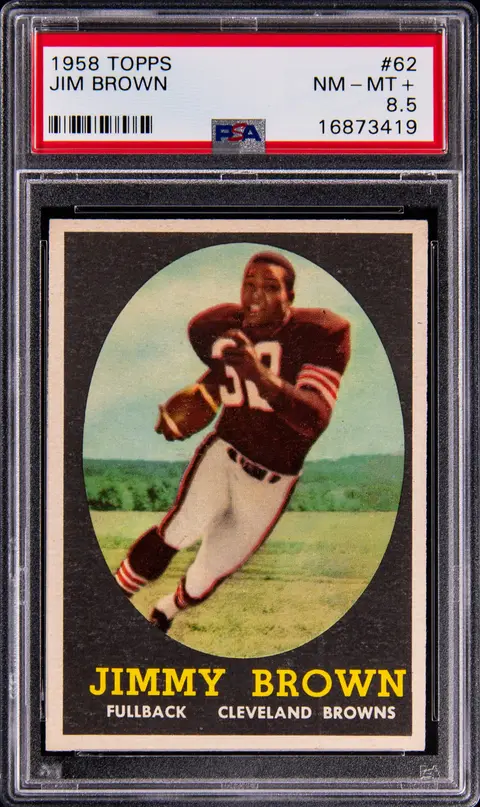
Sold Card
1958 Topps #62 Jim Brown Rookie Card - PSA NM-MT+ 8.5
Sale Price
Platform
Goldin1958 Topps #62 Jim Brown Rookie Card – PSA 8.5 Sells for $219,600
On February 22, 2026, Goldin auctioned a key piece of football history: a 1958 Topps #62 Jim Brown rookie card graded PSA NM-MT+ 8.5, closing at $219,600.
For vintage football collectors, this card is one of the core building blocks of the entire hobby. In this post, we’ll break down what makes this card important, how this price fits into recent market activity, and what collectors can take away from the sale.
The Card at a Glance
- Player: Jim Brown (Cleveland Browns, fullback)
- Year / Set: 1958 Topps Football
- Card number: #62
- Type: True rookie card, flagship Topps issue
- Grading company: PSA (Professional Sports Authenticator)
- Grade: NM-MT+ 8.5
- Attributes: Standard base rookie, no autograph or patch – value is driven by era, condition, and Hall of Fame status.
The 1958 Topps set is a foundational vintage football release. Card #62 is Jim Brown’s first mainstream, widely recognized trading card, and it has become the defining piece for collectors who focus on Hall of Fame running backs, Cleveland Browns history, or blue-chip vintage football.
Why Jim Brown’s Rookie Matters
Jim Brown is widely considered one of the greatest football players of all time. A few key points that drive sustained demand for his rookie:
- On-field legacy: Three-time NFL MVP, eight-time rushing yards leader, and a key figure in the Cleveland Browns’ history.
- Cultural impact: Beyond the field, Brown became a notable figure in film, activism, and broader American culture, which often draws interest from collectors outside traditional sports circles.
- Era scarcity: 1950s football cards were printed in far smaller numbers than modern releases, and many surviving copies show heavy wear from childhood handling.
Because of this mix of performance, historical importance, and era, the 1958 Topps Jim Brown rookie is often mentioned alongside the most important vintage football cards, such as the 1935 National Chicle Bronko Nagurski and the 1957 Topps Bart Starr and Johnny Unitas rookies.
Understanding the PSA 8.5 Grade
PSA’s NM-MT+ 8.5 grade sits between PSA 8 (Near Mint-Mint) and PSA 9 (Mint). For a 1950s card, this typically means:
- Very sharp corners with only minor touches
- Strong gloss and color
- Centering that is slightly off but still attractive
- Clean surfaces with only small print or handling imperfections
In the vintage space, single half grades (like 8.5) can matter a lot. Population reports – often called the “pop report,” which is simply the census of how many copies exist in each grade – usually show a steep drop-off as you move from PSA 8 to PSA 9 and PSA 10.
For Jim Brown’s rookie, the highest graded examples are extremely limited, and each step up the ladder (from 7 to 8, 8 to 8.5, and 8.5 to 9) tends to show a meaningful price jump.
Where This $219,600 Sale Fits in the Market
The card sold at Goldin on February 22, 2026, for $219,600. To understand that number, it helps to look at recent “comps” – short for comparables, meaning the prices realized by similar cards recently.
While exact figures move over time, recent market activity around this card has generally shown:
- PSA 7–8 range: Strong five-figure to low six-figure sales, depending on eye appeal and auction timing.
- PSA 8.5: Often a noticeable premium over straight PSA 8 sales because the 8.5 population is significantly smaller and closer to the high-end tier.
- PSA 9: Historically into the high six figures and beyond, with some notable peak-market results well above the PSA 8.5 level.
Within that structure, a PSA 8.5 at $219,600 sits in the higher end of the mid-tier vintage football market but remains clearly below the most elite PSA 9 or better copies. This is in line with how condition-sensitive vintage football has behaved in recent years: incremental grade bumps above PSA 8 command strong premiums because so few examples survive in that shape.
Rather than reading this as a dramatic outlier, collectors can view the result as part of an established pricing staircase from mid-grade to top-grade Jim Brown rookies. The exact number will move over time with broader market conditions, but the hierarchy between grades has stayed relatively consistent.
Vintage Football Context
The 1958 Topps Jim Brown rookie lives firmly in the vintage era. Compared to modern and ultra-modern cards, vintage has a few distinct characteristics:
- Limited high-grade supply: Cards were not pulled from packs and immediately sleeved the way they are now. High-grade survivors are the exception.
- No parallels or inserts: The value is concentrated in the base card and its condition rather than colored parallels or serial-numbered versions.
- Longer price histories: Key vintage rookies have decades of sales history, which makes their price trends more traceable over time.
For many collectors returning to the hobby, vintage football – especially Hall of Fame rookies like Jim Brown’s – offers a clear narrative: one key card per player, in a recognizable flagship set, tied directly to on-field accomplishments.
Factors Influencing Interest
A few ongoing themes help explain why interest in Jim Brown’s rookie remains solid:
Hall of Fame and GOAT conversations
Jim Brown’s name consistently appears in “greatest ever” debates among fans and analysts. That attention tends to reinforce long-term collector interest in his primary rookie.Cross-collecting between sports and culture
Brown’s film and social impact broaden his appeal beyond purely football-focused collectors.Set-building and registry competition
PSA’s registry system – where collectors build and publicly track graded sets – has driven demand for high-grade copies of the 1958 Topps set. Card #62 is a cornerstone, and competition among set builders can support stronger prices for top-tier examples.Stable recognition over time
Unlike speculative modern rookies, Jim Brown’s legacy is fully established. While prices still rise and fall with hobby cycles, the underlying reason people want this card is consistent and well-understood.
Takeaways for Collectors
Whether you’re a new collector or a seasoned vintage buyer, here are a few practical observations from this sale:
- Condition still drives the biggest gaps. Moving from strong mid-grade (PSA 6–7) to high grade (PSA 8 and above) often represents a major jump in price, especially for 1950s football.
- Half grades matter in tight populations. On a card where every incremental improvement is rare, PSA 8.5 can behave much closer to PSA 9 than to PSA 8 in terms of demand.
- Know the auction house and timing. This result came via Goldin on February 22, 2026; different venues and seasonal timing can influence final prices, even for the same grade.
- Think in terms of history, not headlines. Rather than treating one sale as a signal of where the card “must” go next, it’s more helpful to place it in the broader pattern of vintage football pricing and population data.
Final Thoughts
The $219,600 sale of a 1958 Topps #62 Jim Brown rookie card in PSA NM-MT+ 8.5 at Goldin on February 22, 2026, reinforces why this card sits near the top of vintage football collecting.
It’s a true flagship rookie of an all-time great, in a condition tier where supply is thin and demand is steady. For collectors building long-term football collections, this result is another data point confirming the central role Jim Brown’s 1958 Topps rookie continues to play in the hobby.
As always, it’s best to treat sales like this as price context rather than prediction. For most collectors, the key decision is which combination of grade, eye appeal, and budget feels right—then building a collection that tells the football history you care about most.