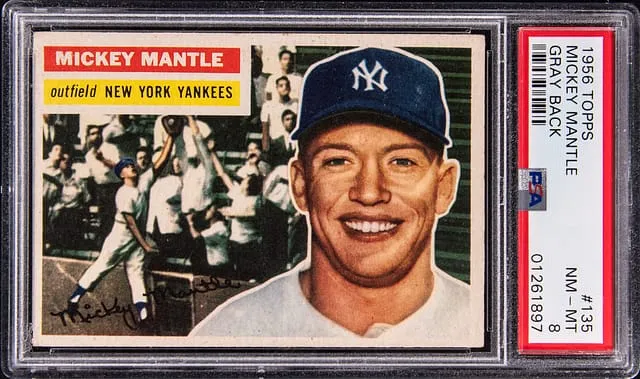
1956 Topps Mickey Mantle PSA 8 Gray Back sells for $18K
Goldin sold a 1956 Topps Gray Back #135 Mickey Mantle PSA 8 for $18,331. See how this vintage Mantle result fits recent comps and the wider market.
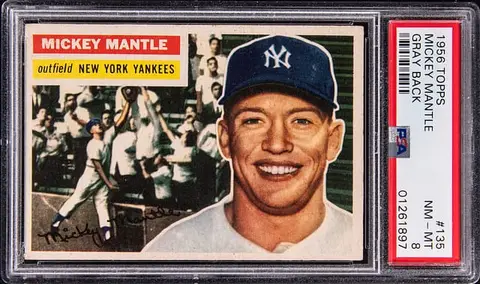
Sold Card
1956 Topps Gray Back #135 Mickey Mantle - PSA NM-MT 8
Sale Price
Platform
Goldin1950s Mantle cards are a language of their own in the vintage baseball market, and the 1956 Topps issue sits right in the middle of that conversation. A recent result adds another useful data point: on March 15, 2026, Goldin sold a 1956 Topps Gray Back #135 Mickey Mantle in a PSA NM-MT 8 holder for $18,331.
In this post we’ll walk through what this card is, why collectors care, and how this price fits into the broader Mantle and 1950s Topps market.
Card overview: 1956 Topps Gray Back Mantle in PSA 8
Let’s pin down the basics of the card that sold:
- Player: Mickey Mantle, New York Yankees (center field)
- Year & set: 1956 Topps Baseball
- Card number: #135
- Back variant: Gray Back (as opposed to the more common White Back, depending on print run and sheet)
- Rookie status: Not a rookie card – Mantle’s Topps rookie is 1952 Topps #311. 1956 is a key early-career Mantle.
- Era: Vintage (1950s)
- Grading company: PSA (Professional Sports Authenticator)
- Grade: NM-MT 8 (Near Mint-Mint)
The 1956 Topps Mantle is one of the core playing-days cards for the hobby’s most collected postwar player. It features a large portrait combined with an action scene – a design many vintage collectors view as one of Topps’ strongest from the decade.
The copy in this auction is the Gray Back version. In 1956, Topps printed cards with different cardboard stocks; some cards have noticeably grayer reverse sides, others are on a lighter, whiter stock. Collectors track these as back variations. They are not parallels in the modern sense (no serial numbering or foil), but they’re a recognized variation within the set.
Why the 1956 Topps Mantle matters to collectors
A cornerstone Mantle, even if it’s not the rookie
While the 1952 Topps Mantle tends to dominate headlines, the 1956 Topps issue often lands near the top of collectors’ "essential Mantle" lists. Reasons include:
- Prime-era image: This is Mantle coming off his 1956 Triple Crown season (leading the league in batting average, home runs, and RBIs). The card effectively captures him right as he becomes a defining star of the era.
- Classic Topps design: The dual-image layout (portrait plus action) is characteristic of mid-50s Topps and is widely considered display-friendly.
- Accessible cornerstone: Compared with the 1952 Topps, the 1956 Mantle is more obtainable for many collectors, especially in mid-to-high grades.
In short, this is not the first Mantle, but it is very much a key issue for anyone building a Mantle run or a 1950s Yankees display.
Vintage era dynamics
Being a 1950s card, this Mantle sits firmly in what collectors call the vintage era. That typically means:
- Fixed, finite supply: Production is long finished, and many copies were lost or damaged over time. Whatever survives in high grade is what the market has to work with.
- Grade sensitivity: Small jumps in condition (for example, PSA 7 to PSA 8, or 8 to 9) can have a large effect on price because the population thins quickly at the top.
- Set-building interest: Many hobbyists still build 1950s Topps runs by year or by team, which keeps demand relatively steady.
PSA 8 and the importance of grade
PSA’s NM-MT 8 grade sits in the "investment-grade" part of the vintage scale for many collectors while staying below the steep premiums attached to PSA 9s and 10s. In practical terms, a PSA 8 Mantle from the 1950s usually offers:
- Strong eye appeal: Sharp corners, solid centering (though not necessarily perfect), and clean surfaces.
- Relative scarcity compared to lower grades: The higher the grade, the fewer examples typically exist, especially for heavily handled stars like Mantle.
Population report data (commonly called a “pop report”, a count of how many copies have been graded at each grade level) helps frame how tough this card is in PSA 8 versus PSA 7 or PSA 9. For many key Mantles, there are substantially fewer 9s than 8s, and the price curve often reflects that jump.
While exact pop counts can change over time, the general pattern for 1950s Mantles is clear: they become increasingly scarce at the top, which pulls a card like this into focus for collectors who want high grade without paying record-setting multiples.
Recent sales and price context
When collectors talk about “comps,” they mean comparable recent sales that help put a card’s price into context. For a 1956 Topps Mantle Gray Back PSA 8, the most useful comparables include:
- Other PSA 8 Gray Backs sold in the last 6–18 months
- PSA 8 White Backs, to understand how the two backs trade relative to each other
- PSA 7 and PSA 9 copies to see how prices stack across grades
Across major marketplaces and auction houses, recent results for 1956 Mantle PSA 8 have generally clustered in the low-to-mid five-figure range, depending on centering, eye appeal, and back variation. The $18,331 Goldin sale on March 15, 2026, lands in that broader band.
A few factors that often influence where a specific PSA 8 lands within that range:
- Centering: Vintage buyers can be very centering-sensitive. Well-centered PSA 8s tend to command a premium over off-center examples, even within the same grade.
- Back designation: Some collectors specifically seek Gray Backs or prefer to match a full run of one back type, which can nudge demand.
- Auction timing and visibility: High-profile auction houses like Goldin typically bring strong bidder pools, but final hammer prices can still vary based on how many underbidders happen to be active at that time.
Within that context, $18,331 appears consistent with the card’s status as a premium but not unprecedented example of an important Mantle.
How this result fits into the broader Mantle market
Mickey Mantle cards, especially from the 1950s, are often treated as a kind of "blue chip" of the vintage baseball world. A few ongoing dynamics help explain why his market has held attention:
- Historical stature: Mantle sits in the same conversation as Willie Mays, Hank Aaron, and other mid-century legends, and he has deep cross-generational recognition.
- Registry competition: PSA’s Set Registry, where collectors compete to build the best graded sets, keeps steady demand flowing toward high-grade Mantles.
- Iconic imagery: Mantle’s 1950s cards feature some of the most recognizable designs in the hobby, making them focal points in showcases and displays.
While headline-grabbing sales often revolve around the 1952 Topps or unusually high grades, results like this 1956 PSA 8 Gray Back help map the "middle" of the Mantle market – where many serious collectors actually operate.
Takeaways for collectors and small sellers
For collectors thinking about 1956 Topps Mantle cards, this Goldin sale offers a few useful reference points:
- Grade remains the primary driver. PSA 8 sits in a sweet spot for eye appeal versus cost. Understanding the price spread between PSA 7, 8, and 9 is key when setting budgets or evaluating potential upgrades.
- Back variation is a nuance, not the whole story. Gray Back vs. White Back matters to variation-focused collectors, but centering, registration, and overall presentation usually have more impact on final price.
- Auction context matters. High-visibility auctions can help establish public reference points for pricing, but individual results will still swing based on bidding competition and card-specific attributes.
For small sellers considering when and where to offer a 1956 Mantle:
- Review recent public comps from multiple platforms.
- Pay attention to eye appeal and provide clear, high-quality images.
- Be transparent about back type (Gray vs. White) and any centering or print features.
This Goldin sale at $18,331 on March 15, 2026, doesn’t rewrite the Mantle record books, but it does reinforce the steady role that high-grade 1950s Mantle cards continue to play in the vintage market.
As always, these observations describe recent market behavior rather than predictions. Mantle remains a central figure in vintage collecting, and the 1956 Topps #135—especially in PSA 8 and above—continues to be one of the clearest windows into that part of the hobby.