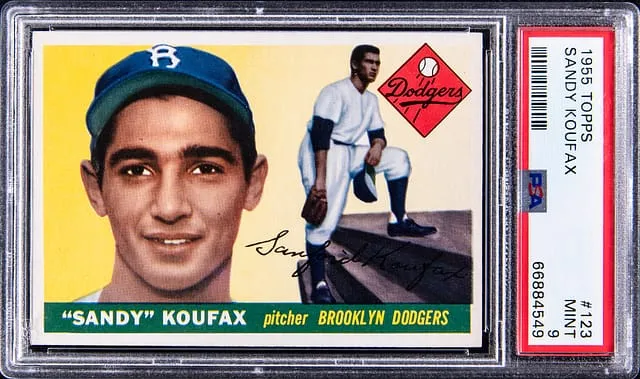
1955 Topps Sandy Koufax Rookie PSA 9 Sells for $292K
Goldin sold a 1955 Topps #123 Sandy Koufax rookie PSA MINT 9 for $292,800 on Feb 22, 2026. See how this result fits recent comps and pop report data.
Sold Card
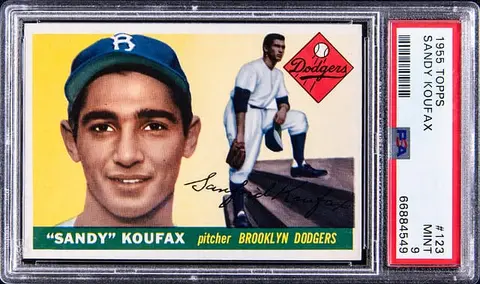
1955 Topps #123 Sandy Koufax Rookie Card - PSA MINT 9 - Only 3 Higher PSA Copies
Sale Price
Platform
GoldinA PSA MINT 9 copy of the 1955 Topps #123 Sandy Koufax rookie card just closed at Goldin on February 22, 2026 for $292,800. For vintage baseball collectors, this is one of the true cornerstone cards of the post-war era, and high-grade examples rarely change hands publicly.
Card overview: 1955 Topps Sandy Koufax rookie
- Player: Sandy Koufax (Hall of Fame pitcher)
- Team: Brooklyn Dodgers
- Year & set: 1955 Topps Baseball
- Card number: #123
- Type: True rookie card (first mainstream Topps issue)
- Grade: PSA MINT 9
- Grading company: PSA (Professional Sports Authenticator)
- Special attributes: Standard base rookie, no parallel/autograph; significance comes from era, scarcity in high grade, and Hall of Fame status.
The 1955 Topps design is horizontal, with a portrait on one side and an action image on the other. Centering, print quality, and chipping along the colored borders make high-grade copies of Koufax’s rookie especially difficult.
Population, scarcity, and why PSA 9 matters
When collectors talk about “pop report”, they mean the population report published by grading companies that shows how many copies of a card exist in each grade. For the 1955 Topps Koufax, the PSA population skews heavily toward mid-grade copies.
At the time of this sale, PSA’s pop data shows that only a small number of Koufax rookies have ever reached PSA 9, with just three PSA 10 examples graded higher. That combination—vintage card, iconic Hall of Famer, low population at the top grades—is the main driver behind results like this $292,800 sale.
Market context and recent comps
In hobby language, “comps” are comparable sales used to gauge where the market has been trading recently.
Public auction results over the last few years show:
- PSA 9 copies of the 1955 Topps Koufax rookie have consistently sold in the low- to mid-six-figure range, depending on centering, eye appeal, timing, and venue. Results over $300,000 have been observed at peak demand points, while softer periods have seen sales somewhat lower.
- PSA 8 copies often land in the five-figure to low six-figure range, again depending heavily on centering and overall presentation.
- PSA 10 copies, with only three in existence, have commanded record-level prices in the past and are rarely offered. Those results sit far above the PSA 9 level and are typically discussed as outliers in the vintage market.
Against that backdrop, the $292,800 Goldin sale for this PSA 9 Koufax rookie looks directionally consistent with other recent high-grade vintage Hall of Fame rookie results. It is on the stronger side for the current environment but not out of line with what collectors have seen from this card in the last few years, especially when offered by a major auction house.
Because eye appeal—centering, print, focus, and color—can vary significantly from copy to copy, two PSA 9s do not always sell for identical amounts. Auction timing, overall market sentiment, and how many high-end buyers are active on a given night can also push prices up or down within a band.
Why this card matters to collectors
A few key factors explain why the 1955 Topps #123 Sandy Koufax rookie is so important in the hobby:
Hall of Fame resume
Koufax’s peak from 1961–1966—three Cy Young Awards, an MVP, four no-hitters including a perfect game, and multiple World Series rings—cemented him as one of the greatest pitchers in MLB history. The fact that he retired early due to injury adds to the sense of a dominant but brief prime.Vintage era significance
This is a vintage card, from the 1950s. Vintage cards (roughly pre-1975) were printed and distributed in a very different environment than today’s hobby: kids bought them to trade, flip, or put in bike spokes, not to preserve in gem-mint condition. Surviving high-grade examples of key rookies are inherently scarce.Important Topps design
The 1955 Topps set is one of the most recognizable post-war issues, with its horizontal design and strong color. Alongside names like Roberto Clemente and Jackie Robinson, Koufax anchors the checklist.Condition sensitivity
Centering issues, print defects, and edge/corner wear mean that true mint copies are rare. Many surviving Koufax rookies fall in PSA 3–7 range. That makes every PSA 9 a major event when it hits the open market.Iconic rookie status
For many collectors, the primary way they interact with a Hall of Famer’s career is through their “flagship” rookie card—the main, broadly distributed base card from a major brand. For Koufax, that card is this 1955 Topps #123.
How this sale fits into the broader vintage market
This $292,800 result at Goldin comes in a hobby environment where vintage, blue-chip Hall of Fame rookies have generally shown more stability than many modern and ultra-modern speculative cards.
A few context points:
- Flight to quality: When collectors become more cautious, they often refocus on proven players and historically important sets rather than chasing the newest products. Koufax’s rookie fits squarely into that “quality” bucket.
- Limited supply at the top: With only three PSA 10s and a small population of PSA 9s, there is simply not much supply available to satisfy high-end demand. Years can pass between public offerings of PSA 9 or better copies.
- Long-term collecting patterns: Many long-time collectors treat cards like this as centerpiece items in a Hall of Fame run or a 1950s Topps run, rather than something they flip quickly. That tends to reduce turnover.
While it is useful to reference these patterns, it is important to remember that past sales are not guarantees of future prices. Market conditions, collector preferences, and broader economic factors can all shift over time.
Takeaways for collectors and small sellers
Whether you are just returning to the hobby or already active in vintage, there are a few practical lessons in this sale:
Know your grade tiers
The price gap between PSA 7, 8, and 9 on iconic vintage rookies can be huge. Understanding how many copies exist in each grade (via the pop report) helps explain those differences.Eye appeal matters, even within the same grade
Two PSA 9s can bring different prices based on centering, color, and print quality. When checking comps, try to compare cards with similar visual appeal, not just the same numeric grade.Track multiple venues
Major auction houses like Goldin, along with fixed-price marketplaces, can sometimes show slightly different results for the same card. Looking across platforms gives a fuller price picture.Think in ranges, not single numbers
Instead of treating $292,800 as the “value” of every PSA 9 Koufax, treat it as a data point within a broader range. Recent sales can help you understand a ballpark, but actual realized prices will always move within that band.
Final thoughts
The February 22, 2026 Goldin sale of a 1955 Topps #123 Sandy Koufax Rookie Card in PSA MINT 9 at $292,800 reinforces the card’s place as one of the key post-war vintage issues. With only three PSA copies graded higher, every public auction of a Koufax rookie at this level offers a useful benchmark for how the market is currently valuing true blue-chip Hall of Fame cards.
For collectors building a vintage portfolio—whether that means a single centerpiece card or a full run of 1950s Topps—tracking results like this helps frame expectations, understand scarcity, and appreciate why certain cards have become long-term hobby touchstones.