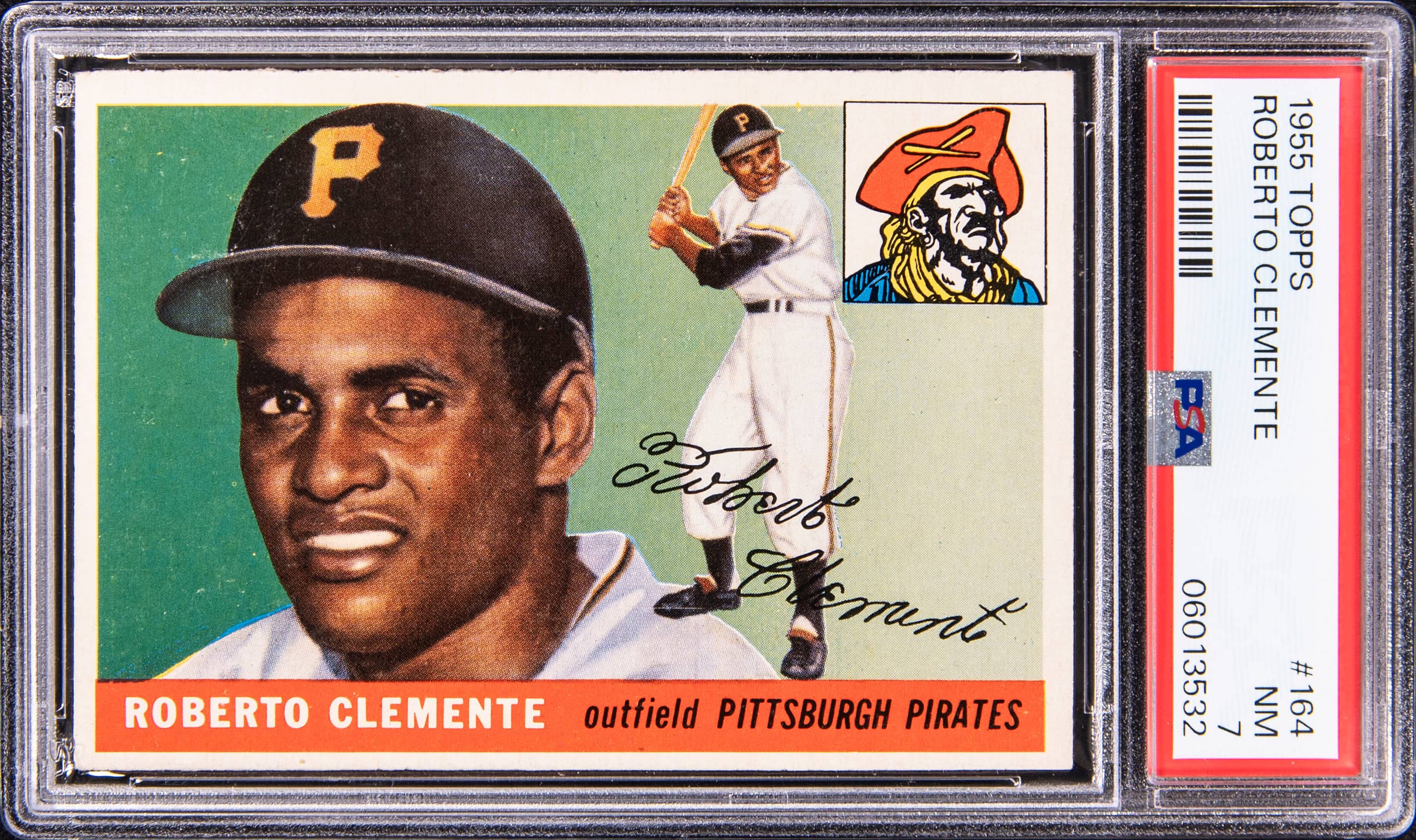
1955 Topps Roberto Clemente Rookie PSA 7 Sells
Goldin sold a 1955 Topps #164 Roberto Clemente rookie PSA NM 7 for $19,520 on Feb 22, 2026. See how this result fits recent vintage market trends.
Sold Card
1955 Topps #164 Roberto Clemente Rookie Card - PSA NM 7
Sale Price
Platform
Goldin1955 Topps #164 Roberto Clemente Rookie Card – PSA NM 7 Sells for $19,520
On February 22, 2026, Goldin sold a 1955 Topps #164 Roberto Clemente rookie card graded PSA NM 7 for $19,520. For vintage baseball collectors, this card is one of the true cornerstones of the hobby, and a sale like this helps frame where mid‑grade Clemente rookies are currently trading.
In this post, we’ll break down what this card is, why it matters so much to collectors, and how this sale fits into recent market activity.
Card overview: 1955 Topps #164 Roberto Clemente rookie
Card details
- Player: Roberto Clemente
- Team: Pittsburgh Pirates
- Year: 1955
- Set: 1955 Topps Baseball
- Card number: #164
- Type: True rookie card and key issue
- Era: Vintage (pre-1970)
- Grading company: PSA (Professional Sports Authenticator)
- Grade: NM 7 (Near Mint)
This is Clemente’s flagship rookie card from the 1955 Topps set, which is known for its horizontal design, bright color backgrounds, and dual image layout (portrait plus action shot). For many player and Hall of Fame collectors, this is the Clemente card to own.
There are no serial numbers, patches, or autographs here—it’s a straightforward vintage base card. In the pre-modern era, scarcity comes more from age, condition sensitivity, and survival rate than from manufactured short prints or parallels.
Why collectors care so much about this card
1. Hall of Fame resume and cultural impact
Roberto Clemente is a 3,000‑hit Hall of Famer, 12-time Gold Glove winner, World Series champion, and one of baseball’s most respected figures on and off the field. His humanitarian work and the circumstances of his passing in 1972 have made his legacy especially meaningful to collectors.
Because of that, Clemente’s rookie card isn’t just a statistical milestone—it’s a hobby touchstone that represents both excellence and character. Many collectors who focus on Hall of Famers, Puerto Rican players, or Latin American baseball history consider this one of the most important post‑war baseball cards.
2. Key card in a landmark vintage set
The 1955 Topps set is one of the classic post‑war releases. Its horizontal design and bold color blocks make it visually distinct, and it includes major rookie cards beyond Clemente, such as:
- Sandy Koufax
- Harmon Killebrew
Clemente is widely viewed as the headliner of the set. For set builders and vintage specialists, landing a strong example of #164 is usually one of the final and most expensive steps to completing 1955 Topps.
3. Condition sensitivity and grade scarcity
Like many mid‑1950s cards, 1955 Topps issues can suffer from:
- Off‑center printing
- Chipping on the colored borders
- Print marks
- Corner and edge wear
As a result, eye appeal varies widely at the same numerical grade. PSA 7 (Near Mint) generally indicates:
- Relatively sharp corners (with minor wear)
- Clean surfaces with limited print defects
- Solid gloss
- Centering within PSA’s NM tolerance
High‑end examples (PSA 8 and above) command substantial premiums, but PSA 7 has emerged as a “sweet spot” for collectors who want a strong vintage copy without moving into the more volatile high‑grade price tier.
Market context: where does $19,520 fit?
When collectors talk about “comps,” they mean comparable recent sales used to understand the going rate for a card in a specific grade. For a key vintage rookie like Clemente, comps often come from large auction houses (Goldin, Heritage, PWCC, REA) plus major marketplaces and fixed-price results.
Based on recent public auction history for 1955 Topps #164 in PSA 7:
- PSA 7 copies have typically sold in the mid‑ to high‑teens (thousands) in recent years, with some results pushing over the $20,000 mark in strong market windows.
- Lower grades like PSA 5–6 generally trade at a noticeable discount to PSA 7, while PSA 8 and above jump sharply in price and can reach well into five figures and beyond depending on centering and eye appeal.
At $19,520, this February 22, 2026 Goldin result lands in the expected range for a strong PSA 7 example:
- It aligns with other recent auction outcomes for nice-looking PSA 7 copies.
- It reflects steady demand for Clemente’s rookie rather than a major price spike or collapse.
Exact prices will continue to move over time, but within the current backdrop, this sale reads as market‑consistent for a solid mid‑high vintage grade.
How PSA 7 fits in the broader Clemente rookie ladder
While exact population report numbers (the grading company’s count of how many copies exist in each grade) change as more cards are graded or regraded, the general structure for Clemente’s 1955 Topps rookie looks like this:
- There are many lower‑grade copies (PSA 1–5), reflecting the card’s age and handling over seven decades.
- PSA 6 and PSA 7 are heavily targeted because they balance condition and price accessibility for serious collectors.
- PSA 8 and above become significantly more scarce, which is reflected in much higher price multiples.
In that context, a PSA 7 sale near $20,000 underscores that this is a core hobby piece—not an ultra‑rare “one of one,” but a historically important card with stable, long-term collector demand.
Vintage vs. modern: what makes this different?
Modern and ultra‑modern cards (roughly mid‑2000s to today) often use scarcity created by design:
- Low serial numbering
- Short prints
- Color parallels
- Autographs and patches
By contrast, vintage cards like the 1955 Topps Clemente rely on:
- Age and condition scarcity
- Historical significance
- Player legacy
There’s no short‑print label or stamped serial number here. Instead, value is driven by how few high‑quality examples have survived, and by how strongly collectors feel about Clemente’s place in the game.
What this sale means for collectors and small sellers
For new and returning collectors:
- This sale is a good reference point for understanding how important flagship rookie cards of inner‑circle Hall of Famers can become over decades.
- You don’t have to start at PSA 7—raw (ungraded) copies and lower grades can offer lower entry points if you mainly care about owning a piece of history.
For active hobbyists and small sellers:
- A $19,520 result in PSA 7 supports the idea that demand for key vintage Hall of Fame rookies has remained resilient, even as the modern and ultra‑modern segments go through their own cycles.
- Eye appeal and presentation (centering, color, gloss) matter a lot within each grade. Two PSA 7s can perform differently depending on how they look in hand.
For Clemente-focused collectors:
- This Goldin sale is another data point confirming that the 1955 Topps rookie continues to be one of the most closely followed vintage cards in the market.
None of this is a prediction about where prices will go next, but as of February 22, 2026, a PSA 7 Clemente rookie changing hands at $19,520 is very much in line with its status as a blue‑chip vintage piece.
Key takeaways
- The 1955 Topps #164 Roberto Clemente is his true flagship rookie card and a centerpiece of 1950s baseball collecting.
- This PSA NM 7 copy sold for $19,520 at Goldin on February 22, 2026 (UTC).
- The price sits within the recent range for PSA 7 examples, reflecting steady demand rather than an outlier result.
- Condition and eye appeal remain critical drivers of value within the same numerical grade.
- For collectors at all levels, this sale is a clear reminder of how enduring vintage Hall of Fame rookies can be in the hobby.
As more 1955 Topps Clemente rookies surface in future auctions, this Goldin sale will serve as a useful benchmark for where strong PSA 7 examples have been trading in early 2026.