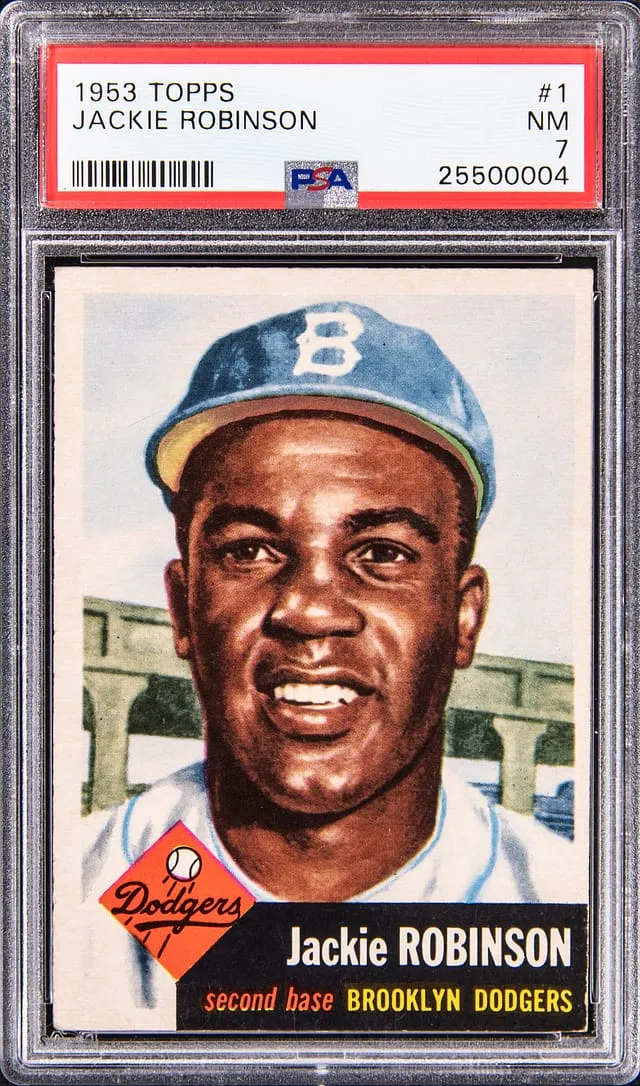
1953 Topps Jackie Robinson PSA 7 sells for $13K
Goldin sold a 1953 Topps #1 Jackie Robinson PSA 7 for $13,421 on Feb 22, 2026. See how this vintage key compares to recent sales and why it matters.
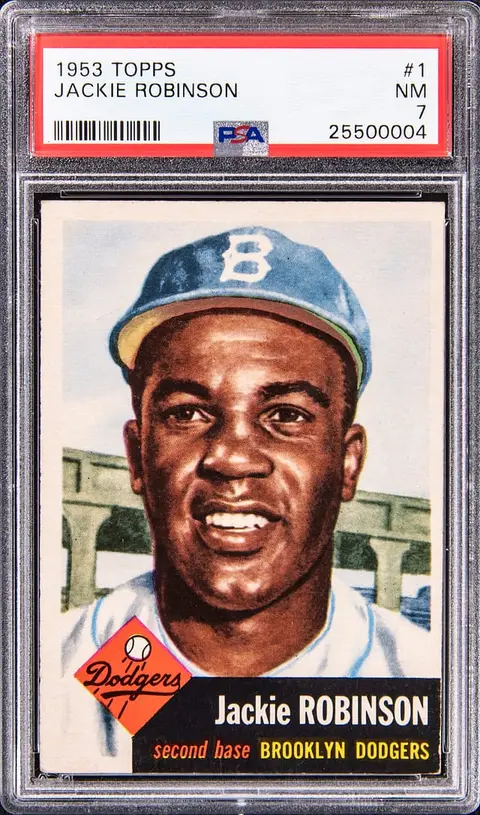
Sold Card
1953 Topps #1 Jackie Robinson - PSA NM 7
Sale Price
Platform
GoldinA PSA 7 copy of the 1953 Topps #1 Jackie Robinson just closed at auction for $13,421 on Goldin (sale date: 2026-02-22, UTC), and it’s a useful data point for anyone tracking vintage baseball or key Jackie cards.
Below is a breakdown of what sold, why this card matters, and how this price lines up with recent sales.
The card: 1953 Topps #1 Jackie Robinson – PSA NM 7
Key details
- Player: Jackie Robinson, Brooklyn Dodgers
- Year / Set: 1953 Topps Baseball
- Card number: #1
- Parallel / variant: Standard base issue (no parallel)
- Rookie?: Not a rookie card (Jackie’s widely recognized rookie is 1948 Leaf), but a major “key card” in his run.
- Era: Vintage (pre-1970)
- Grading company: PSA (Professional Sports Authenticator)
- Grade: NM 7 (Near Mint)
There are no on-card autographs, patches, or serial numbering in this era. The card’s importance comes from:
- Jackie Robinson’s status as a Hall of Famer and civil rights icon
- The 1953 Topps set’s artistic, hand-painted portraits
- The difficulty of finding clean, centered examples of card #1
Being card #1 in a vintage set matters. Top and bottom cards on old rubber-banded stacks were more exposed to wear. That extra exposure makes high-grade copies notably tougher, which shows up both in grading populations and realized prices.
Why the 1953 Topps Jackie Robinson #1 matters to collectors
1. An essential Jackie Robinson card
Jackie’s 1948 Leaf is the hobby’s go-to rookie, and his 1952 Topps is another cornerstone. The 1953 Topps #1 sits just behind those in many Jackie-focused collections:
- It’s his second Topps card.
- The portrait artwork is one of the most recognizable Jackie images on cardboard.
- It’s often on short lists of “iconic postwar cards” alongside early Mays, Mantle, and Aaron issues.
For many collectors, this card checks three boxes at once: Brooklyn Dodgers history, Topps history, and civil rights history.
2. The 1953 Topps set
1953 Topps is known for:
- Painted portraits rather than photos
- A relatively short, but star-heavy checklist
- Condition sensitivity: centering, print issues, and edge wear are common
It’s less massive in scale than 1952 Topps, but it’s still a flagship Topps release. In hobby terms, “flagship” simply means the main, annual Topps baseball set, as opposed to a side product or insert.
3. Scarcity in higher grades
While exact population counts can change as more cards are submitted, PSA’s population reports (often called “pop reports”) show how many copies exist in each grade. These reports consistently show:
- A healthy number of low- to mid-grade 1953 Jackie Robinsons in circulation
- A significant drop off starting around PSA 7 and above
In this context, PSA 7 represents a fairly high-grade copy that is still somewhat attainable compared with PSA 8 and PSA 9, where populations become very thin and prices jump.
Market context: where does $13,421 fit?
This Goldin result came in at $13,421. To understand that, it helps to look at “comps” (short for comparables, or recent sales of the same or very similar cards).
Recent PSA 7 sales and nearby grades
Public auction and marketplace data over the past couple of years for the 1953 Topps Jackie Robinson #1 show a fairly wide band, influenced by centering and eye appeal:
- Lower-end–looking PSA 7 copies (off-center, weaker color) have tended to sit toward the lower range for the grade.
- Strongly centered PSA 7s with good color can challenge or overlap weaker PSA 8s.
PSA 8 and higher sales have routinely landed well above PSA 7 pricing, reflecting the scarcity and eye appeal jump once you pass that NM 7 threshold.
Within that context, this $13,421 result is best viewed as:
- A solid mid-to-upper range price for a PSA 7, consistent with recent vintage pricing for strong Hall of Fame keys.
- Not a record-breaking outlier, but also not a discounted or distressed result.
The exact positioning within the PSA 7 band usually depends on the specific copy’s centering, registration, and color saturation—factors that can make one PSA 7 more desirable than another even at the same numerical grade.
Comparing across the Jackie Robinson portfolio
Looking broadly at Jackie’s major vintage cards:
- 1948 Leaf Jackie (rookie): Typically commands a market premium in similar grades due to rookie status and set difficulty.
- 1952 Topps Jackie: Also highly pursued, with strong demand in mid- to high-grade.
- 1953 Topps #1 Jackie (this card): Often slotted just behind those two in prestige, but it benefits from being card #1 and from the beloved 1953 artwork.
In that light, a low five-figure result for a strong PSA 7 copies lines up with where this card has been settling in the modern vintage market.
Factors likely supporting this sale level
Several structural factors continue to support demand and pricing for this card:
1. Jackie Robinson’s lasting legacy
Jackie remains one of the very few players whose appeal extends far beyond baseball collectors. His integration of Major League Baseball in 1947 and his broader civil rights role make his cards historically important artifacts, not just sports memorabilia.
That broader interest helps the card hold collector attention even when the broader market cycles up or down.
2. Vintage stability vs. modern volatility
This card sits firmly in the vintage category (pre-1970). Vintage cards often have:
- More predictable supply (most surviving copies have already surfaced)
- Less reliance on short-term performance swings
By contrast, ultra-modern cards can be more volatile as they react to weekly headlines, injuries, and speculation. The 1953 Jackie tends to trade on long-term historical significance.
3. Grade tier and accessibility
While PSA 8 and PSA 9 copies are much rarer, they also come with a significant price step-up. Many collectors target:
- PSA 6–7 as the sweet spot for balancing cost, eye appeal, and long-term collectability.
This keeps steady demand in the PSA 7 lane, especially when the copy has above-average centering and presentation for the grade.
What this means for collectors and small sellers
A few practical takeaways if you’re collecting or considering selling a 1953 Topps Jackie Robinson #1:
1. Eye appeal within the grade matters
Not all PSA 7s are equal to buyers. When looking at comps or evaluating your own copy, focus on:
- Centering: Left-right and top-bottom
- Color and registration: How crisp and saturated the image is
- Surface and corners: Visible wear vs. clean presentation
Strong eye appeal can justify a premium over average sales at the same grade.
2. Use multiple comps, not just one headline sale
This Goldin sale at $13,421 is a meaningful data point, but it’s best viewed alongside:
- Recent sales on other major auction houses
- Fixed-price and best-offer results on marketplaces
Averaging several recent comps provides a more realistic picture of the current range than relying on one standout auction.
3. Think in ranges, not exact numbers
For a card like this, it’s more useful to think in ranges (for example, a typical band for PSA 7 under current conditions) rather than a single “true value.” Auction outcomes can swing based on timing, bidder mix, and the specific copy’s look.
About this specific sale
- Card: 1953 Topps #1 Jackie Robinson – PSA NM 7
- Auction house: Goldin
- Sale date (UTC): 2026-02-22
- Realized price: $13,421
For Jackie Robinson and 1950s Topps collectors, this result reinforces the card’s place as a core vintage key that continues to command strong, steady demand in solid mid-to-high grade.
figoca will continue tracking this and related Jackie Robinson cards across major auction houses so collectors can place individual results like this Goldin sale into better long-term context.