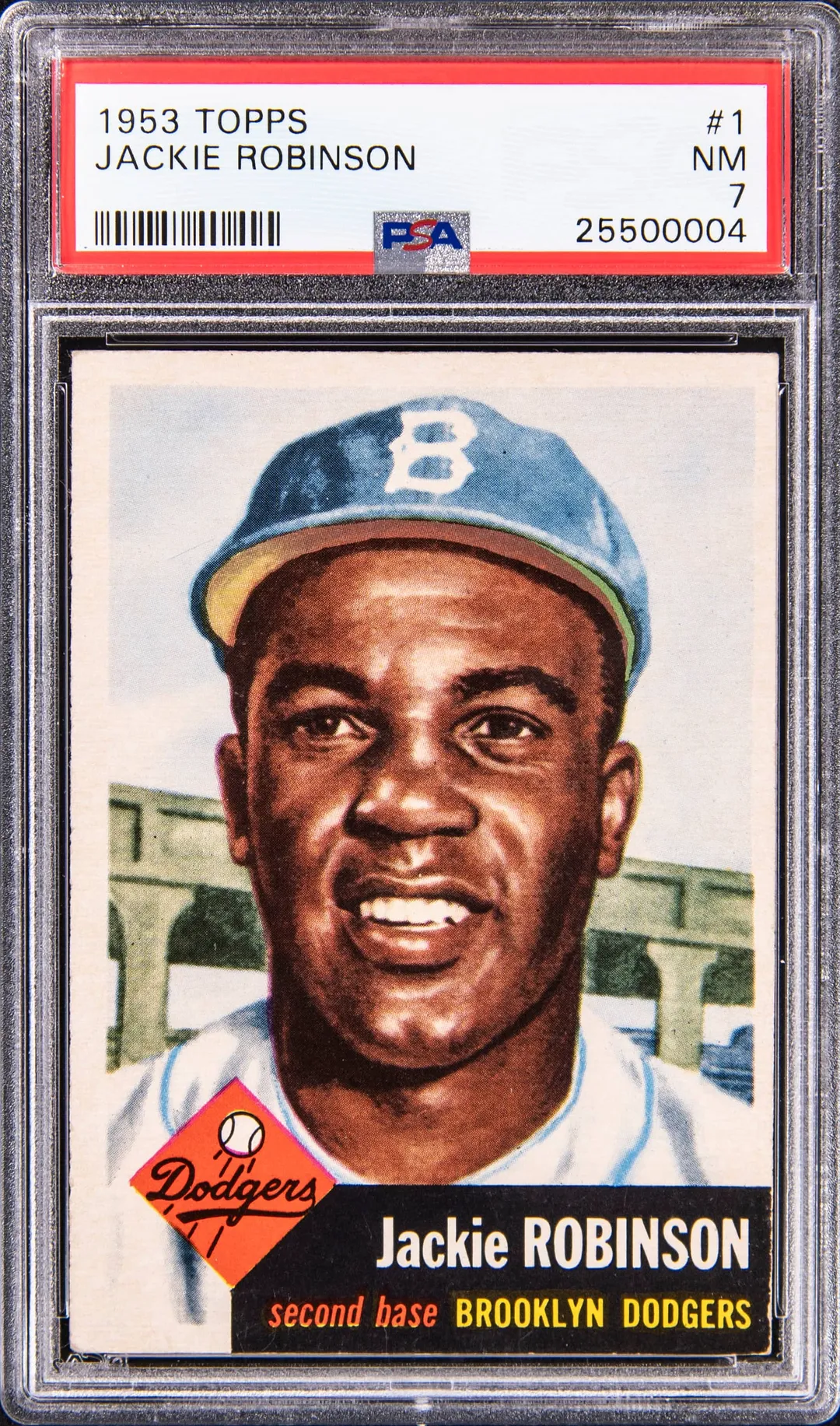
1953 Topps Jackie Robinson PSA 7 sells for $13,421
Goldin sold a 1953 Topps #1 Jackie Robinson PSA NM 7 for $13,421 on Feb 22, 2026. See how this vintage key fits into current market trends.
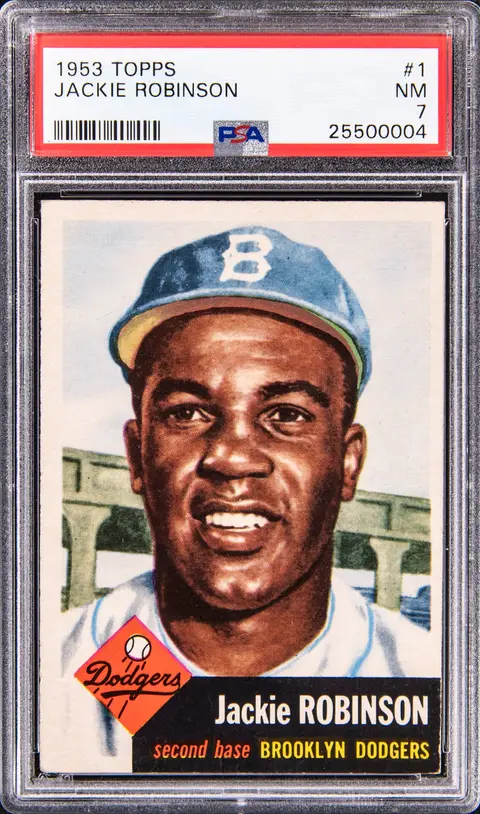
Sold Card
1953 Topps #1 Jackie Robinson - PSA NM 7
Sale Price
Platform
Goldin1953 Topps Jackie Robinson cards sit at the crossroads of vintage history and modern hobby data, and this latest sale is a clean example of how that plays out in today’s market.
On February 22, 2026, Goldin sold a 1953 Topps #1 Jackie Robinson graded PSA NM 7 for $13,421. For collectors who track this card closely, that’s a meaningful data point—not just because of the player on the front, but because of what this specific issue represents.
The card: 1953 Topps #1 Jackie Robinson, PSA 7
Let’s pin down the basics:
- Player: Jackie Robinson, Brooklyn Dodgers
- Year / Set: 1953 Topps Baseball
- Card number: #1
- Grading company: PSA (Professional Sports Authenticator)
- Grade: NM 7 (Near Mint)
- Attributes: Standard base card, no autograph or relic, not numbered
- Status: Not a rookie card (Jackie’s true rookie is 1948 Leaf), but a key vintage issue
The 1953 Topps release is one of the classic early Topps sets, known for its painted-style portraits and strong checklist (including Mickey Mantle, Willie Mays, and Satchel Paige). Jackie’s card taking the #1 slot is important—card #1s from this era often suffer from extra wear because they sat on top of kids’ stacks and rubber-banded bundles.
That extra wear makes higher grades harder to find. A PSA 7 in this context is more than just a mid–high grade; it’s where eye appeal, condition rarity, and budget reality start to intersect for many serious vintage collectors.
Why collectors care about this card
Even if you ignore the numeric grade, this is a strongly collected Jackie Robinson issue for several reasons:
Historical significance of the player
Jackie Robinson is one of the key figures not just in baseball but in American history. His cards are foundational pieces in any Hall of Fame or history-focused collection.Early Topps era
The card comes from the second full-sized Topps baseball set (following 1952 Topps). For set builders and early-Topps specialists, 1953 is right in the sweet spot of vintage collecting.Card #1 difficulty
Being the first card in the checklist adds a layer of condition scarcity. Top cards were more likely to be dinged, rubber-banded, and exposed to light and dust. That’s why you often see populations (the number of graded copies, usually pulled from a pop report, which is the grading company’s population report) thinning out as the grades get higher.Not a rookie, but still a key
While it’s not his rookie, this is widely considered a key Jackie issue. Many collectors who are priced out of his earliest cards move into 1952 and 1953 Topps as historically important, more reachable targets.
Market context and recent sales
In hobby language, “comps” are comparable sales—recent transactions of the same card and grade that help set expectations for current pricing. For a 1953 Topps Jackie Robinson #1 in PSA 7, recent comps in the mid-2020s have generally clustered in a band that reflects both its vintage pedigree and Jackie’s stable long-term demand.
Across major auction houses and marketplaces, PSA 7s have typically changed hands in the low–to–mid five-figure range, with realized prices shifting based on:
- Centering and overall eye appeal
- Timing (off-season vs. major hobby events)
- Auction-house reach and how well the specific copy is promoted
Against that backdrop, the $13,421 Goldin result on February 22, 2026 sits comfortably within the established window for this grade. It doesn’t read as a wild outlier, but rather as a solid, market-aware sale that continues the card’s pattern of being well supported in PSA 7.
Higher grades—PSA 8 and especially PSA 9—tend to show much steeper price jumps where they appear, reflecting how few truly sharp copies survived from the early 1950s. Lower grades offer more entry points but often sacrifice the clean portrait and strong color that make this issue so attractive.
Grade, scarcity, and the PSA 7 sweet spot
Vintage collecting often revolves around a balancing act: historical significance, visual appeal, and budget. For this card, PSA 7 is one of those “sweet spot” grades where many serious collectors aim:
- Above the heavy wear line: You’re past soft corners, heavy creases, and major paper loss.
- Below the scarcity cliff: You aren’t yet paying the steep premium that comes with PSA 8 and above, where the population numbers tighten and competition intensifies.
This is especially true for a card like Jackie’s 1953 Topps #1, where the #1 checklist position naturally reduces the supply of nicer examples.
Where this sale fits in the broader Jackie Robinson market
Jackie Robinson’s market tends to be steadier and less speculative than many modern stars:
- His significance is rooted in history, not current-season performance.
- Demand comes from multiple directions: vintage baseball collectors, civil rights historians, Brooklyn Dodgers fans, and broader Americana collectors.
- Key cards—1948 Leaf, 1952 Topps, and 1953 Topps among them—tend to have relatively well-established demand patterns.
Within that landscape, a $13,421 PSA 7 sale on Goldin helps confirm a few ongoing themes:
- Sustained interest in early Topps Jackies rather than sudden spikes or collapses.
- Preference for graded, mid–high condition examples where buyers can trust the card’s authenticity and condition.
- Continued strength in marquee auction settings for historically important vintage pieces.
Takeaways for collectors and small sellers
Whether you’re new to vintage or revisiting it after years away, here are a few practical notes drawn from this sale:
Know the set and the number
With 1950s Topps, card number and checklist position can matter almost as much as the player. Being #1 adds to this Jackie’s condition challenge and desirability.Understand where your card fits on the grading curve
A PSA 7 doesn’t live in the same world as a PSA 3 or a PSA 8, even though they’re all the same card. Checking population reports and recent comps helps you see how your copy compares.Use recent auction results as context, not guarantees
A $13,421 result on February 22, 2026 at Goldin gives a solid reference point, but future results can move up or down depending on timing, marketing, and how the specific copy presents.Eye appeal still matters inside the grade
Two PSA 7s are not always equal. Centering, print quality, and color can tilt bidders in one direction or another, especially on a portrait-driven set like 1953 Topps.
Final thoughts
The 1953 Topps #1 Jackie Robinson in PSA NM 7 sits in that rare space where historical weight, set importance, and condition all line up. The February 22, 2026 Goldin sale at $13,421 doesn’t rewrite the record books, but it does reinforce what many collectors already see on the ground: this is a cornerstone Jackie card with steady, educated demand.
For anyone building a focused Jackie run, a Dodgers history collection, or a curated early Topps set, this sale is another data point confirming that the 1953 Topps #1 remains a serious, long-term piece of the vintage landscape.