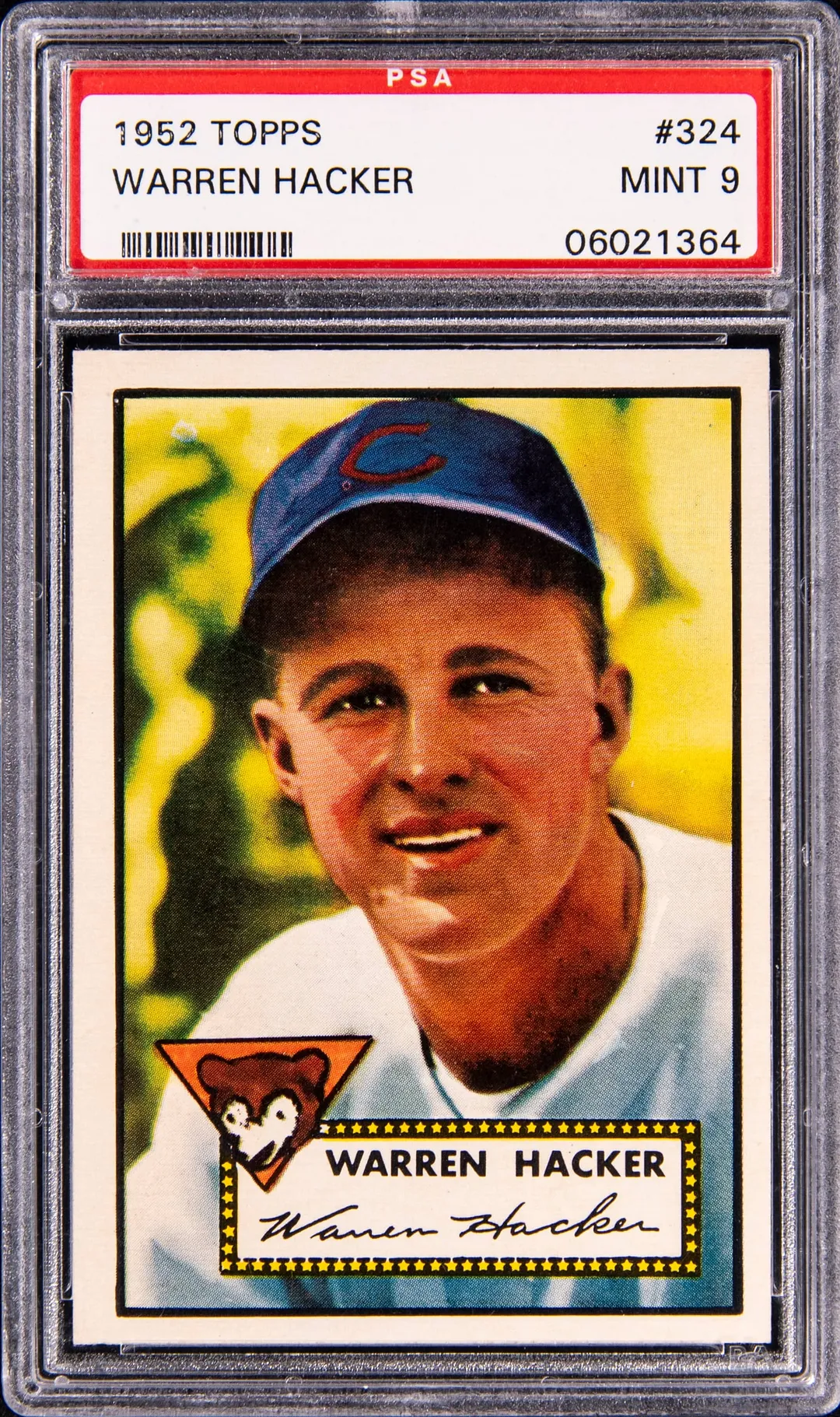
1952 Topps Warren Hacker PSA 9 Sells for $15,860
Figoca breaks down the $15,860 Goldin sale of a 1952 Topps #324 Warren Hacker PSA 9 (Pop 8, highest graded) and what it says about vintage demand.
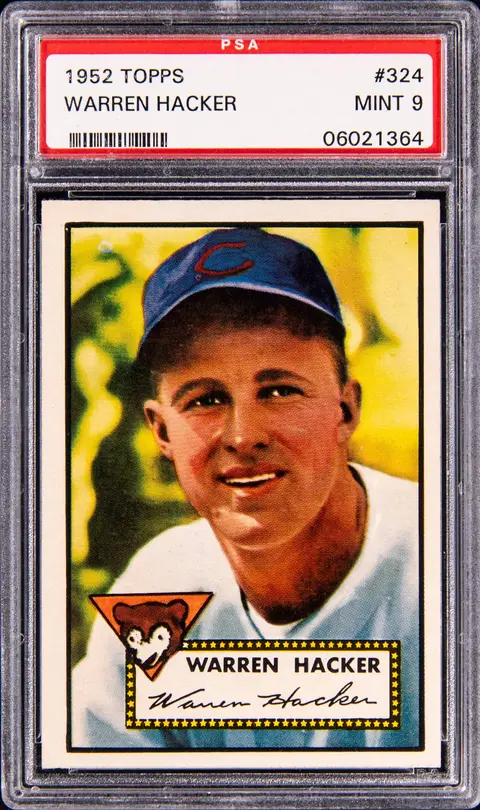
Sold Card
1952 Topps #324 Warren Hacker - High Humber - PSA MINT 9 - Pop 8; Highest PSA Copy
Sale Price
Platform
GoldinA PSA MINT 9 example of the 1952 Topps #324 Warren Hacker – often nicknamed the “High Humber” variation – just closed at Goldin on February 22, 2026 for $15,860.
For a relatively modest name in the 1952 Topps checklist, this is a meaningful vintage data point. It speaks less to player star power and more to how deeply collectors value high-grade examples from one of the most important post‑war baseball sets ever produced.
The card at a glance
- Player: Warren Hacker (pitcher)
- Team: Chicago Cubs
- Year / Set: 1952 Topps Baseball
- Card number: #324
- Nickname: Often referred to in hobby circles as “High Humber”
- Rookie or key issue? Not a true rookie or major star card, but part of a cornerstone vintage set
- Grading company: PSA (Professional Sports Authenticator)
- Grade: PSA MINT 9
- Population: PSA Pop 8 in this grade
- Notable: This is tied for the highest grade PSA has awarded on this card; there are no PSA 10s on record at the time of sale.
There are no autographs, patches, or serial numbering on this card. Its appeal comes from being a very high‑grade example of an early‑1950s Topps card that is difficult to find well‑centered and clean.
Why 1952 Topps still matters
1952 Topps is widely considered Topps’ first full‑scale modern baseball release and a foundation of post‑war collecting. For many hobbyists, it is the vintage set after the pre‑war tobacco and gum issues.
Key reasons collectors care about 1952 Topps:
- Historical importance: It’s the landmark early Topps design, with full‑color portraits, team logos, and nameplates that shaped the look of cards for decades.
- Star power: The set includes the iconic Mickey Mantle #311, Jackie Robinson, Willie Mays, and other Hall of Famers, which lifts the profile of the entire checklist.
- Condition sensitivity: Printing, centering, and handling issues mean that true high‑grade copies of many commons and minor stars are scarce.
- Era: As a vintage (pre‑1970) release, surviving examples in clean condition often have real scarcity compared with modern and ultra‑modern issues.
Within this context, even a non‑Hall of Famer such as Warren Hacker can command strong prices when the card reaches the very top of the grade scale.
Population and scarcity: what “Pop 8” and “Highest PSA Copy” mean
When collectors talk about a card’s “pop report,” they’re referring to the grading company’s population data – how many copies have been graded at each level. For this Warren Hacker card:
- PSA MINT 9 population: 8 copies
- Higher‑graded PSA copies: None currently listed, making PSA 9 the highest graded tier for this card.
In other words, this specific card sits at the ceiling of what PSA has seen. For collectors who chase top‑of‑the‑registry sets – people who try to assemble the highest‑graded possible run of 1952 Topps – these population numbers matter more than the player’s career resume.
Market context and recent sales
For a lower‑profile player from a major vintage set, prices tend to hinge on two main factors:
- Set importance – 1952 Topps remains one of the most heavily pursued vintage sets, especially in PSA slabs.
- Condition scarcity at the top end – once you reach PSA 8 and PSA 9, even “commons” can see surprising sale prices.
Based on recent public auction data for similar 1952 Topps cards:
- Lower‑grade Warren Hacker examples (in the mid‑grade PSA range) commonly trade for a fraction of this result.
- Other non‑star 1952 Topps PSA 9 cards with similar population counts often realize mid‑four‑figure to low‑five‑figure prices depending on centering, eye appeal, and timing.
At $15,860, this sale sits toward the upper range of what’s typically seen for a non‑Hall of Fame name in PSA 9 from this set, but it’s consistent with the pattern that:
- Registry‑quality vintage cards
- In a historically important set
- With very few examples at the top grade
can attract strong bidding when they surface at a major house like Goldin.
Because this card is pop‑limited at the highest grade and does not appear at auction frequently, there aren’t many truly direct, recent “comps.” In hobby terms, “comps” are comparable recent sales that collectors use for rough price reference. In this case, the best context comes from looking at other high‑number or mid‑series 1952 Topps PSA 9 commons with similar population counts.
Why collectors care about a non‑star like Hacker
Even though Warren Hacker himself isn’t a hobby headliner, this card checks a few boxes that matter to set builders and vintage specialists:
- Completing high‑grade sets: Collectors chasing a 1952 Topps PSA 8–9 set can spend years waiting for specific cards to reappear in public auctions.
- Eye appeal at the top end: Many 1952 Topps cards suffer from poor centering, print snow, or color fade. A PSA 9 example that presents strongly can be a significant upgrade.
- Registry competition: Some collectors compete on PSA’s Set Registry, where every half‑grade can change rankings. A pop‑8 top‑grade card can be a deciding factor between first and second place.
In short, the context – 1952 Topps, PSA 9, highest‑graded – is doing most of the work here, not player fame.
What this Goldin sale tells us
This Goldin sale on February 22, 2026 reinforces a few ongoing trends:
- Top‑grade vintage remains resilient. Even outside the superstar names, top‑population vintage cards from blue‑chip sets still find determined bidders.
- Condition scarcity drives separation. The price gap between mid‑grade commons and PSA 9 examples continues to be wide, showing how much collectors value the best surviving copies.
- Set prestige matters. A 1952 Topps card with limited top‑grade supply can bring significantly more attention than an equivalent card from a less iconic vintage release.
This doesn’t mean every 1950s common is suddenly a four‑figure card. It does highlight how specific the demand can be: right set, right grade, right buyer pool.
Takeaways for collectors and small sellers
For collectors:
- If you’re building a 1952 Topps run, sales like this help you prioritize which cards may require extra patience and budget at the high grades.
- If you collect primarily stars, it’s a reminder that the “commons” in your vintage boxes might be worth a closer condition check, especially if they’re well‑centered and sharp.
For small sellers and hobbyists:
- Review your 1950s Topps inventory for strong candidates to grade: good centering, bright color, clean surfaces, and sharp corners.
- When looking at comps, make sure you’re comparing grade to grade and paying attention to population data – not just the player on the front.
The $15,860 result for the 1952 Topps #324 Warren Hacker PSA MINT 9 (Pop 8, highest PSA copy) at Goldin on February 22, 2026, is another clear reminder: in vintage, quality and context can matter just as much as the name on the card.