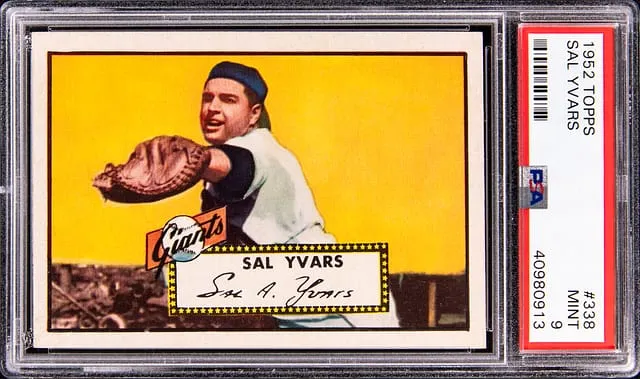
1952 Topps Sal Yvars PSA 9 sells for $16,165
Goldin sold a 1952 Topps #338 Sal Yvars PSA 9 high-number rookie for $16,165. See how pop, set importance, and grade shaped this vintage result.
Sold Card
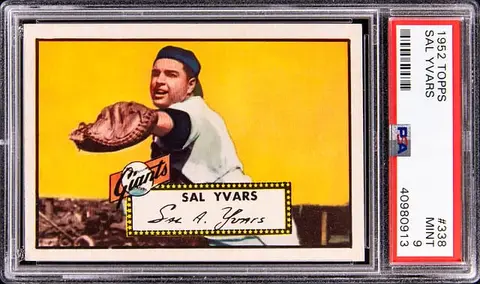
1952 Topps #338 Sal Yvars Rookie Card - High Number - PSA MINT 9 - Pop 7; Highest PSA Copy
Sale Price
Platform
Goldin1952 Topps #338 Sal Yvars Rookie Card PSA 9 Sells for $16,165
On February 22, 2026, Goldin closed a quiet but important vintage sale: a 1952 Topps #338 Sal Yvars Rookie Card, High Number, graded PSA MINT 9, realized $16,165.
For most collectors, Sal Yvars isn’t a headliner in the way that Mickey Mantle or Willie Mays is. But this card checks a very specific set of boxes that matter to vintage set builders and condition-focused collectors:
- 1952 Topps – the hobby’s flagship vintage baseball set
- High-number series card (#338), which is generally tougher than low and mid numbers
- True rookie card
- PSA-graded MINT 9 with a population ("pop") of just 7 copies at that grade
- Labeled as the highest PSA copy, which implies no PSA 10s exist
Below, we’ll break down what this means in context, how the price fits recent sales, and why a non-star from 1952 can still attract five-figure bids.
Card identification and key details
- Player: Sal Yvars (catcher)
- Team: New York Giants
- Year / Set: 1952 Topps Baseball
- Card number: #338
- Subset: High-number series
- Rookie status: Widely recognized as Sal Yvars’ rookie card
- Grading company: PSA (Professional Sports Authenticator)
- Grade: PSA MINT 9
- Population: Pop 7 in PSA 9; no higher PSA grade noted in the listing (making these the highest PSA copies)
There are no on-card autographs, relics, or serial numbers here. The appeal is purely vintage: original 1952 cardboard, strong eye appeal, and extremely clean condition for a high-number card.
Why 1952 Topps high numbers matter
1952 Topps is often considered the first truly modern baseball card set. It introduced:
- Bigger card size than the tobacco and gum issues that came before
- A full-color, portrait-driven design
- Comprehensive checklists that many collectors treat as the foundation of postwar baseball cards
Within that, the high-number series (commonly #311–407) is famous for being more difficult. Distribution was limited and there are long-standing stories about unsold high-number cases being dumped instead of widely circulated. Whether every story is literally true or not, the result is easy to observe in the data:
- High numbers are generally scarcer in nice condition.
- High grades (PSA 8 and above) get disproportionately more attention from set builders and registry competitors.
Even for a role player like Sal Yvars, the high-number tag and the 1952 Topps brand create a strong baseline of interest.
Population and grade scarcity
When collectors talk about the “pop report,” they mean the grading company’s public count of how many copies exist at each grade.
For this card:
- PSA 9 population: 7 copies
- Highest PSA grade: PSA 9 (no PSA 10s listed in the auction description)
That combination matters for several reasons:
- Top of the census: Anyone trying to build a top-ranked 1952 Topps PSA set has to compete for the very few PSA 9s that exist.
- Wide gap between mid-grade and mint: Most surviving 1952 Topps cards—especially high numbers—show off-centering, corner wear, and surface issues. It’s much easier to find this card in PSA 3–6 than in 8–9.
- Ceiling defined by PSA 9: Without a PSA 10 on record, PSA 9 effectively becomes the best you can do in the PSA registry for this issue.
In that sense, the auctioned copy isn’t just “a high-grade example”; it’s part of an extremely small pool that determines how competitive the registry race can get.
Market context and recent prices
This Goldin sale closed at $16,165 on February 22, 2026.
Because this is a pop 7 card with no higher PSA grade, sales are naturally infrequent. You don’t see new comps (short for “comparables,” or recent sales of similar items) every month the way you might with more common modern cards.
Based on available public auction records and the way similar 1952 Topps high-number non-stars behave:
- Lower-grade Sal Yvars rookies (PSA 4–6) have typically sold in the low hundreds to low four figures, depending on eye appeal and auction setting.
- PSA 7–8 copies usually step up meaningfully from that range, because they appeal to more condition-focused collectors and budget-conscious set builders.
- PSA 9 examples have appeared only occasionally, and prior public sales have tended to land in the five-figure range, with outcomes influenced by centering, color, and timing in the broader vintage market.
Against that backdrop, $16,165 fits a pattern we see across the 1952 Topps high-number run:
- Star players and hobby icons command very large premiums.
- Non-stars and role players can still reach strong prices at the very top of the grading scale, driven by set collectors and registry competition rather than player demand alone.
While every sale is unique, this auction result looks consistent with the trend that top-pop, high-number 1952s in PSA 9 often clear a meaningful premium over mid- and even near-mint grades.
Why collectors care about this card
For most buyers, the interest here is less about Sal Yvars’ on-field legacy and more about the card’s place in the set and the grading census:
1952 Topps set building
There is a long-standing tradition of building the entire 1952 Topps run in graded form. For those aiming for a uniform, high-grade look, cards like this become essential puzzle pieces.PSA Set Registry competition
The PSA Set Registry lets collectors compete based on the grades in their sets. When a card only exists in PSA 9 at the top, owning one of the seven copies can materially influence a collector’s ranking.High-number scarcity in mint condition
Many high numbers are simply hard to find sharp and well-centered. A true PSA MINT 9 that presents well visually will typically draw attention whenever it surfaces.Vintage stability vs. modern volatility
Vintage cards from the early 1950s tend to trade based on long-term collector demand and condition rarity, rather than short-term player performance swings. That doesn’t make them predictable or guaranteed, but it does mean their buyer base often looks different from that of ultra-modern, performance-driven cards.
How this sale fits the broader vintage market
During periods when modern and ultra-modern headlines dominate, it’s easy to overlook quieter vintage results. But sales like this Goldin auction show a few ongoing patterns in the vintage lane:
Condition and set context can outweigh player star power.
A non-star in a key set can outperform a semi-star or even a star in a less important release, purely because of scarcity and set-building demand.Top-pop vintage continues to draw focused bidders.
When only a handful of collectors can physically own a card at the highest grade, competition at auction tends to be concentrated yet serious.1952 Topps remains a reference point.
Even as other vintage sets gain attention, 1952 Topps high numbers keep functioning as a benchmark for how the market values condition rarity in a historically important issue.
Takeaways for collectors and small sellers
A few practical notes if you’re navigating this space:
For set builders:
Expect to pay a substantial premium for 1952 high numbers in PSA 8–9, even for non-headliners. Registry competition and low pops underpin that premium.For raw-card hunters:
Centering, corner sharpness, and original color matter a lot. Even if most raw copies won’t reach PSA 9, strong eye appeal can still support healthy prices in mid-to-high grades.For small sellers:
If you’re holding vintage high numbers, consider checking the population reports before pricing. A card that looks common at first glance might be thin at the top of the grading scale.For newer collectors:
This sale is a good example of how the hobby values history, scarcity, and condition. You don’t need a Hall of Famer on the front of the card to see significant results—especially in a set like 1952 Topps.
The Goldin sale on February 22, 2026, of the 1952 Topps #338 Sal Yvars Rookie Card in PSA MINT 9 at $16,165 doesn’t rewrite any record books, but it quietly reinforces a consistent theme: in vintage, the combination of iconic set, high-number scarcity, and top-pop grade still commands respect from serious collectors.
At figoca, we track these kinds of outcomes to help collectors and sellers understand not just the headline cards, but the underlying market structure that keeps vintage sets like 1952 Topps relevant decade after decade.